
Your browser cannot save progress right now. You can still investigate; keep this tab open or enable local storage to save.
This case has been updated. Compatible choices are kept; revisit the evidence before drawing your conclusion.
01 · The briefing
Begin with the question.
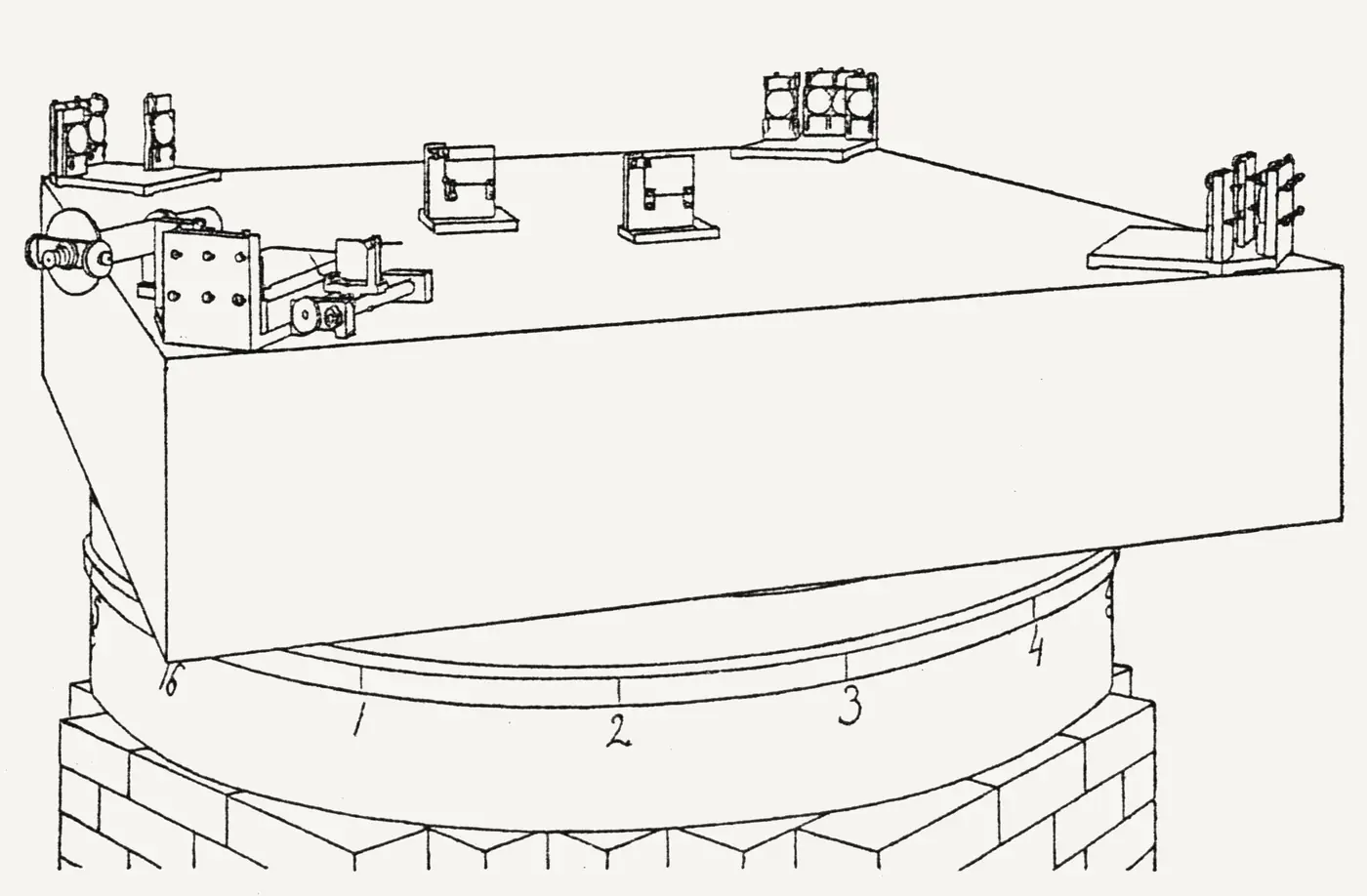
In the late nineteenth century almost all physicists treated light as a wave in an all-pervading medium called the luminiferous ether. If Earth moved through that medium, a beam travelling along the direction of motion and one travelling across it should take slightly different times, and an interferometer should show a shift in its fringes when the apparatus is turned. Albert Michelson and Edward Morley built an instrument of this kind at what is now Case Western Reserve University in Cleveland. Their 1887 paper gives an expected shift of about 0.4 of a fringe for Earth's orbital motion, and an observed shift far smaller. Several readings were open. The ether might exist with Earth nearly at rest relative to it; the ether might be dragged along with Earth; or the expected shift might be wrong because of an assumption about matter or measurement. The investigation asks which of these the 1887 result can separate, and what the result cannot decide on its own. Keep the observation, the calculation and the interpretation apart.

The timeline
Michelson's earlier experiment on the question appears in the American Journal of Science; the 1887 paper notes an error in it, pointed out to him in the winter of 1881.
Michelson and Morley publish On the Relative Motion of the Earth and the Luminiferous Ether, reporting an expected shift of 0.4 fringe and an observed shift far smaller.
George Francis FitzGerald suggests in Science that the length of material bodies changes with their motion through the ether.
Lorentz's Nobel lecture describes an electron-and-ether theory and notes that Michelson and Morley repeated Fizeau's water-flow experiment.
Einstein's paper on the electrodynamics of moving bodies cites the unsuccessful attempt to detect Earth's motion relative to the light medium, without naming Michelson or Morley.
A researched reconstruction for learning. These reasoning steps simplify a complex record; no score can capture the full history.
02 · The evidence
What does the record show?
Read each exhibit before settling on an explanation. The source links below every exhibit lead to the record behind it.
Exhibits reviewed 0 of 5
An expected shift and an observed bound
The paper computes the displacement to be expected from Earth's orbital velocity as 0.4 of a fringe, and says the actual displacement was certainly less than one-twentieth of that and probably less than one-fortieth. The authors note the apparatus would be turned through 90 degrees, reversing the expected difference. The result is a bound on the shift, not a measured zero.
Source record s1en.wikisource.org
A velocity bound and its limits
Because the displacement is proportional to the square of the velocity, Michelson and Morley conclude that Earth's relative velocity through the ether is probably less than one-sixth of its orbital velocity, and certainly less than one-fourth. They add that the result would need modifying if the solar system's own motion were combined with the orbital motion, and that they have no right to extend the conclusion to opaque bodies.
Source record s1en.wikisource.org
Lorentz's ether
In his 1902 Nobel lecture Lorentz describes a theory in which the physical world consists of matter, electrons and ether, with the ether filling the universe as the bearer of light. The lecture notes that Michelson and Morley repeated Fizeau's water-flow experiment and obtained a result in agreement with Fresnel's drag coefficient. The ether is a working part of the theory here, not a discarded idea.
Source record s4nobelprize.org
A length change that keeps the ether
FitzGerald, responding to the Michelson and Morley result, proposed that the length of material bodies changes with their motion through the ether, by an amount depending on the square of the ratio of velocity to the speed of light. He called this almost the only hypothesis that could reconcile the result with other experiments showing that the ether in air is carried along only slightly. The proposal explains the null result without abandoning the ether, by changing the apparatus itself.
Source record s2en.wikisource.org
Einstein's silence about the experiment
Einstein's 1905 paper refers to the unsuccessful attempt to substantiate the motion of the earth relative to the light-medium as one example suggesting that absolute rest has no physical meaning. It does not name Michelson or Morley. How far the 1887 result shaped Einstein's thinking is a question historians of science have debated.
Source record s3en.wikisource.org
03 · Your reasoning
Follow the strongest explanation.
Choose an interpretation, then compare it with the evidence. You can revise your choice. The goal is understanding, not a perfect score.
04 · The findings
The chain behind the outcome.
Your notebook
Case report
Next in science & discovery: The skull assembled to deceive
The 1887 result is a null in the practical sense that the fringe shift fell far below the 0.4 fringe the authors expected for Earth's orbital motion. The paper gives a bound rather than a precise zero, and it concludes that Earth's velocity relative to the ether, if it moved through it at all, must be small compared with its orbital speed. Physicists had several responses. The most direct was to keep a stationary ether and find a reason the expected effect was absent. FitzGerald's 1889 proposal that material bodies change length with motion through the ether is the best-known example in these sources. Lorentz developed an ether theory built on electrons, which his 1902 Nobel lecture describes. Einstein's 1905 paper took a different route: it dropped the idea of absolute rest and derived electrodynamic consequences from two principles, citing the unsuccessful attempt to detect Earth's motion relative to the light-medium without naming Michelson or Morley. The sources do not show that the 1887 result was the decisive cause of Einstein's theory, and historians of science have debated how much it shaped his thinking. The clearer lesson is methodological. A null result tests a theory together with its assumptions about matter, measurement and the medium, and the 1887 authors themselves noted limits on extending their conclusion. A result can be secure while its interpretation depends on what is held fixed, and the later history shows several readings of the same observation coexisting.
Contributing causes and conditions
- Earth's orbital motion, which would produce an expected fringe shift when the apparatus is turned.
- A very small predicted effect, because the shift scales with the square of the velocity relative to the speed of light.
- Ether theory and its assumptions about matter, which allowed a null result to be absorbed by a length change (FitzGerald, 1889).
- Later theory that removed the privileged frame and reinterpreted the observation.
OutcomeMichelson-Morley experiment
Take the method with you
- A null result constrains a combination of theory and assumptions, not one hypothesis alone.
- Calculate the expected effect before interpreting an observation, because the size of the expectation sets the test.
- A result that rules out one explanation may leave several others open, so check which assumptions each rival keeps.
You can read findings at any time. Exploring every reasoning step marks this case as complete in your notebook.
The open record
Sources & further reading
Read the original record and its scope before relying on a conclusion. Source references support the exhibit summaries; Faultory’s reasoning prompts are editorial reconstructions.
- s1
- s2
- s3
- s4Nobel Prize — Hendrik A. Lorentz, Nobel Lecture (1902)
www.nobelprize.org
Written and curated for Faultory by Yunus Emre Vurgun, with AI-assisted research and drafting. Sources and interpretations can need correction. Read our editorial standards or report an issue.
From the journal
Field notes that use this case
Keep investigating