After reading, you will be able to distinguish a residual that signals a hidden cause from one that signals an instrument problem. You will know which checks turn an anomaly into a testable claim.
01A recurring feature on a chart
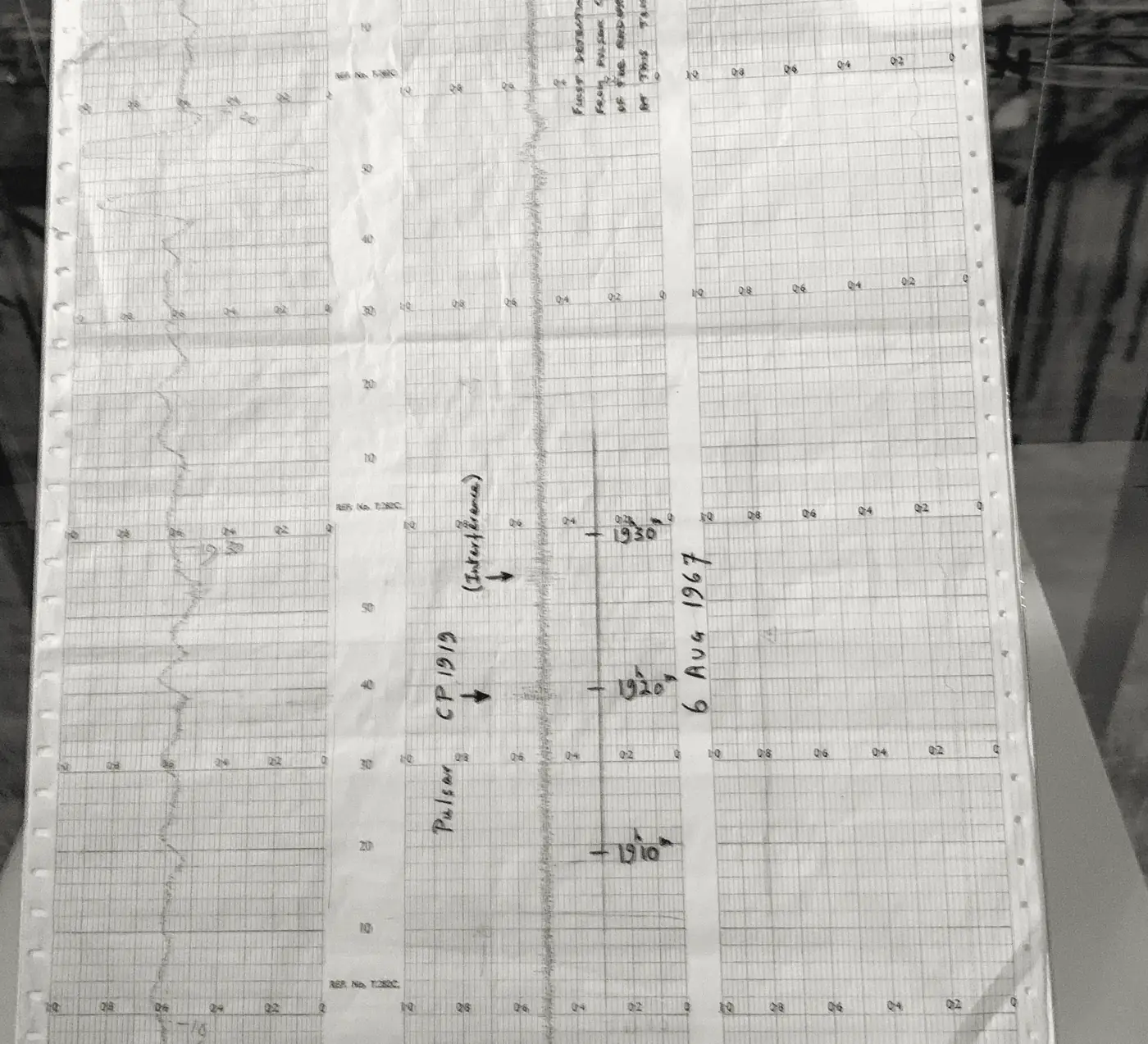
At Cambridge in 1967, Jocelyn Bell Burnell was studying radio-telescope chart records made with an instrument built for a different investigation. She noticed a recurring feature that did not look like the rest of the record. Before it could be treated as something in the sky, faults and terrestrial interference had to be ruled out.
Faster recording resolved the feature into a string of pulses. The University of Cambridge's account describes the record from late November 1967, when the pulses came again as a regular train about one and a third seconds apart. Regularity made the feature worth investigating, though it did not by itself identify the source.
A residual is an observation that the current model does not explain. It is not yet a discovery, and it is not yet noise. The work lies in deciding which.
02Neptune: a residual with an address
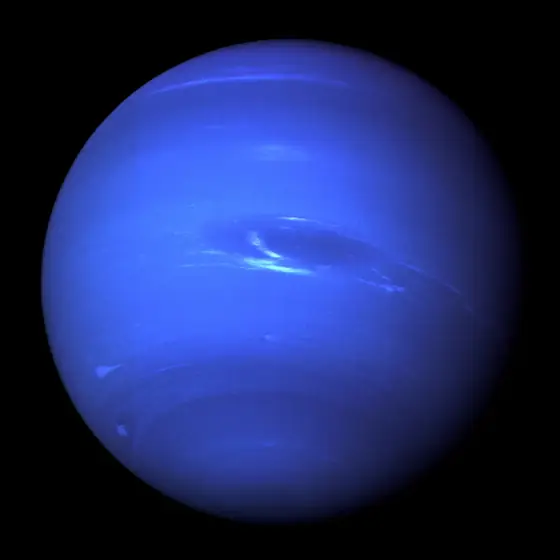
In the nineteenth century, the orbit of Uranus did not match calculations based on the known planets. Astronomers had to ask whether the observations were wrong, whether the model was incomplete, or whether an unknown body was pulling on Uranus.
JPL's history of the discovery records that Urbain Le Verrier's prediction supplied a position in the sky, not merely a claim that another planet existed somewhere. Johann Galle of the Berlin Observatory found Neptune in 1846 as a result of that prediction. John Couch Adams had worked on the same problem independently.
The important property is risk. A prediction that names a location can fail. When it succeeds, the residual becomes a test of the explanation rather than a loose story about Uranus.
03Michelson and Morley: a null residual
In 1887, Michelson and Morley compared light travel times along perpendicular arms of an interferometer, looking for the Earth's motion through the hypothesized luminiferous ether. Michelson's first apparatus, in 1881, could expect a shift of only 0.04 of the fringe spacing. With light paths of about eleven metres, the 1887 instrument raised the expected shift to 0.4 of a fringe.
The observed displacement was certainly less than a twentieth of that expected, and probably less than a fortieth. The authors had noted that the small effect expected from the first apparatus might have been masked by experimental errors; the larger instrument was built to remove that doubt. Even so, the null result was a limit on the effect under their apparatus, not an automatic demonstration that the expected effect was absent.
A null residual still demands explanation. Is the instrument sensitive enough to see the predicted effect, and do the uncertainties allow it to be seen? Those questions turn a non-result into a measured limit.
04The noise that filled the sky
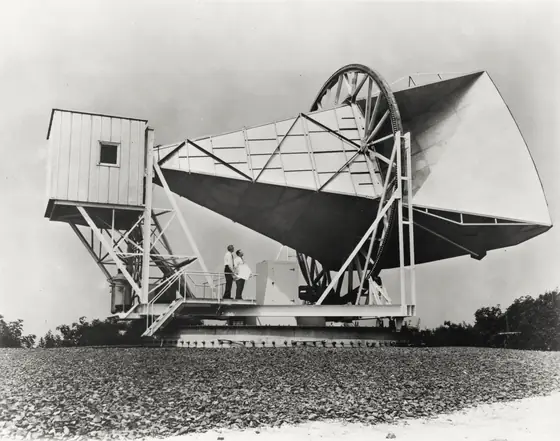
At Bell Laboratories in Holmdel, a large horn-reflector antenna measured microwave intensity from the sky. Arno Penzias and Robert Wilson found an excess signal that did not disappear. Wilson's Nobel lecture describes the horn-reflector instrument at Bell Laboratories and the steps the team took with it.
Before attributing the excess to the sky, the team had to consider the receiver, the ground, the atmosphere and nearby sources. Calling it cosmic too early would have been premature, and dismissing it as junk would have discarded something informative. Persistence matters: an excess that remains after the expected sources are considered can point to a common origin, but persistence alone does not identify that origin.
The interpretation came when a theoretical group connected the excess to a relic of a hot early universe. Later measurements across many wavelengths, including those of the COBE mission, tested that interpretation far more strictly than a single frequency could. The residual became evidence once it had a testable shape.
05Checks that turn a residual into a claim
The practical sequence recurs across these cases. First, establish that the observation is real and not an artifact: check the instrument, the timing, the calibration and the environment. Second, define what a physical explanation would predict about direction, time, frequency or location.
Third, look for an independent way to observe the same phenomenon. The Neptune prediction pointed to a place. The pulsar regularity pointed to a timescale. The microwave excess pointed to a spectral shape that could be measured again. Each prediction could fail.
Fourth, keep alternatives open. Early pulsar papers kept several kinds of compact star possible, and the rotating neutron star picture developed as later observations established a new class of source. Record what an explanation leaves unresolved, along with what it explains.
06Where residuals mislead
Not every residual is a discovery. Many are instrument problems, modeling simplifications or data-handling errors. The discipline is to label a residual explicitly as unexplained, measured or explained, rather than letting its status drift.
A residual can also persist because it is attractive. The Michelson and Morley result was a stubborn residual whose meaning depended on the sensitivity of the apparatus and on the theory being tested. Later theory had to accommodate it, and the lesson was about the framework as much as about the number.
A successful prediction does not make every parameter exact. Neptune's discovery did not guarantee that every future orbital anomaly would have the same cause, and an explanation can be right in its main claim while needing refinement in its details.
Residuals also arise inside the analysis. Subtracting a background, choosing a fitting window or calibrating against a reference can each introduce a residual that belongs to the method rather than to nature. Before attributing a mismatch to the world, reprocess the data with another reasonable choice and see whether the residual survives.
07Practical questions for an anomaly
When you meet a residual in any field, ask whether the measurement is sound, whether the model has been checked, and whether the residual has a direction or pattern. A pattern that persists across instruments or over time deserves more attention than a single outlier.
Then ask which observation would decide between the explanations. If no observation can distinguish them, the anomaly remains an open question, however exciting it looks.
Write the residual down before its explanation. That order keeps the evidence visible after the explanation becomes familiar.
The same checklist applies in both directions. A residual is sometimes celebrated before it is checked, and sometimes dismissed because it does not fit a favored theory. Both habits skip the same step, which is to test the residual against an alternative explanation that predicts it.
Terms in this note
- Residual
- The difference between what a model predicts and what is observed, after the expected effects have been accounted for. Glossary
- Null result
- A measurement that does not detect the effect it was designed to find. It is interpreted together with the sensitivity of the apparatus. Glossary
- Falsifiable prediction
- A specific consequence of an explanation that could turn out to be wrong when observed. Glossary
Test the idea
The case files behind this note


The open record
Sources & further reading
- 1Planetary Discovery Circumstances
NASA Jet Propulsion Laboratory
- 2Journeys of discovery: Jocelyn Bell Burnell and pulsars
University of Cambridge
- 3
- 4
- 5Nobel Lecture (Robert Wilson)
Nobel Prize Outreach
- 6COBE: Cosmic Background Explorer
NASA LAMBDA archive
- 7Observation of a rapidly pulsating radio source
Nature (Hewish and colleagues, 1968)
Written for Faultory by Yunus Emre Vurgun, with AI-assisted research and drafting. Editorial standards · Report an issue.