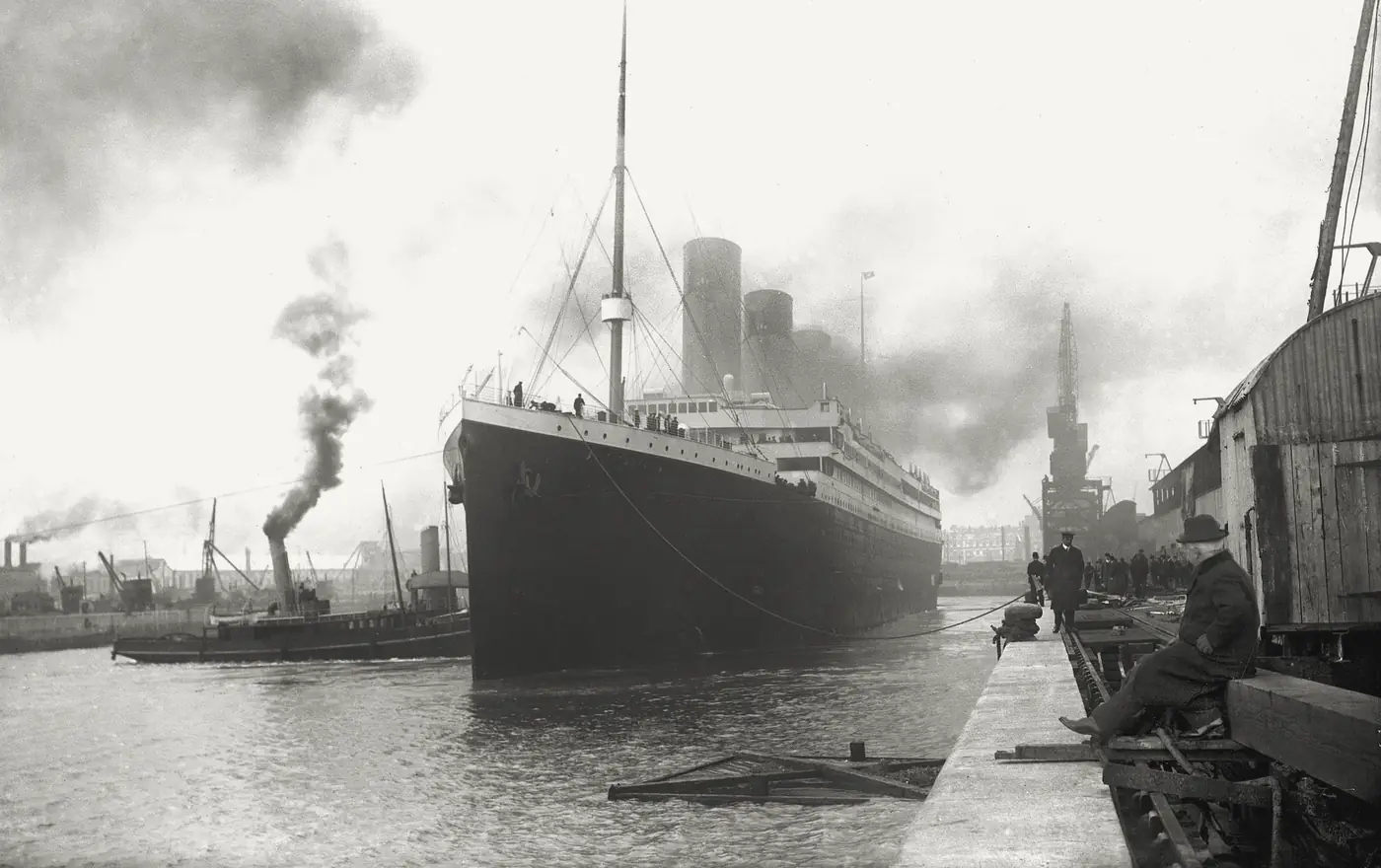
After reading, you will be able to separate the existence of a warning from its reach, identify who could act on it, and recognize how earlier survival can become false reassurance. The cases are the Titanic ice reports, the Columbia foam strike, the Challenger cold-weather concerns and the Johnstown dam.
01Ice reports on a fast crossing
On the night of 14 April 1912 the Titanic struck an iceberg in the North Atlantic. The British Wreck Commissioner's inquiry reviewed the ice messages the ship had received that day. A message from the Caronia, received at 9 a.m. by the ship's time, reported icebergs, growlers and field ice. A message from the Baltic was received at 1:42 in the afternoon, and it too carried ice information.
The inquiry's findings are direct about what followed. The ice information did not lead to a change of course, and the inquiry records that the course was not altered because of it. The warnings existed in the ship's communications. The question the case raises is what those warnings were able to change, and who had the authority and the information to change it.
The ice messages reflect the routine of the day. Ships reported ice to one another and passed information along the route, so the ice picture was available to officers on the bridge. Whether that picture reached the people responsible for speed and course, and how it was weighed, is the question the messages raise.
02Places in the boats
The inquiries also record how much boat space there was. The US Senate report says the ship carried lifeboats for 1,176 persons, while only 706 people were saved.
Subtracting one figure from the other shows that the boats had room for a little over half of the people on board. That arithmetic is not an accusation. It describes the margin that existed before any ice was reached. A warning about ice does not add boats, and a rescue system planned for a capacity cannot absorb an emergency that exceeds that capacity.
Reports, capacities and regulations each existed on paper. A warning matters only when someone with authority connects it to the other facts that bear on the decision. Here the connection was not made in a way that changed the voyage.
03A strike seen before
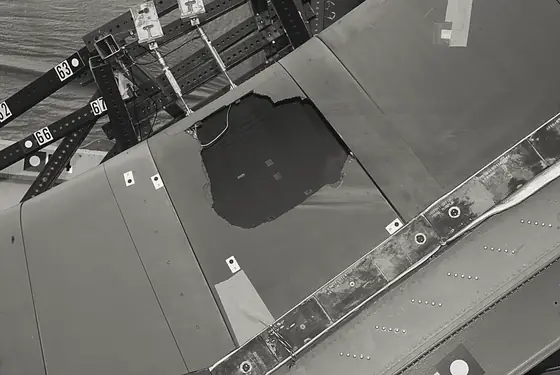
The Columbia Accident Investigation Board's report, Volume I, dated August 2003, describes how insulating foam separated from the external tank during the launch on 16 January 2003 and struck the orbiter's left wing near reinforced carbon-carbon panel 8. The board concluded that the strike created a breach in the thermal protection, through which superheated air entered during re-entry.
The board also examined the reasoning around earlier foam losses. It described how NASA first began and then continued flying with foam losses, and it cited the sociologist Diane Vaughan's term normalization of deviance for accepting events that were not supposed to happen. The board warned against accepting risk solely because of prior success, a reliance it found had replaced dependable engineering data and rigorous testing.
Past survival is evidence about the conditions that existed before. It does not define the safe boundary of a hazard that has not been measured in the new case. Missing evidence of damage is also not evidence of no damage. The question is whether the organization had a way to obtain the evidence that would decide between those possibilities.
04Cold weather and a fixed schedule
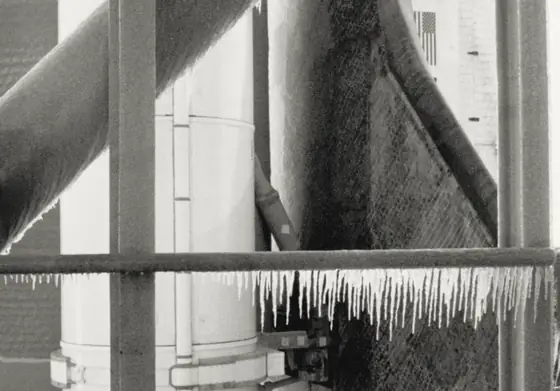
On 28 January 1986 the Space Shuttle Challenger was launched in cold weather, with an ambient temperature of 36 degrees Fahrenheit. The Rogers Commission records that this was about 15 degrees colder than the next-coldest previous launch.
The Commission's chapters describe the history of the solid rocket booster joints. Erosion of the primary O-ring by hot gases had first been observed on an earlier flight, STS-2. Engineers at the contractor, Thiokol, expressed concern that cold temperatures could affect the O-rings' performance. The question for the decision-makers was whether a concern based on limited data and an unprecedented temperature would be enough to change the launch decision.
The case shows that a warning can exist in a technical record while the decision is taken through another channel, with different information and different pressures. The Commission's chapters on this history are the place to read the sequence in full.
05A dam already in question
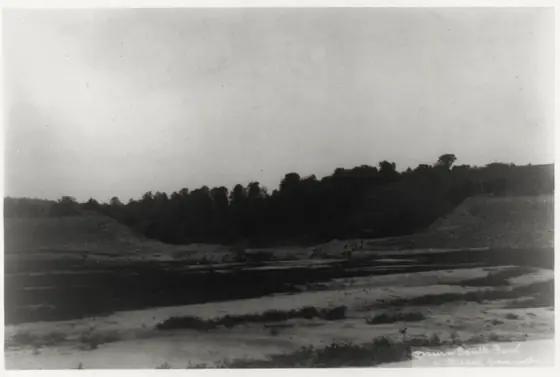
On Friday, 31 May 1889, the South Fork Dam above Johnstown, Pennsylvania, failed. The National Park Service's account of the Johnstown Flood states that the failure released water reported as 20,000,000 tons and killed 2,209 people. The disaster is a reminder that the scale of a consequence can exceed anything a community has planned for.
Its warning question differs from the others in this article. It asks what information existed about the dam's condition before the failure, who controlled the reservoir, and who had the authority and the means to act on what they knew. A summary cannot answer those questions. They require the investigations and detailed histories, which should be read directly before drawing conclusions about any individual's responsibility.
The general point holds regardless of the details. A hazard can be known in principle long before anyone acts on it. A warning becomes a decision only when someone is assigned to evaluate it and a threshold for action is set in advance.
06Who can act on a warning
Warnings can fail to land for three recurring reasons. They may reach people without the authority to change the plan. They may arrive without the basis needed to act on them. Or they may be discounted because the event has not happened before. The three cases show different combinations of these problems.
A useful test is to ask what decision the warning is meant to change, who makes that decision, and what evidence would be needed for that person to change it. If no one can name the decision, the warning has not yet become information. A warning can also be right while its reach stays limited, and that makes the reporting channel part of the investigation.
Warnings also need a route through which they can be recorded and tracked to closure. A concern that is raised, discussed and then lost has not been tested. Each warning should have an owner, the question it poses and a recorded outcome, whether that outcome is a change of plan or a documented reason for not changing it.
Terms in this note
- Normalization of deviance
- The gradual acceptance of anomalies that have not yet caused a disaster, so that departures from expectations come to seem normal. The term is associated with the sociologist Diane Vaughan and was cited by the Columbia board. Glossary
- Decision threshold
- The condition at which a warning should trigger a change of plan. It should be defined before the event rather than after it. Glossary
Test the idea
The case files behind this note

The open record
Sources & further reading
- 1British Wreck Commissioner's report on the loss of the Titanic: messages
Titanic Inquiry Project
- 2
- 3
- 4
- 5Johnstown Flood National Memorial: history of the 1889 flood
National Park Service
- 6United States Senate inquiry report: lifeboats and the rescue
US Senate (1912), via the Titanic Inquiry Project
Written for Faultory by Yunus Emre Vurgun, with AI-assisted research and drafting. Editorial standards · Report an issue.