

After reading, you will be able to ask what reference a measurement depends on and why repeatability does not prove accuracy. You will also recognize how a small timing or calibration error can become a large, systematic error in a result.
01A sharp mirror that would not focus
After the Hubble Space Telescope was deployed in April 1990, its images revealed an optical problem. Light reflected from the main mirror was not converging on a single focus. The fault lay in the optics, but its cause lay in how the mirror had been checked.
The mirror's shape had been tested with a reflective null corrector, a device built to show whether a curved surface matches its intended form. Investigators later found a spacing error of about 1.3 millimeters inside that corrector. The error made a mirror that was too flat away from its center look correct. The 1.3 millimeters describes a gap inside the testing apparatus, not a 1.3-millimeter flaw on the mirror.
Other optical checks had also indicated an error, and their disagreement with the main result was not resolved before launch. When a trusted instrument and a less favored check disagree, the trusted instrument's reputation cannot settle the matter. The disagreement is the signal to investigate.
02Repeatable is not the same as accurate
Precision describes how closely repeated readings agree with each other. Accuracy describes how close they are to the true value. An instrument can be extraordinarily precise and still be systematically wrong, because the same error appears in every reading. The readings agree beautifully, and they agree on the wrong answer.
Repeating the Hubble mirror test with the same apparatus would have produced the same reassuring result each time. Only a method that did not share the same reference geometry could have exposed the problem early. Metrologists call the documented chain of comparisons that links a reading to an accepted standard traceability, and every link in that chain must be checked.
03A timing chain with a bad connection
The first OPERA preprint, posted in September 2011, reported that neutrinos sent through the CNGS beam from CERN toward the Gran Sasso laboratory in Italy arrived about 60.7 nanoseconds earlier than light would have. The uncertainties were roughly seven nanoseconds each. A result of that kind would challenge a foundation of physics, so it demanded an unusually thorough search for ordinary causes.
The collaboration checked its timing chain, from the master clock to the electronics that stamped each event. The later paper describes two equipment faults. An optical fiber connection had not been properly made, reducing the light reaching a clock converter. The master clock's oscillator also had a small frequency offset. The paper reports that the fiber delay in the later configuration was about 73 nanoseconds larger than in the earlier one, and that the oscillator offset could produce timestamps overestimated by up to about 74 nanoseconds.
After these corrections the final analysis reported a result consistent with the speed of light, and the investigations ran until mid-February 2012. The lesson is not that the physicists were careless. A claim that would overturn a well-established result should be the most heavily checked claim in the room, and that means testing the chain before testing the physics.
04Clocks that disagree with their own physics
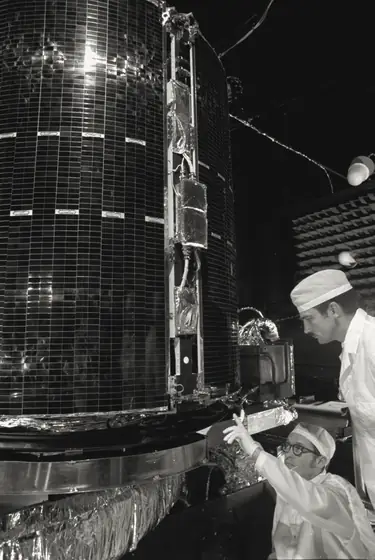
A clock's rate depends on how fast it moves and how deep it sits in a gravitational field. A navigation satellite experiences both differently from a clock on the ground. NIST's explanation of GPS gives approximate figures: special relativity predicts that orbiting clocks lose about 7 microseconds per day because they move quickly, and general relativity predicts that they gain about 45 microseconds per day because gravity is weaker at orbital altitude. The net effect is about 38 microseconds per day, unless it is corrected.
The clocks are not defective. A system that assumed every clock keeps the same rate wherever it is would accumulate a growing error. The design therefore has to model the rate of each clock, not only its quality. A good oscillator does not remove the need for the model.
05Counting in tenths of a second
On 25 February 1991 a Patriot missile battery at Dhahran, Saudi Arabia, failed to intercept an incoming missile, and 28 American soldiers were killed. The GAO identified the cause as a software problem. The system kept time by counting in tenths of a second, and each count carried a small error that accumulated the longer the system ran.
A tenth of a second has no exact representation in the binary arithmetic a computer uses, so each increment was slightly wrong. The GAO analysis shows that after more than 100 hours of continuous operation the clock error had grown to about 0.34 seconds, enough to shift the computed range gate by roughly 687 meters. Each reading looked reasonable, and a short test would probably have looked fine. Drift has to be measured against elapsed time and given a limit.
06Dating the Earth and the lead around us
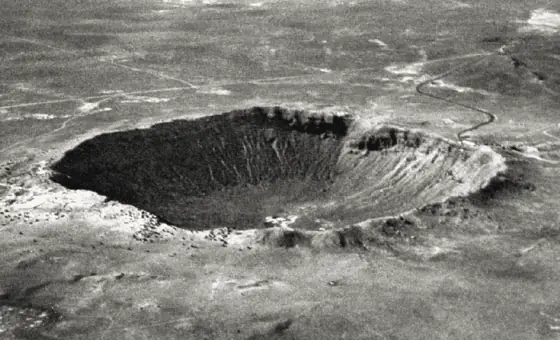
The chemist Clair Patterson's titles show two questions he had to keep apart. His 1956 paper was titled Age of meteorites and the earth. His 1965 paper was titled Contaminated and natural lead environments of man. One question concerns what lead in meteorites reveals about the age of the Earth. The other asks how much of the lead in people's surroundings came from human activity rather than nature.
The second question is a calibration problem in disguise. A lead measurement is meaningful only if the blanks, reagents, containers and laboratory air contribute far less lead than the sample. Without such controls, a sensitive method reports contamination as though it were the natural content of the material studied. The method details belong in the papers themselves.
07Noise that survives the repairs
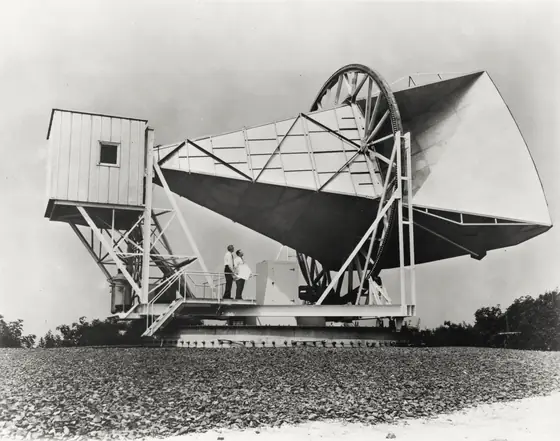
At Bell Laboratories' Holmdel site, Arno Penzias and Robert Wilson measured an excess signal with a sensitive microwave receiver and horn antenna. Before anyone could claim a cosmic source, the receiver, the ground, the atmosphere and nearby equipment all had to be considered. Wilson's Nobel lecture describes the checks, including the antenna's throat section, which was found in order.
By then almost a year had passed, and the excess antenna temperature had not changed. Persistence weakened explanations expected to change with the geometry of the solar system. The excess was the measurement; its cosmological interpretation came from a Princeton group. Later spectral measurements by the COBE satellite tested whether the radiation followed a blackbody form, a test a single-frequency excess could never settle.
Terms in this note
- Calibration
- Comparing an instrument against a reference of known value and recording the relationship, so that its readings can be corrected or trusted within stated limits. Glossary
- Systematic error
- An error with the same direction and size in every reading, so it does not average out when more readings are taken. Glossary
- Traceability
- The documented chain of comparisons that links a measurement to an accepted reference standard, with each link checked. Glossary
Test the idea
The case files behind this note
 A perfect result from a wrong rulerHubble Space Telescope
 Early neutrinos and a faulty connectorOPERA neutrino timing anomaly (2011 to 2012)
 A clock that drifted with uptimePatriot missile failure at Dhahran
 The clock that is right in the wrong placeGPS and relativity
 The Noise That Filled the SkyCosmic microwave background
 The lead that dated the EarthLead isotope dating of the Earth and leaded gasoline
The open record
Sources & further reading
- 1
- 2Measurement of the neutrino velocity with the OPERA detector in the CNGS beam
arXiv (OPERA Collaboration)
- 3Hubble's mirror flaw
NASA Science
- 4
- 5Patriot Missile Defense: Software Problem Led to System Failure at Dhahran, Saudi Arabia (GAO/IMTEC-92-26, copy)
General Accounting Office, copy on Internet Archive
- 6
- 7COBE: Cosmic Background Explorer
NASA LAMBDA archive
- 8The Hubble Space Telescope optical systems failure report
NASA Technical Reports Server (Allen board, 1990)
- 9
- 10
Written for Faultory by Yunus Emre Vurgun, with AI-assisted research and drafting. Editorial standards · Report an issue.