
Your browser cannot save progress right now. You can still investigate; keep this tab open or enable local storage to save.
This case has been updated. Compatible choices are kept; revisit the evidence before drawing your conclusion.
01 · The briefing
Begin with the question.
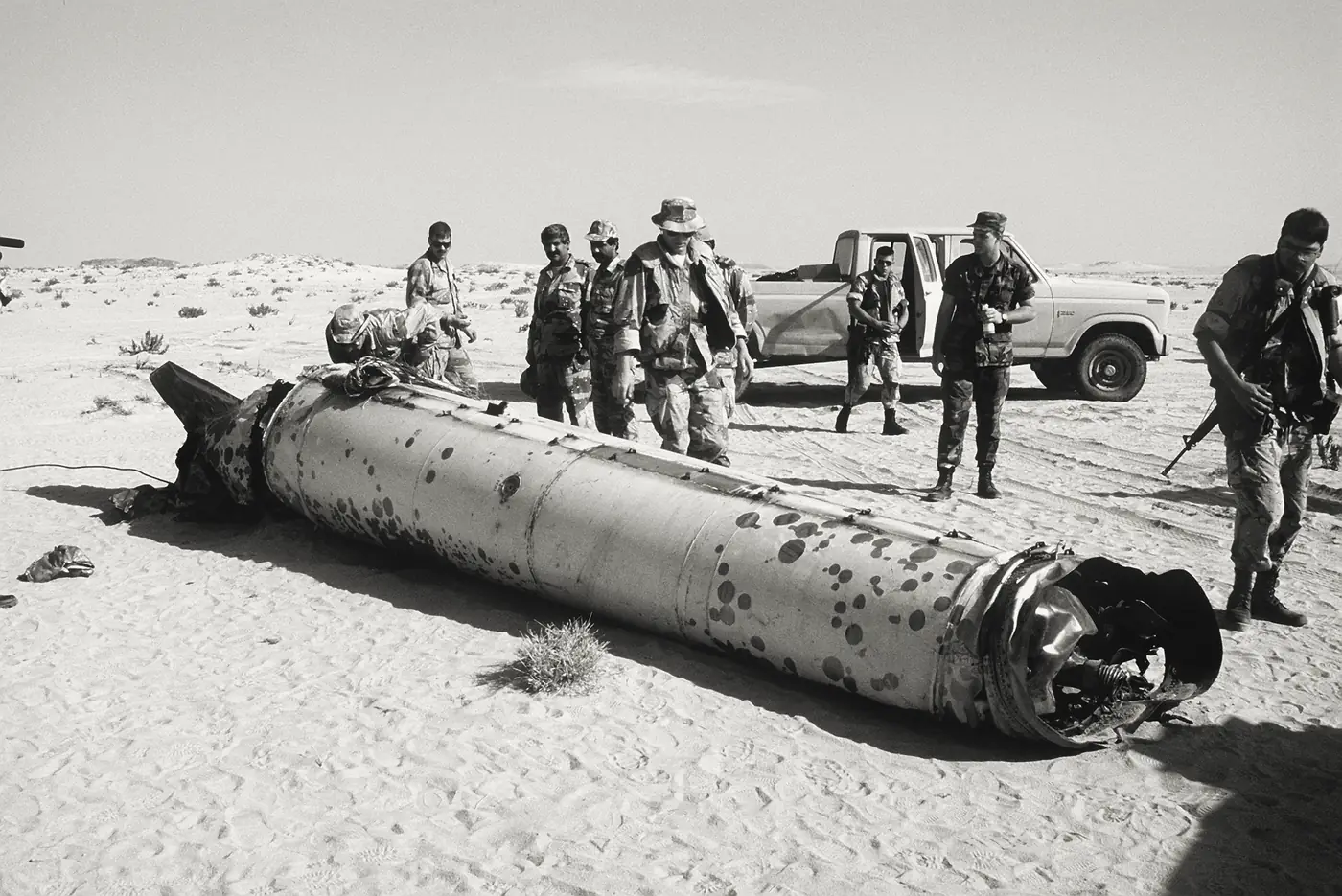
On 25 February 1991, during the Gulf War, an American Patriot battery at Dhahran, Saudi Arabia, failed to track and intercept an incoming Iraqi Scud missile. The Scud struck an Army barracks and 28 American soldiers were killed. The Patriot had been built to defend against aircraft and cruise missiles and had later been adapted for short-range ballistic missiles. It had not been expected to run for long periods without restart. Several explanations seemed plausible at first. One held that the Scud had simply outperformed the interceptor. Another held that the radar had failed to see the target. A third suggested that the battery calculations were wrong in a way that would affect every battery equally. Your investigation has to separate the tracking calculation from the radar and the interceptor, and then ask what changed in the battery over time. Consider what the system stored as time, how precisely it converted that number, and what a prediction depended on. Treat the people involved with care, and keep the focus on how the system behaved.
The timeline
The Patriot Project Office receives Israeli data showing a range-gate shift after eight consecutive hours of operation.
A modified software version that compensates for the timing error is released.
The Dhahran battery fails to track and intercept an incoming Scud, which strikes an Army barracks; 28 American soldiers are killed.
The modified software reaches Dhahran, the day after the incident.
The General Accounting Office report IMTEC-92-26 is issued on the software problem at Dhahran.
A researched reconstruction for learning. These reasoning steps simplify a complex record; no score can capture the full history.
02 · The evidence
What does the record show?

Read each exhibit before settling on an explanation. The source links below every exhibit lead to the record behind it.
Exhibits reviewed 0 of 5
A 24-bit clock conversion
GAO reports that the Patriot internal clock counted tenths of a second as an integer, and that converting that count to a real number used registers only 24 bits long, limiting precision. The error in the conversion grew with the length of continuous operation. This explains why uptime mattered; it does not, on its own, quantify the Scud track.
Source record s1web.archive.org
Growth with run time
Appendix II of the report tabulates calculated timing inaccuracy against hours of operation: about 0.0034 seconds after one hour, 0.0275 after eight, 0.0687 after twenty, and 0.3433 after about one hundred hours. The corresponding range-gate shifts are roughly 7, 55, 137 and 687 meters. These are calculated values from the stated precision, not measured track data.
Source record s1web.archive.org
A worked explanation
A university mathematics page reproduces the GAO passage and explains the binary truncation of one tenth in a 24-bit register. Multiplying the small per-conversion error by the large count of tenths of a second yields an error of about 0.34 seconds after about 100 hours. The page is an explanatory summary and gives no operational data of its own.
Source record s3web.archive.org
A warning that arrived early
GAO reports that Army officials received Israeli data indicating a 20 percent range-gate shift after eight consecutive hours, modified the software, and that the modified version reached Dhahran the day after the incident. The report says the officials did not use the Israeli data to determine how long the system could run before the error became critical. This shows a known warning; it does not show that software delivery alone caused the failure.
Source record s1web.archive.org
The official summary
The GAO product summary describes the same chain of events: operation for over 100 hours, a tracking calculation that became worse with run time, and a software change that arrived after the incident. The summary is short and omits the appendix values, but it is consistent with the full report.
Source record s2web.archive.org
03 · Your reasoning
Follow the strongest explanation.
Choose an interpretation, then compare it with the evidence. You can revise your choice. The goal is understanding, not a perfect score.
04 · The findings
The chain behind the outcome.
Your notebook
Case report
Next in engineering & technology: A reset from a waiting task
The most convincing reconstruction is that the Patriot tracking calculation drifted because it converted a count of tenths of a second into a real number using 24-bit registers. The conversion error for each step is small, but the time count grew with uptime, so the error grew with it. GAO ties the magnitude to run time. After about 20 hours of continuous operation, the calculated shift would have been large enough to place the range gate away from the target, and after about 100 hours the calculated timing error was 0.3433 seconds, corresponding to a shift of about 687 meters. The search window therefore moved away from the Scud. Israeli data had reported a 20 percent shift after eight hours. The Army modified the software in mid-February 1991, but the new version reached Dhahran only on 26 February. GAO also notes that rebooting, which resets the clock, could have prevented significant shifts. The established points are the mechanism, the calculated magnitudes from the stated precision, and the timing of warnings and software. The interpretation lies in the exact track geometry at the moment of the attack, which the summaries do not reconstruct. The durable lesson is that a system can be correct at restart and still drift during continuous use, so long-run behavior needs its own test.
Contributing causes and conditions
- A 24-bit register that cannot represent one tenth of a second exactly
- A clock count that grows with continuous uptime, so the conversion error scales with run time
- A prediction that depends on time and velocity, so the timing error shifted the range gate away from the target
- A system not expected to run for long periods against Scud-class targets
- A software correction that reached the field after a known anomaly and after the incident
OutcomePatriot missile failure at Dhahran
Take the method with you
- A component can be correct at restart and still drift during continuous use.
- Compare a sequence of warning signs with the system operating envelope before deciding that a warning is atypical.
- Small numerical errors matter when they are multiplied by large counts, so check their magnitude across the full operating range.
You can read findings at any time. Exploring every reasoning step marks this case as complete in your notebook.
The open record
Sources & further reading
Read the original record and its scope before relying on a conclusion. Source references support the exhibit summaries; Faultory’s reasoning prompts are editorial reconstructions.
- s1
- s2U.S. GAO: IMTEC-92-26 product page (archived)
web.archive.org
- s3
Written and curated for Faultory by Yunus Emre Vurgun, with AI-assisted research and drafting. Sources and interpretations can need correction. Read our editorial standards or report an issue.
From the journal
Field notes that use this case
 Software timing failures: priority, drift and inherited codeSoftware can be correct at each step and still fail through timing: a task that never runs, a clock that drifts, or code reused where it no longer fits.
 When the instrument is wrong: calibration in six casesPrecise instruments can still mislead. Learn to ask what each measurement was compared against, and whether that comparison was itself checked.
 When the computer is presumed right: testing system recordsAn organization that treats a system's output as proof can turn a software fault into a loss for whoever disputes it. Learn how to test records instead.
Keep investigating