After reading, you will be able to recognize fatigue, brittle fracture and load-path failure, and to ask where stress concentrates, how a material behaves at its working temperature, and whether another route could carry a load. The cases show each pattern in a real structure.
01Three ways a steel part can fail
Structural failures are often described as sudden events, but many are slow processes that end abruptly. Three patterns recur. In fatigue, a part is loaded and unloaded many times, and a small crack grows with each cycle until the remaining section cannot carry the load. In brittle fracture, a material that bends at one temperature breaks at another, often starting from a notch. In load-path failure, a structure that matches its drawings still sends force somewhere the design did not intend.
None of these requires obviously weak material. A bridge, a ship's hull or a walkway can contain sound steel and still fail, because the danger lies in geometry, temperature, the number of cycles or the route taken by the force. The next sections use three cases to show these patterns, and the last section sets out questions that help find them before the metal does.
02Where the force goes
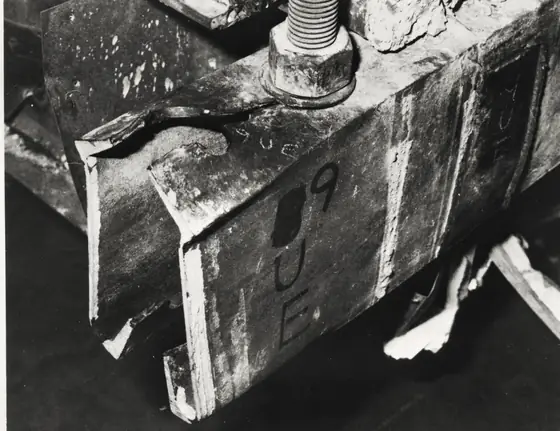
The Hyatt Regency walkways in Kansas City collapsed on 17 July 1981. The investigation focused on the connections between hanger rods and box beams. In the original arrangement, continuous rods carried the lower walkway's load past the upper walkway. In the built arrangement, separate rods hung the lower walkway from the upper walkway's structure. The two arrangements looked similar from a distance, but they did not carry load in the same way.
The National Bureau of Standards report found that the change essentially doubled the load on the box beam to hanger rod connections at the fourth-floor walkway. It also found that the original connection design fell short of the applicable code requirements. The responsible conclusion is not that a safe design was ruined by one substitution. Both the load path and the available resistance needed checking.
The habit this teaches is simple. When a detail changes during construction, ask which connection now carries which load. A parts list can match the drawing while the structural model no longer does.
03When steel stops bending
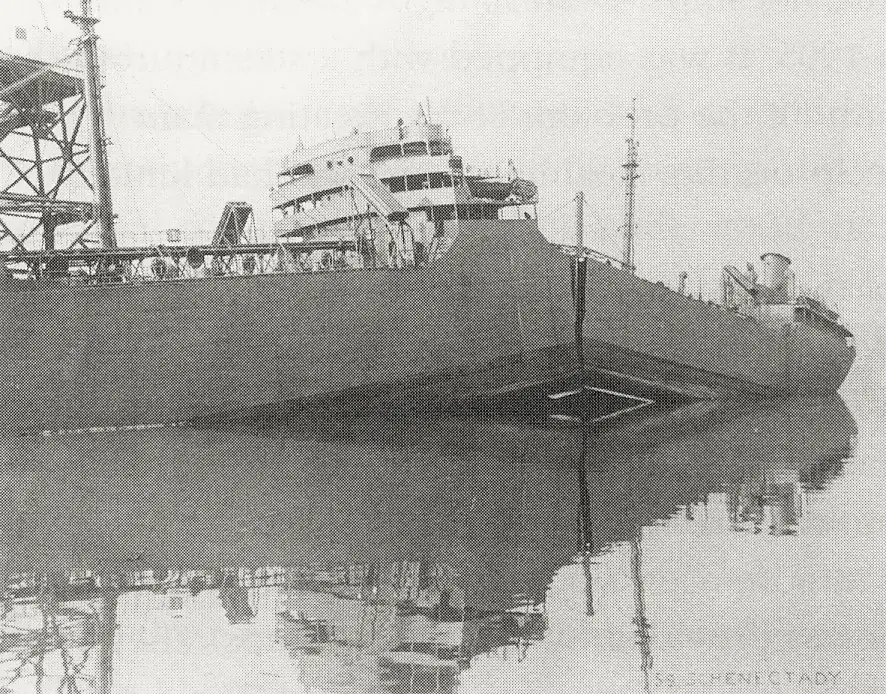
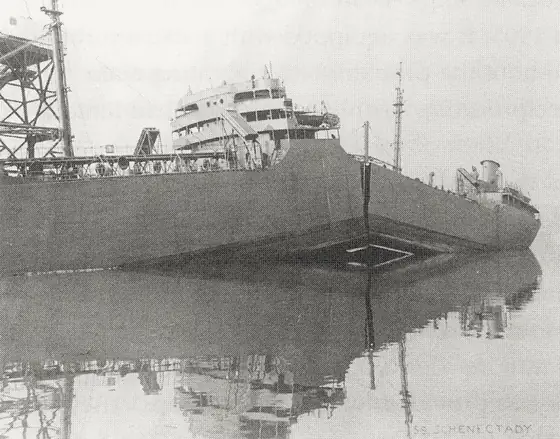
A US Navy board of investigation issued a report in July 1946 on the design and construction of welded steel merchant vessels, drawing on hull fractures in wartime Liberty ships. The report uses the term brittle fracture and identifies notch-sensitive steel with low energy absorption at low temperature as a central concern.
Toughness is the property that matters here. A steel can be strong and still fail suddenly once a crack starts, if it cannot absorb the energy by deforming. Toughness falls as temperature falls, and a notch, a weld defect or a sharp change in section can start the crack. The board noted that welding can aggravate the effect of such notches and discontinuities.
The response was practical. The report notes that crack arrestors were fitted and that vessels operating in low-temperature areas were modified. The lesson for nonexperts is that a property measured at room temperature does not describe a structure's safety in cold service.
04Compression is a different danger
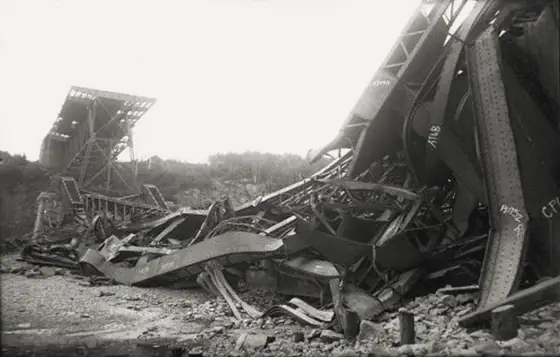
The Quebec Bridge over the St. Lawrence collapsed on 29 August 1907 during construction. A Royal Commission investigated, and its report and plans, digitized on the Internet Archive, contain the evidence presented. Among that evidence is the buckling of a lower compression chord member, described in witness statements and drawings.
Buckling is a different failure from fracture. A slender compression member can give way sideways at a load well below what its material could carry in tension. The design question is therefore not only whether the steel is strong enough, but whether the member is stable under the loads it will actually carry, including its own weight.
The record also discusses dead loads, the permanent weights of the structure, and compares a dead-load table with the loads actually in the structure. The commission's conclusions should be read in the original report, and this article does not restate them. The lesson concerns evidence: strength means little unless the loads on each member are correctly known, and buckling can make a modest error in those loads decisive.
05Fatigue: the crack that grows each time
Fatigue needs no dramatic overload. A part that carries loads well below its static strength can still crack if those loads are applied and removed often enough. The process starts where stress is concentrated, at a hole, a sharp corner, a weld toe, a scratch or a sudden change of section. Local stress there can be several times the average stress in the part. A small crack forms, and each cycle extends it a little, until the remaining section cannot carry the load.
Two consequences follow. First, a design safe for one load may be unsafe after millions of repetitions, so the number of cycles belongs in the design brief. Second, inspection is a safety decision. A crack found while small can be repaired or the part replaced. A crack missed between inspections can run to failure. The inspection interval is therefore part of the design, not paperwork.
The same logic appears in everyday objects. A paperclip bent back and forth breaks at the bend, where strain is concentrated, not in the straight sections that were never flexed as much. Designers apply the same reasoning when they round corners, smooth transitions and place welds away from the most highly stressed areas. These are precautions against fatigue, not decorations.
06Reading a failed part as evidence
A fracture surface is a record. Brittle failures often look flat and crystalline, with little deformation near the origin. Fatigue failures can show smooth zones spreading outward from an origin, a trace of many cycles, followed by a rougher zone where the remaining section gave way. Investigators read these features alongside drawings, loads, material records and service history.
The method is to keep the physical record and the documents in step. A drawing says how the part was meant to be; the fracture says what happened. Where they disagree, the disagreement is the lead. For nonexperts the practical version comes down to four questions: where did the crack start, how many times was the load applied, what temperature did the metal experience, and could anything else have carried the load if this part had failed?
Investigators also examine the material itself. Hardness, composition and the record of heat treatment show whether the metal could have behaved as the design assumed. A sound fracture analysis considers the material, the geometry and the loads together, because each can explain a failure only in combination with the others.
Terms in this note
- Fatigue
- Progressive cracking caused by repeated loading, which can occur under loads well below the material's static strength. Glossary
- Stress concentration
- A local rise in stress at a hole, sharp corner, weld, notch or sudden change of shape. Glossary
- Brittle fracture
- Sudden failure with little plastic deformation, made more likely by low temperature, notches and low toughness. Glossary
- Load path
- The sequence of members and connections through which a load travels from where it is applied to the supports. Glossary
Test the idea
The case files behind this note

The open record
Sources & further reading
- 1Investigation of the Kansas City Hyatt Regency walkways collapse (NBS report NBSIR 82-2465A)
National Bureau of Standards, via NIST
- 2
- 3The Design and Methods of Construction of Welded Steel Merchant Vessels (US Navy board of investigation, 1946, copy)
US Navy, copy on Internet Archive
- 4Report and plans on the design of the Quebec Bridge (Royal Commission, copy)
Royal Commission, copy on Internet Archive
Written for Faultory by Yunus Emre Vurgun, with AI-assisted research and drafting. Editorial standards · Report an issue.