
Your browser cannot save progress right now. You can still investigate; keep this tab open or enable local storage to save.
This case has been updated. Compatible choices are kept; revisit the evidence before drawing your conclusion.
01 · The briefing
Begin with the question.
In 1846 Ignaz Semmelweis became an assistant to Johannes Klein in the maternity clinic of the Vienna General Hospital, the Allgemeines Krankenhaus. The hospital had two maternity divisions. The First Division trained medical students, and the Second trained midwives. Puerperal, or childbed, fever killed many women after delivery, and the First Division's death rate was far higher. One published summary, by Lane, Blum and Fee, puts the First at about 10 percent and the Second below 4 percent, although the figures depend on the period counted. A reasonable observer could suspect several causes: bad air, overcrowding, the condition of the patients, or chance. Some of these would affect both divisions alike, which would not explain a gap inside one hospital. The investigation asks which difference between the two divisions could plausibly cause infection, and whether the evidence shows that this difference was responsible. It also separates the observed fall in deaths from the explanation offered for it, and asks what the record shows about the opposition Semmelweis faced. Later accounts of what happened after he left are disputed, and that dispute affects whether the observed fall can be credited to his method.
The timeline
Semmelweis completes his medical degree at the University of Vienna.
He is appointed assistant to Johannes Klein in the maternity clinic and is puzzled by the higher death rate in the First Division.
After his colleague Jakob Kolletschka dies following an injury received at an autopsy, Semmelweis proposes that material from corpses carried on the hands causes the fever.
Staff are required to wash their hands in a chlorine solution in mid-May; the First Division's mortality falls almost at once to about the Second Division's rate.
Semmelweis is removed from his post as assistant in the First Division.
After a lecture on his experience in May 1850 is poorly received, he leaves Vienna for Budapest.
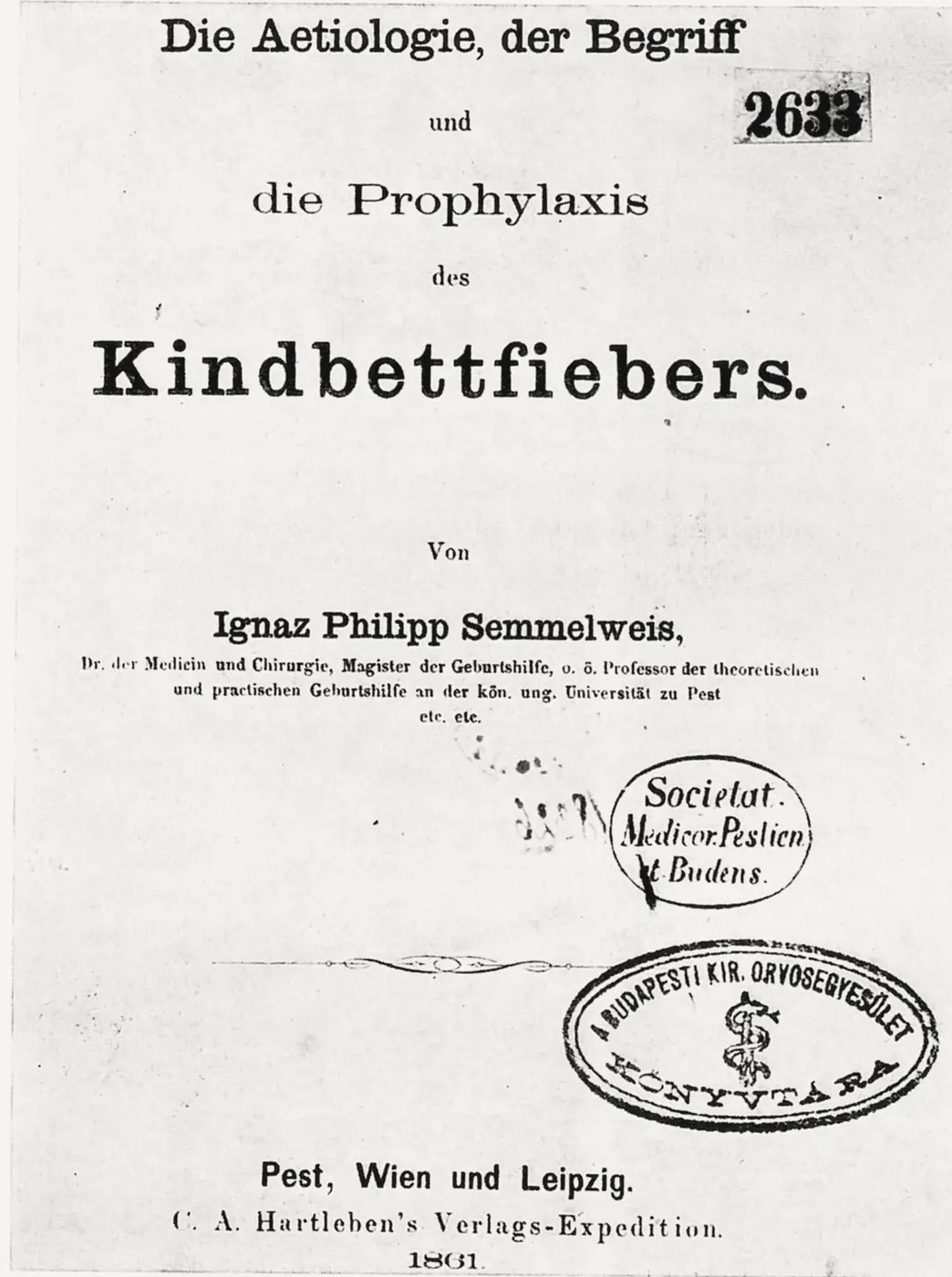
He publishes his main work on the etiology, concept and prophylaxis of childbed fever.
A researched reconstruction for learning. These reasoning steps simplify a complex record; no score can capture the full history.
02 · The evidence
What does the record show?
Read each exhibit before settling on an explanation. The source links below every exhibit lead to the record behind it.
Exhibits reviewed 0 of 5
A gap inside one hospital
Lane, Blum and Fee put the First Clinic's rate at about 10 percent and the Second's below 4 percent, and report that Semmelweis could find no difference between the clinics beyond whom each trained: medical students in one, midwives in the other. Both clinics were in the same hospital, so a hospital-wide cause cannot by itself explain the gap. The rates are an observation about outcomes, not an identification of the cause.
Source record s1pmc.ncbi.nlm.nih.gov
Students, midwives and autopsies
Jadraque and Carter note that the student midwives of the Second Division did not conduct autopsies, while the male student obstetricians of the First Division regularly came to the wards from the morgue with hands still reeking of decaying remains. This is a plausible route for infection. It also bundles several differences together, so it does not single out one of them.
Source record s2pmc.ncbi.nlm.nih.gov
A colleague's death
Lane, Blum and Fee report that Jakob Kolletschka died of septicemia from a finger injury acquired during a post-mortem examination on a woman who had died of puerperal fever. Semmelweis concluded that physicians were carrying cadaverous particles from the autopsy rooms to their patients. The death shows a plausible route for infection, but it does not show that this route explained the whole gap.
Source record s1pmc.ncbi.nlm.nih.gov
Hands and chlorine
Jadraque and Carter date the start of chlorine handwashing to the middle of May 1847, although the exact day is unknown. They report that mortality in the First Division fell almost immediately to about the rate of the Second Division. The timing matters because the fall follows a specific, timed change.
Source record s2pmc.ncbi.nlm.nih.gov
The record after 1849
Semmelweis was removed as assistant in March 1849 and left Vienna in October 1850. The usual account is that mortality rose again under his successor, Carl Braun. Jadraque and Carter argue from monthly figures that Braun's period had similarly low mortality, which suggests the chlorine washings continued. Why Semmelweis met opposition is therefore an open question.
Source record s2pmc.ncbi.nlm.nih.gov
03 · Your reasoning
Follow the strongest explanation.
Choose an interpretation, then compare it with the evidence. You can revise your choice. The goal is understanding, not a perfect score.
04 · The findings
The chain behind the outcome.
Your notebook
Case report
Next in science & discovery: A fringe that barely moved
The central difference in this case is a comparison, not a single hypothesis. Both divisions shared one hospital, so a general cause could not produce the gap by itself. Semmelweis's inference was narrower: physicians and students who came from autopsies to the First Division's wards could carry material from corpses to patients. Jakob Kolletschka's death after an autopsy injury gave that inference a concrete form, and the theory was later extended from corpses to decaying organic matter in general. The decisive evidence is timing. Chlorine handwashing began in mid-May 1847, and the First Division's mortality is reported to have fallen almost at once to about the Second Division's rate. That fall follows a specific change. Several things limit the conclusion, however. The comparison is observational, the rates depend on the period counted, and the theory was broadened over time. Jadraque and Carter argue that the washing probably continued under Carl Braun and that mortality stayed low after Semmelweis left, which undercuts the familiar story in which the discovery was abandoned and deaths rose again. The opposition he faced therefore needs another explanation, which the authors discuss. The lesson is that a mechanism can be plausible and supported by a timed intervention and still remain incomplete. Semmelweis lacked the bacteriology that later explained the fever, so his handwashing result was a striking empirical success rather than a complete causal account.
Contributing causes and conditions
- Physicians and students moving from autopsies to the First Division's obstetric wards.
- Contact between hands contaminated with decaying material and women in labor and after delivery.
- Chlorine handwashing from mid-May 1847, which reduced mortality almost immediately.
- Dispute and opposition after 1849, which shaped how the result was judged.
OutcomeSemmelweis and puerperal fever
Take the method with you
- A large gap within one setting narrows the list of explanations to what differs inside that setting.
- A fall that follows a specific, timed change is stronger evidence than a general impression of improvement.
- A plausible mechanism can be right and still be incomplete, so the mechanism and the observed effect need separate tests.
You can read findings at any time. Exploring every reasoning step marks this case as complete in your notebook.
The open record
Sources & further reading
Read the original record and its scope before relying on a conclusion. Source references support the exhibit summaries; Faultory’s reasoning prompts are editorial reconstructions.
- s1
- s2
- s3PubMed — Ignaz Philipp Semmelweis, the prophet of bacteriology
pubmed.ncbi.nlm.nih.gov
- s4
Written and curated for Faultory by Yunus Emre Vurgun, with AI-assisted research and drafting. Sources and interpretations can need correction. Read our editorial standards or report an issue.
From the journal
Field notes that use this case

Keep investigating