Your browser cannot save progress right now. You can still investigate; keep this tab open or enable local storage to save.
This case has been updated. Compatible choices are kept; revisit the evidence before drawing your conclusion.
01 · The briefing
Begin with the question.
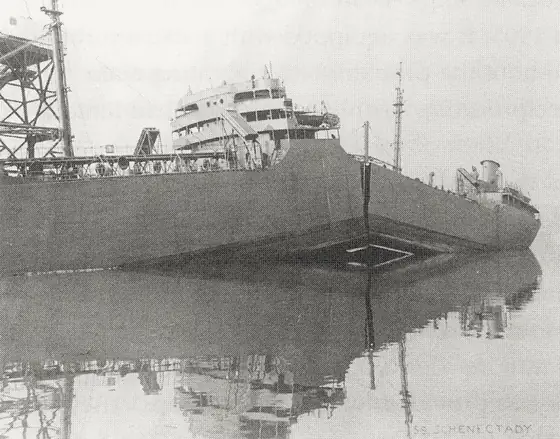
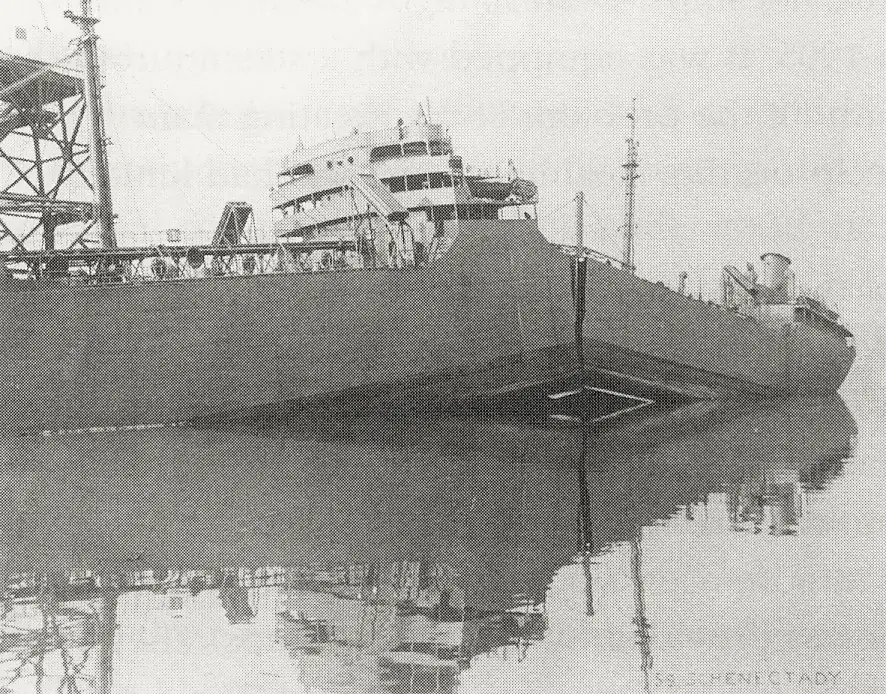
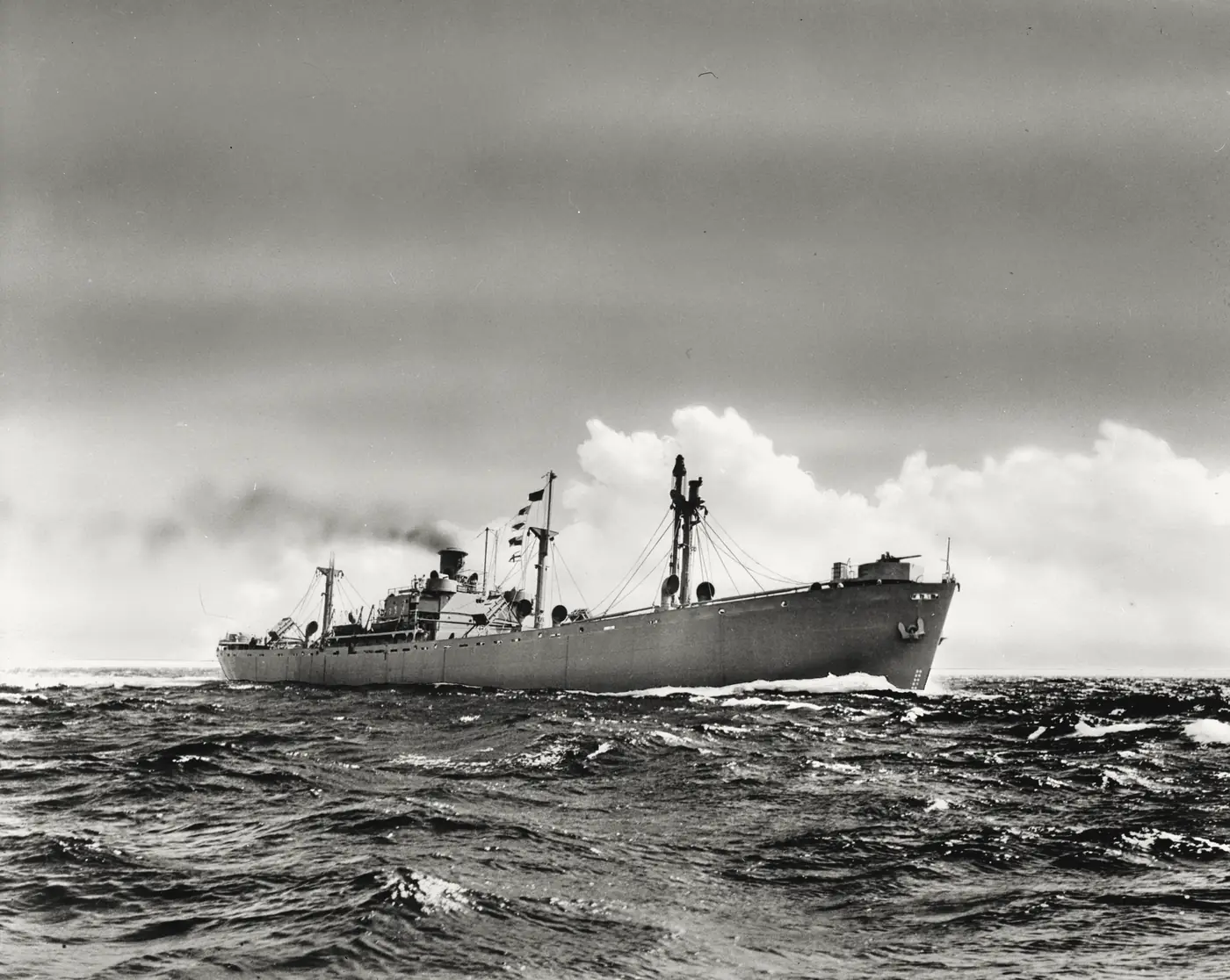
During the Second World War, American shipyards built cargo ships and tankers by welding large steel sections together instead of riveting them, which sped production. Liberty cargo ships and T2 tankers were produced in great numbers. Early in the war, several new welded hulls began to crack, and on 16 January 1943 the tanker Schenectady broke in two at a fitting-out pier at Swan Island in Portland, Oregon. The Navy convened a board of investigation. Several explanations circulated at the time. Some blamed inexperienced workers and poor welds. Others blamed the pressure of rapid production, heavy loading in rough seas, or stresses locked into the steel during construction. Each explanation points to something real. Your investigation has to separate the causes from the conditions that made them dangerous. Look at where the cracks began, at the conditions on the day of failure, and at what the steel could absorb before breaking. Most of the ships did not break, which is itself a clue: the answer must explain why some hulls failed and others did not. A convincing account must explain the calm-water break as well as the failures in storms.
The timeline
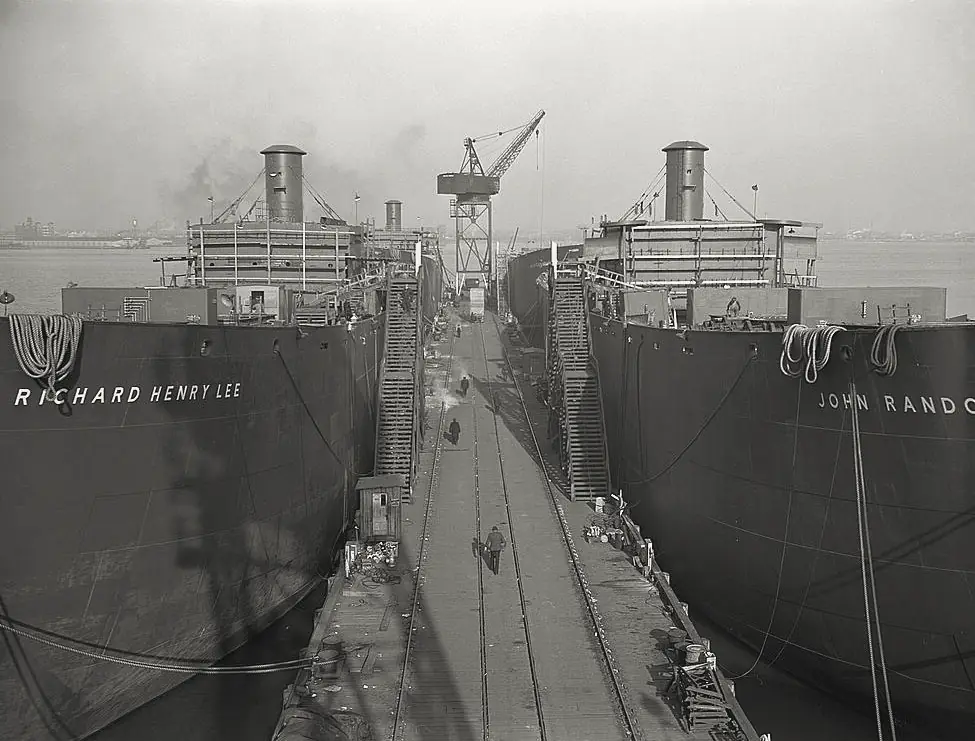
Kaiser shipyards at Swan Island, Portland, build T2 tankers; the Oregon Encyclopedia records 147 built there in these years.
At about 2230 Pacific time, the tanker Schenectady breaks in two while tied up at the Swan Island fitting-out pier, in still water and light wind.
A committee to investigate the cargo-vessel fractures is established, according to the Japanese failure database summary.
The Esso Manhattan breaks in two; the Navy board casualty table lists this date.
The John P. Gaines breaks in two and is abandoned. The board later counts 26 lives lost in the structural failures, 11 of them from the Gaines.
The Navy board final report is dated 15 July 1946. It attributes the fractures to notches and to steel that was notch sensitive at operating temperatures.
J.F. Baker writes to Newnham College that Constance Tipper had shown the American steel to be notch brittle above freezing, as quoted in a 2015 JOM profile.
A researched reconstruction for learning. These reasoning steps simplify a complex record; no score can capture the full history.
02 · The evidence
What does the record show?
Read each exhibit before settling on an explanation. The source links below every exhibit lead to the record behind it.
Exhibits reviewed 0 of 5
A board causal claim
The Navy board concluded that the fractures came from notches together with steel that was notch sensitive at operating temperatures, and that locked-in stresses did not contribute materially. This sets out the board's central finding. It does not show how each hull plate tested, and the board treated workmanship and design as contributing conditions.
Source record s1archive.org
Calm water and a corner
The board record for the Schenectady gives 2230 on 16 January 1943, a fitting-out pier, still water and light wind, with the fracture starting at a corner where a superstructure fashion plate met the sheer strake. The air and water temperatures on the scanned form are only partly legible, so the thermal conditions are approximate. The record alone does not settle how much weld quality at that corner contributed.
Source record s1archive.org
Where the cracks began
The board reported that about a quarter of the fractures on Liberty ships began at hatch corners, and cited photoelastic studies showing appreciable stress concentration there. This shows that geometry concentrated stress where cracks started. It does not show that the steel was brittle, because a high stress at a corner matters most when the material cannot absorb it.
Source record s1archive.org
A colleague account of the steel
A 2015 JOM profile of Constance Tipper, published by the Minerals, Metals and Materials Society, recounts her Cambridge work and quotes J.F. Baker's 1962 letter. Baker credits Tipper with suggesting that the fault lay with the steel rather than the welding, which he described as notch brittle above freezing. This is a retrospective account built on correspondence, not Tipper's own test series.
Source record s3link.springer.com
A rivet from the John W. Brown
A 2015 JOM study examines a rivet from the Liberty ship John W. Brown, launched in 1942, and compares it with modern restoration rivets. The authors treat the rivet as an analogue for the plate used in these ships, and note that post-mortem studies of Liberty ships advanced understanding of brittle fracture and the ductile-to-brittle transition. It does not reproduce the wartime impact tests, and it does not analyze the hull plate itself.
Source record s4link.springer.com
03 · Your reasoning
Follow the strongest explanation.
Choose an interpretation, then compare it with the evidence. You can revise your choice. The goal is understanding, not a perfect score.
04 · The findings
The chain behind the outcome.
Your notebook
Case report
Next in engineering & technology: Loads repeated, cracks unseen
The most defensible reconstruction joins three conditions that were each insufficient alone. The first was the steel. Impact tests on samples from damaged ships showed notch sensitivity, especially at low temperature, and the Navy board concluded that the fractures arose from notches combined with such steel at operating temperatures. The second was geometry. A continuous welded hull gives a crack few natural stopping points, and fractures clustered at stress concentrations, most notably hatch corners, where the board recorded that about a quarter of Liberty ship fractures began. The third was circumstance: cold weather, loading in rough seas, and in some cases residual stress that added to the demand at a discontinuity. Not every failure needed storm loading, as the calm-water break of the Schenectady shows. The board judged that locked-in welding stresses did not contribute materially, and it examined workmanship and design as separate factors. Constance Tipper's work at Cambridge, as recounted later, moved attention from the welds to the toughness of the steel and produced a test now known by her name. The established points are the steel notch sensitivity at operating temperatures and the clustering of cracks at corners. The interpretation lies in the relative weight of each contributor on each ship. The durable lesson is that a structure can meet static strength requirements and still fail when a notch, a low temperature and a continuous path coincide. The response combined steel specifications, hatch-corner reinforcement and crack arrestors.
Contributing causes and conditions
- Steel that was notch sensitive, absorbing little energy in a notch at low operating temperatures
- Stress concentrations at hatch corners, superstructure corners and other discontinuities
- Continuous welded construction that gave a crack few natural stopping points
- Cold conditions, loading and, in some cases, residual stress that raised the demand on the steel
- Weld defects and uneven workmanship at some yards, which started or aggravated some fractures
OutcomeLiberty ships and T2 tanker fractures
Take the method with you
- A material can pass ordinary strength checks and still fail when temperature and a notch coincide.
- A structure with fewer joints or interruptions can also be one in which a crack travels further.
- When several contributors interact, a single-cause story such as bad welds can hide the material property that made the defect dangerous.
You can read findings at any time. Exploring every reasoning step marks this case as complete in your notebook.
The open record
Sources & further reading
Read the original record and its scope before relying on a conclusion. Source references support the exhibit summaries; Faultory’s reasoning prompts are editorial reconstructions.
- s1
- s2
- s3
- s4
- s5Oregon Encyclopedia: Swan Island
www.oregonencyclopedia.org
Written and curated for Faultory by Yunus Emre Vurgun, with AI-assisted research and drafting. Sources and interpretations can need correction. Read our editorial standards or report an issue.
From the journal
Field notes that use this case
Keep investigating