Your browser cannot save progress right now. You can still investigate; keep this tab open or enable local storage to save.
This case has been updated. Compatible choices are kept; revisit the evidence before drawing your conclusion.
01 · The briefing
Begin with the question.
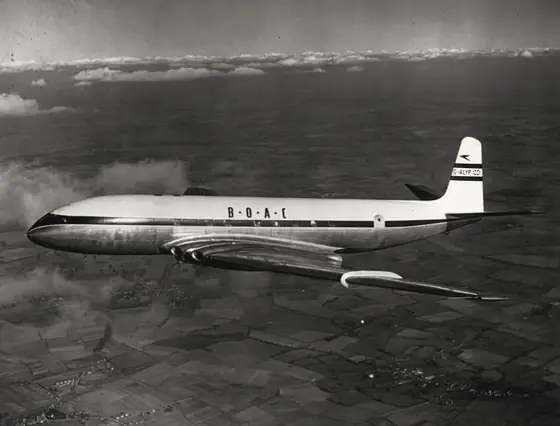
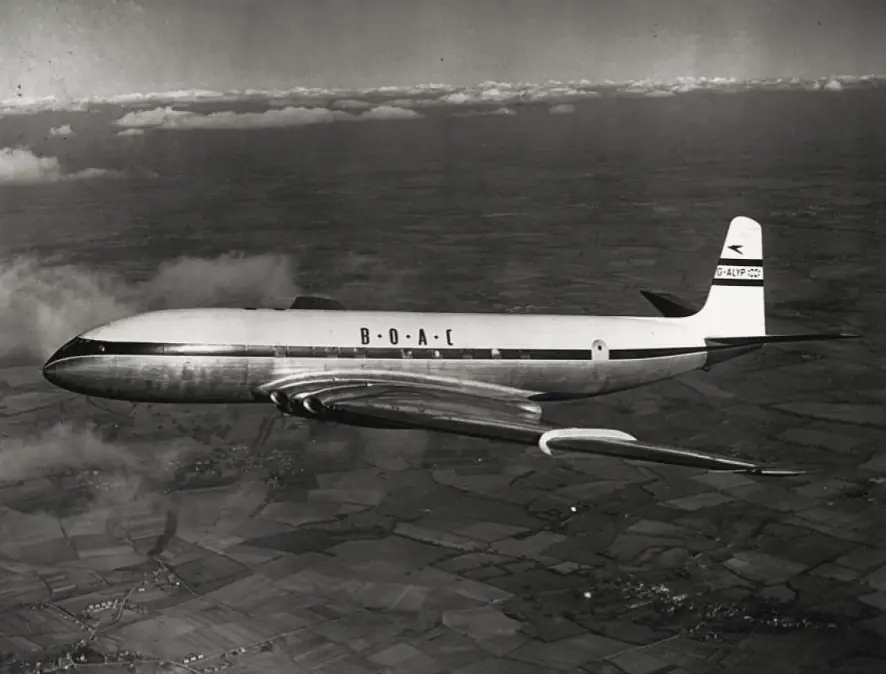
On 10 January 1954 a BOAC Comet 1, registration G-ALYP, broke up in flight near the island of Elba. On 8 April 1954 another Comet 1, G-ALYY, was lost in the Mediterranean south of Naples, with little wreckage recovered. The Comet was the first commercial jet airliner, and its cabin was pressurized. A Comet had also crashed near Calcutta in May 1953, where an Indian court attributed the failure to overstress in a thunderstorm. A rival explanation proposed that the bonded stringers had failed. A popular account blames the square windows; the record supports only part of that claim, because stress and fracture concentrated at window corners. A reconstruction must separate the wreckage evidence, the laboratory tests and the design calculations, and must ask whether a single event such as turbulence or pilot action fits the evidence better than a structural weakness that repeated loads could produce. The Court of Inquiry heard evidence from the designers, the operator, the Royal Aircraft Establishment and the Air Registration Board, and it published its report in 1955. The evidence has to be read with care, because the wreckage of one aircraft was far more complete than the other.
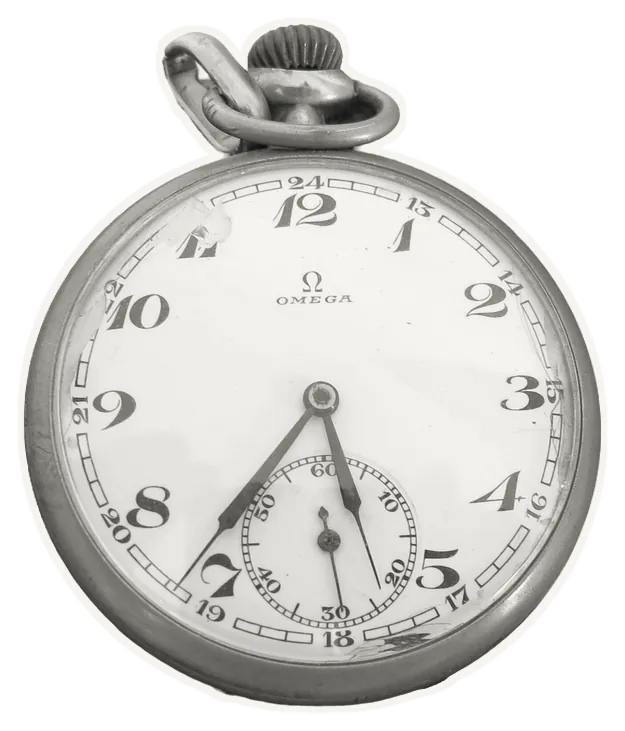
The timeline
Comet G-ALYV crashes in a thunderstorm near Calcutta; an Indian court later attributes the failure to overstress.
By September 1953 a de Havilland pressure-test section has withstood about 18,000 pressurizations; the test later ends in a skin fatigue failure at a window corner.
Comet G-ALYP breaks up in flight near Elba; its pressure cabin is the first part of the aircraft to fail.
Comet G-ALYY is lost in the Mediterranean south of Naples, with little wreckage recovered.
BOAC grounds its Comet fleet while the investigation proceeds.
The Court of Inquiry report on the two accidents is published by HMSO.
A researched reconstruction for learning. These reasoning steps simplify a complex record; no score can capture the full history.
02 · The evidence
What does the record show?
Read each exhibit before settling on an explanation. The source links below every exhibit lead to the record behind it.
Exhibits reviewed 0 of 5
Where the first fracture began
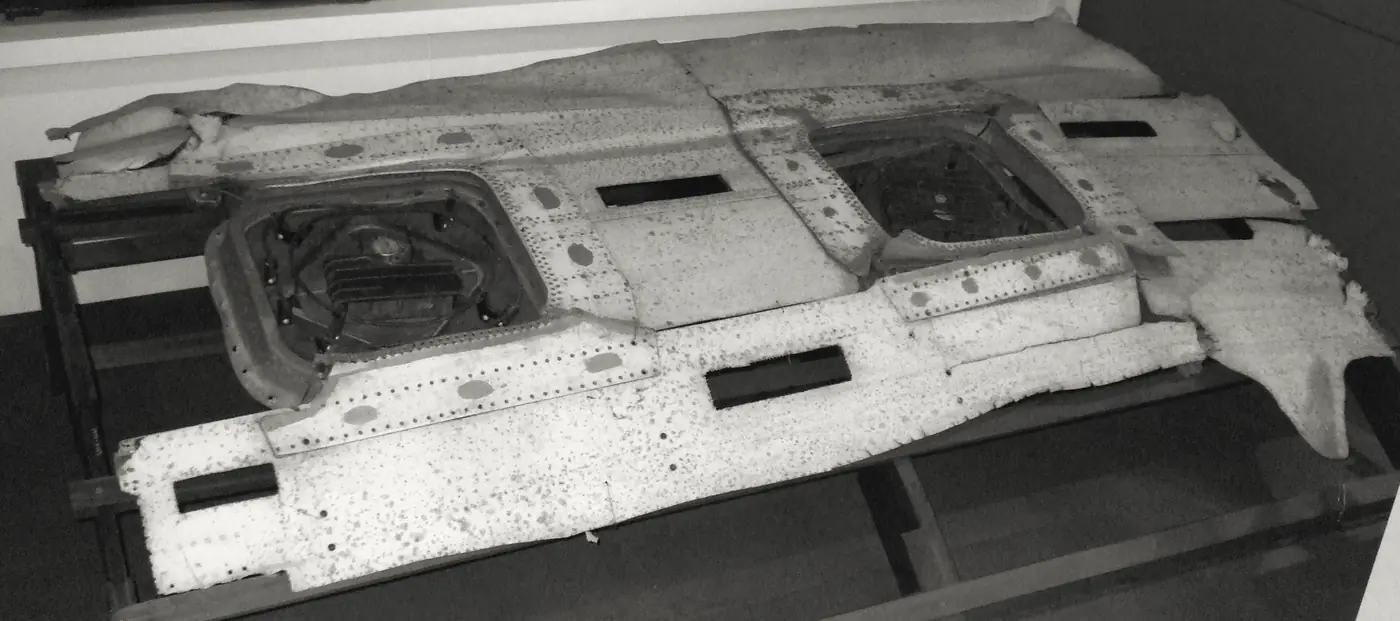
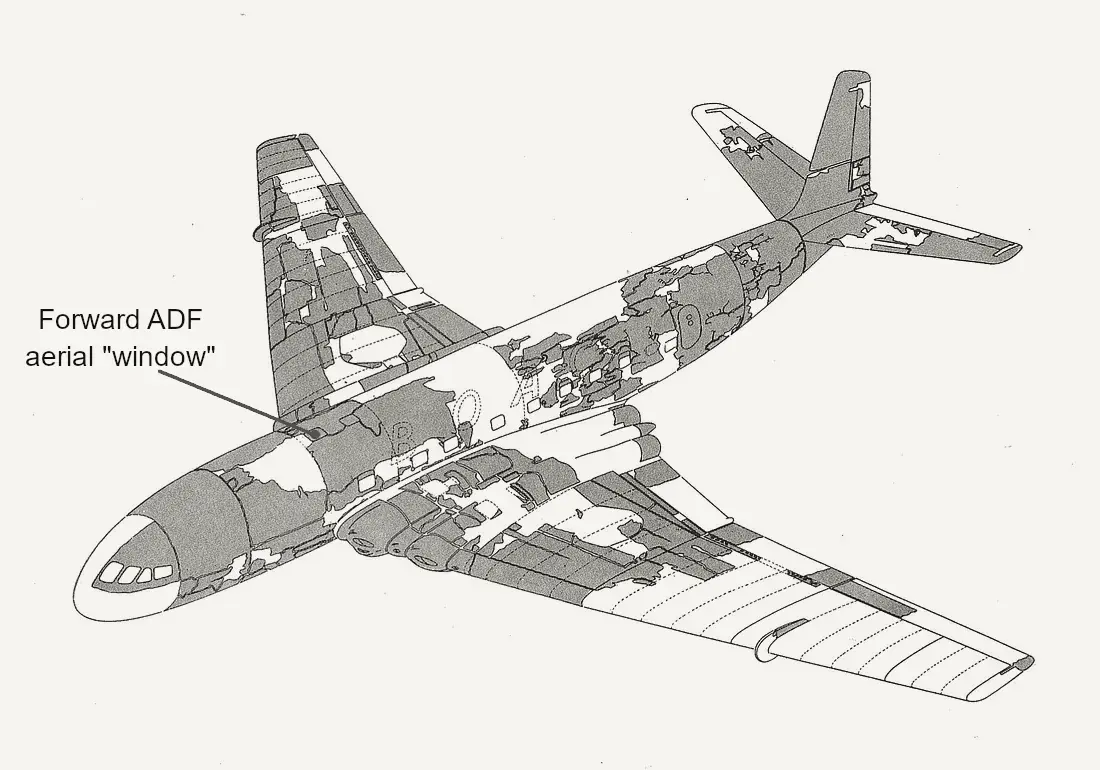
Cohen accepts that the first fracture of G-ALYP's cabin ran fore and aft through the corners of the rear ADF aerial window. He treats the probable starting point as the starboard aft corner, at the edge of a countersunk bolt hole where fatigue had existed, and records an alternative at the opposite corner. The wreckage fixes the area; the origin itself is described as probable.
Source record s1faa.gov
The pressure-test section
A de Havilland test section had been pressurized in repeated cycles. By September 1953 it had withstood about 18,000 applications of the working pressure, and the test ended with a skin fatigue failure at a window corner. The report records that the earlier cycling had been regarded as establishing the cabin's safety with an ample margin, which makes the fatigue failure significant.
Source record s1faa.gov
Corner stresses were not calculated
The Court records that de Havilland did not calculate the stress distribution near the cabin-window corners during design. The Assessors describe a stress of about 28,000 pounds per square inch as an average over a width of two or three inches. This shows a gap in the analysis, and it does not by itself prove that window shape was the cause.
Source record s1faa.gov
The Calcutta explanation
The Indian inquiry into G-ALYV, which crashed on 2 May 1953, reported structural failure during flight through a thunderstorm, attributed to overstress from gusts or control inputs. Fatigue of the cabin was not then suspected. Cohen treats the Calcutta crash as a different accident with a different explanation.
Source record s1faa.gov
The rival adhesive explanation
A rival suggestion, advanced by Mr. Jablonsky, attributed the cabin failure to the bonded stringers. Cohen rejects it after considering the evidence. The record therefore shows the adhesive theory was considered and rejected, not left unexamined.
Source record s1faa.gov
03 · Your reasoning
Follow the strongest explanation.
Choose an interpretation, then compare it with the evidence. You can revise your choice. The goal is understanding, not a perfect score.
04 · The findings
The chain behind the outcome.
Your notebook
Case report
Next in engineering & technology: One eyebar, no second path
The Court accepted the Royal Aircraft Establishment's main conclusion: the Elba accident was caused by structural failure of the pressure cabin brought about by fatigue. The wreckage placed the first fracture at the rear ADF aerial window, running fore and aft through window corners. The probable starting point was a corner of that window, at the edge of a countersunk bolt hole where fatigue had existed, although an alternative corner was also considered. A test section representing the cabin had failed by fatigue at a window corner after many pressurizations, which supported the view that fatigue life was the key question. The Court recorded that de Havilland had not calculated the stress distribution near the cabin-window corners during design, and the Assessors described a stress figure averaged over a width of two or three inches. The Court rejected an adhesive-failure explanation offered as an alternative. For G-ALYY near Naples, little wreckage was recovered, so no definite opinion on its cause was possible. The RAE report quoted by the Court said the Elba explanation appeared applicable. The popular claim about square windows is therefore only partly supported: stress and fracture were at the corners of cut-outs, but the cause was fatigue of the cabin under repeated loads, not window shape alone.
Contributing causes and conditions
- Repeated pressurization cycles accumulated fatigue damage in the cabin skin.
- Stress was concentrated at the corners of window and aerial cut-outs, where detailed stress analysis had not been carried out.
- A small defect, or the edge of a countersunk bolt hole at a window corner, gave a starting point for a crack.
- The fracture ran fore and aft along the top of the cabin through window corners, and the cabin burst near the front wing spar.
- The static test evidence available before service did not establish the cabin's fatigue life under repeated loading.
Outcomede Havilland Comet losses, 1954
Take the method with you
- A static test can pass while repeated loading still produces fatigue cracks.
- Stress at a cut-out or corner is a design question, not a detail to be assumed away.
- When wreckage is missing, a mechanism that explains one accident can be applied to a second only as a hypothesis.
You can read findings at any time. Exploring every reasoning step marks this case as complete in your notebook.
The open record
Sources & further reading
Read the original record and its scope before relying on a conclusion. Source references support the exhibit summaries; Faultory’s reasoning prompts are editorial reconstructions.
- s1
- s2Air Disasters — Comet 1 G-ALYY, 8 April 1954 (secondary accident summary)
www.airdisasters.co.uk
- s3de Havilland Aircraft Museum — de Havilland DH.106 Comet 1A exhibit page
www.dehavillandmuseum.co.uk
Written and curated for Faultory by Yunus Emre Vurgun, with AI-assisted research and drafting. Sources and interpretations can need correction. Read our editorial standards or report an issue.
Keep investigating