Your browser cannot save progress right now. You can still investigate; keep this tab open or enable local storage to save.
This case has been updated. Compatible choices are kept; revisit the evidence before drawing your conclusion.
01 · The briefing
Begin with the question.
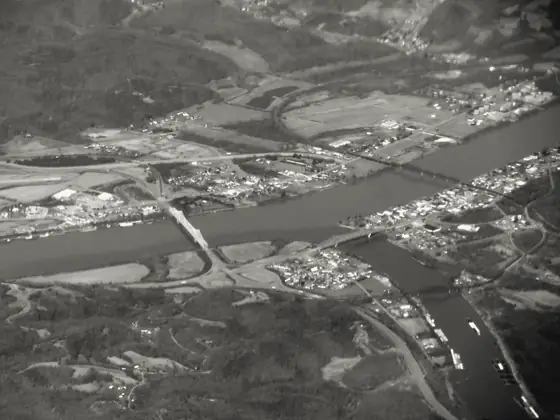
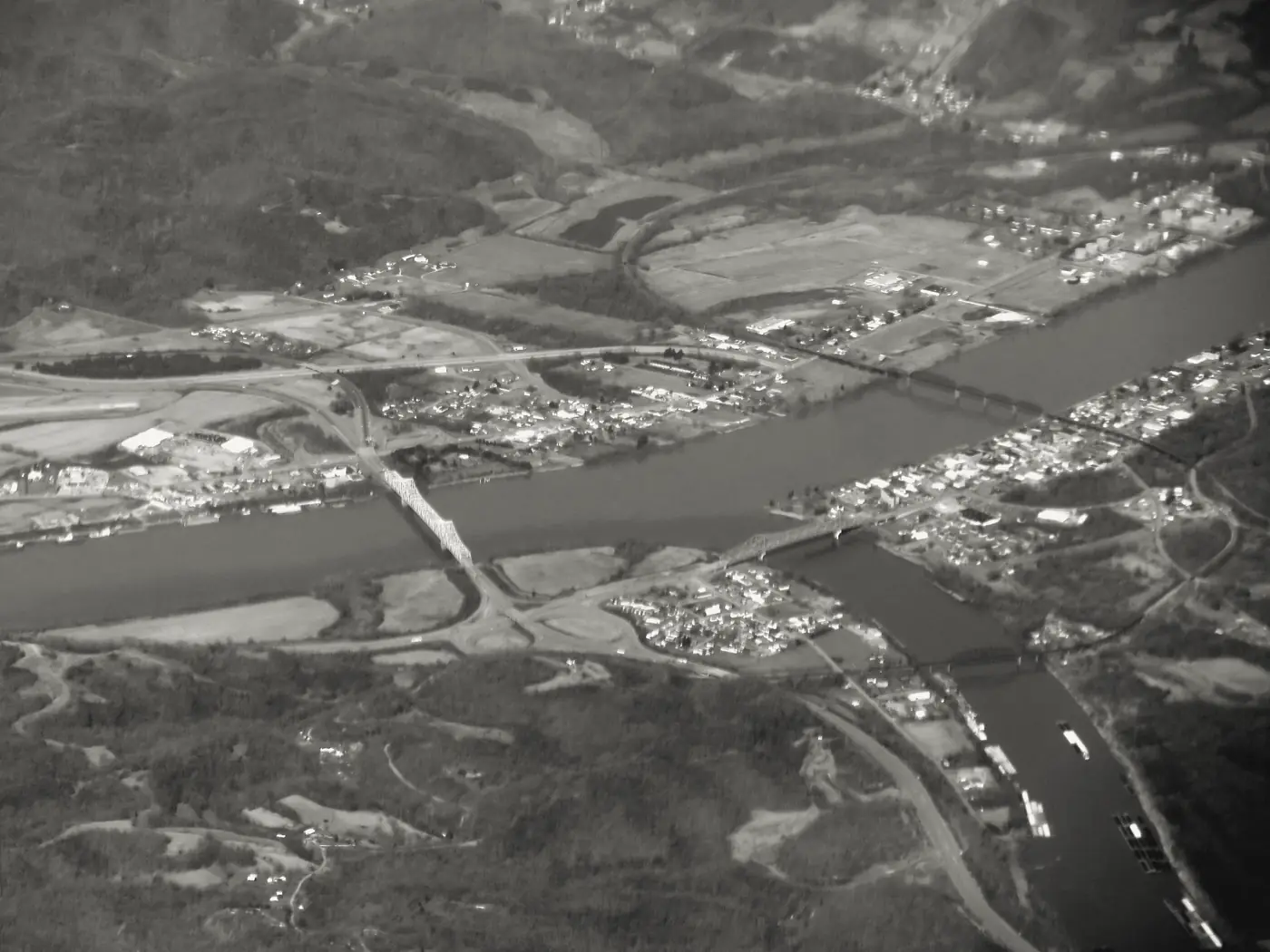
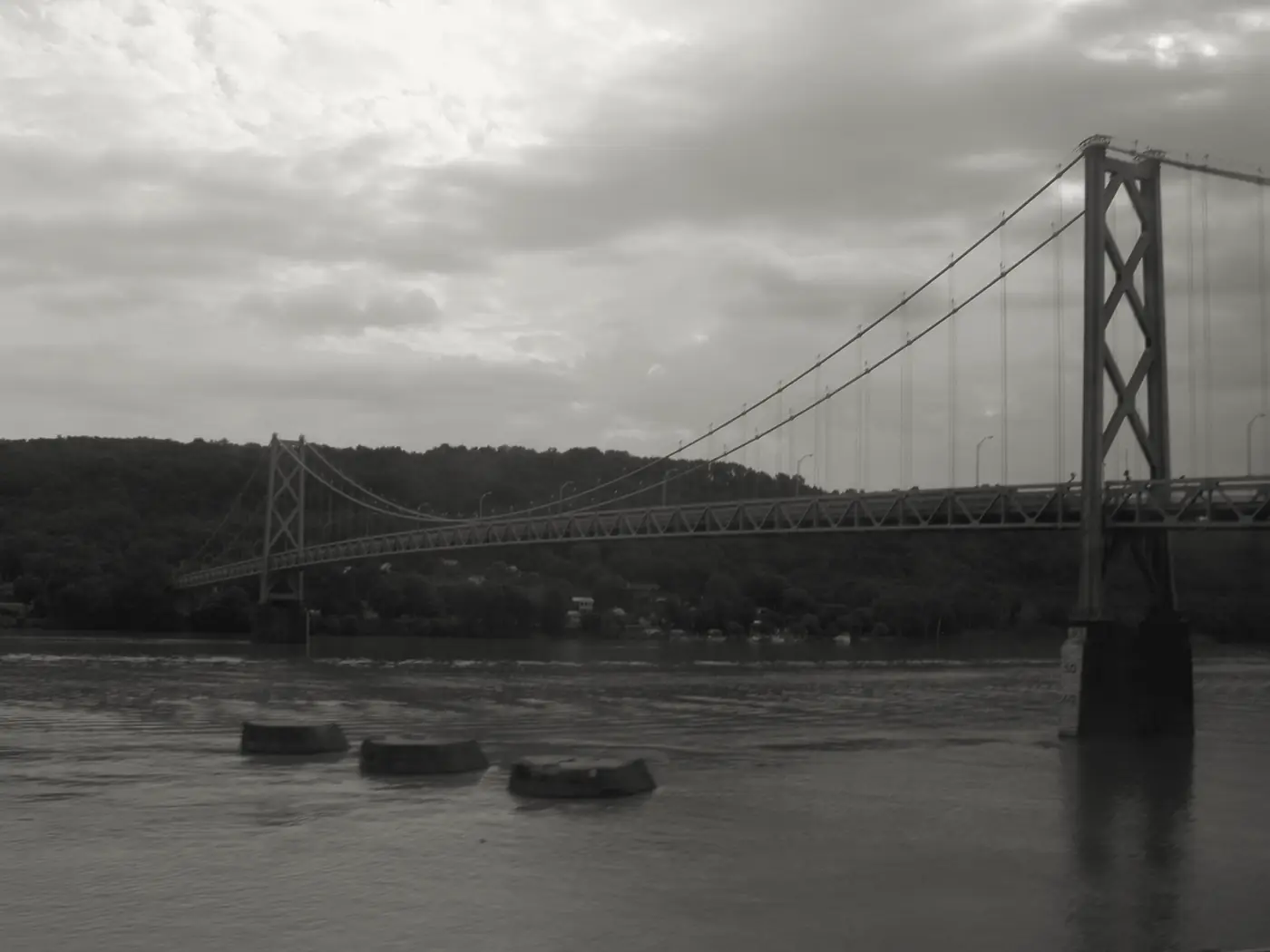
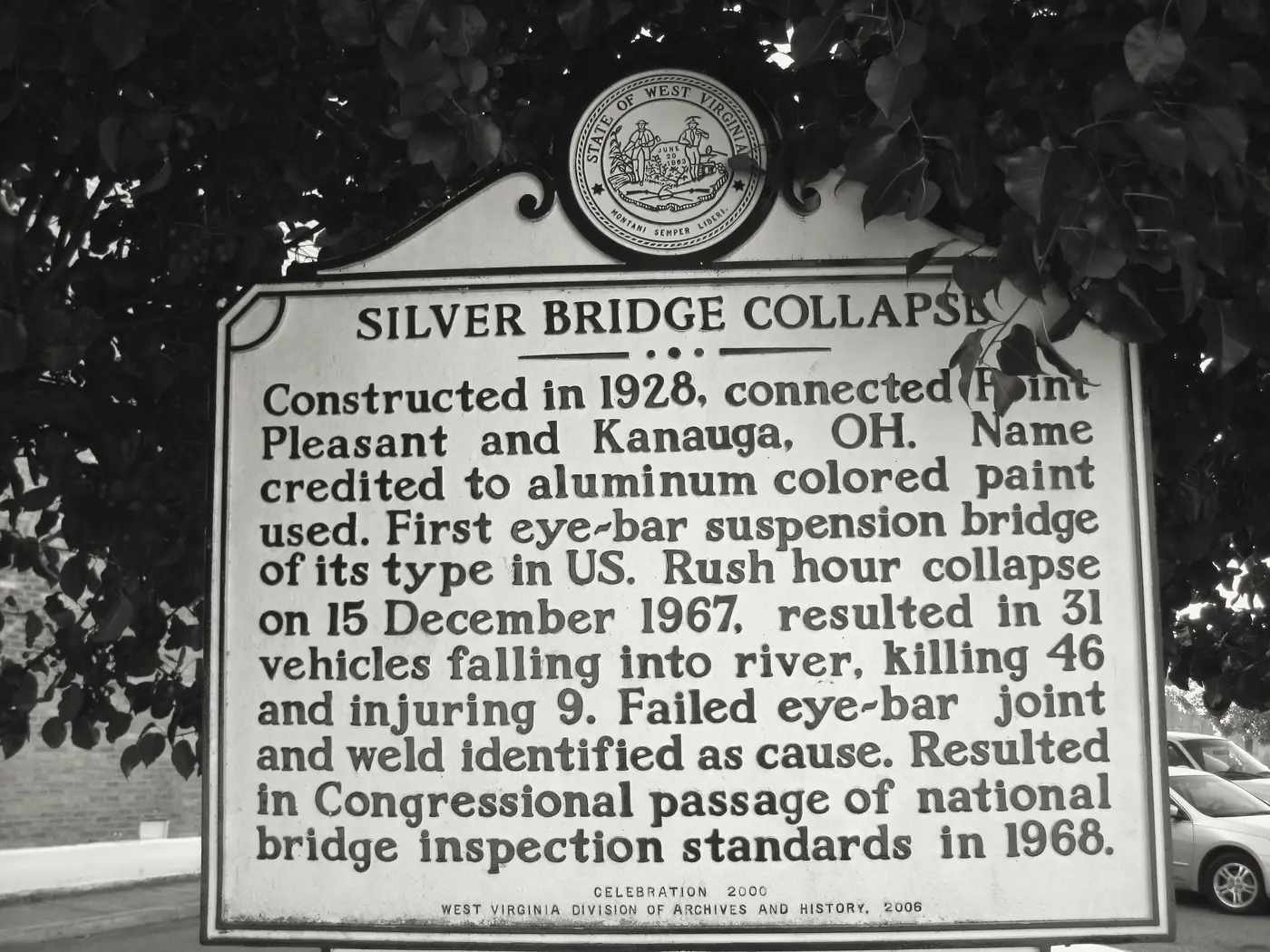
The Silver Bridge carried U.S. 35 across the Ohio River between Point Pleasant, West Virginia, and Kanauga, Ohio. It was completed in 1928 as an eyebar suspension bridge, a design in which chains of flat steel bars, joined at pins, carry the deck. On 15 December 1967 the bridge collapsed in about a minute. Forty-six people died, nine were injured, and 31 of the 37 vehicles on the span fell with it. Investigators had to consider several kinds of explanation. Overload from traffic is one. A sudden defect in the steel or in a weld is another. A slow-growing flaw that could not be seen is a third. The record needed to separate the initial fracture from the sequence that followed, and to establish whether a flaw that grew over decades could have been seen before the collapse. The question is not only what broke, but why a single broken part could bring down the whole structure. The National Transportation Safety Board investigated the collapse and adopted its final report in December 1970, after interim findings in 1968 that were followed by federal action on bridge inspection.
The timeline
The bridge is designed; the Board notes that stress corrosion and corrosion fatigue were not then known to occur in this steel under rural exposure.
The bridge is completed as an eyebar suspension bridge between Point Pleasant and Kanauga.
The bridge collapses; 46 people die, nine are injured, and 31 vehicles fall with it.
The Safety Board's interim report recommends that the Department of Transportation make bridge-safety guidance available to owners of about 330,000 bridges outside the federal-aid system.
The Board announces that laboratory work found minute cracks penetrating the fractured eyebar head, and that stress corrosion is suspected.
The Board adopts its final report on the collapse.
The first National Bridge Inspection Standards are published, after Congress required them in 1968.
A researched reconstruction for learning. These reasoning steps simplify a complex record; no score can capture the full history.
02 · The evidence
What does the record show?
Read each exhibit before settling on an explanation. The source links below every exhibit lead to the record behind it.
Exhibits reviewed 0 of 5
Where the failure began
The Board finds that the initial failure was a cleavage fracture in the lower limb of the eye of eyebar 330, at joint C13N, the first joint west of the Ohio tower. A ductile fracture then separated the eyebar from the joint, and its sister eyebar slipped from its pin. This establishes the sequence of the first separation; the earlier growth of the flaw is a separate question.
Source record s1ntsb.gov
A flaw that grew for decades
The Board concludes that the fracture was caused by a critical-size flaw that developed over the structure's 40-year life, through the joint action of stress corrosion and corrosion fatigue. The finding explains the mechanism of growth. The flaw's exact size and timing are inferred from the fracture evidence rather than observed in service.
Source record s1ntsb.gov
No second path
When the north eyebar chain separated at joint C13N, the Board says total collapse was a certainty because of the bridge's design, with the towers resting on rocker seats. The report therefore treats the failure of that one chain as decisive for the whole span.
Source record s1ntsb.gov
Limits of inspection
The Board found the flaw was inaccessible to visual inspection, and that no inspection method known at the time could detect it without disassembling the eyebar joint. Its December 1968 press release said the cracks might be undetectable in the state of the art without disassembly.
Source record s1ntsb.gov
The policy response
The Federal Highway Administration says that Congress required the Secretary of Transportation to establish bridge inspection standards in 1968, and that the original National Bridge Inspection Standards were published in 1971, creating the nation's first nationally coordinated bridge inspection program.
Source record s2fhwa.dot.gov
03 · Your reasoning
Follow the strongest explanation.
Choose an interpretation, then compare it with the evidence. You can revise your choice. The goal is understanding, not a perfect score.
04 · The findings
The chain behind the outcome.
Your notebook
Case report
Next in engineering & technology: The light that said less
The Board's finding is that the bridge collapsed because of a cleavage fracture in the lower limb of the eye of eyebar 330, at joint C13N in the north suspension chain on the Ohio side. That fracture resulted from a critical-size flaw that developed over about forty years through stress corrosion and corrosion fatigue. The flaw was in a place visual inspection could not reach, and the Board concluded that no method then known could detect it without disassembling the joint. Once the north chain separated at that joint, the sister eyebar slipped from its pin, and the collapse spread through the span within about a minute. The design, with towers resting on rocker seats, meant that the loss of one chain carried the bridge down. The contributing causes therefore combine the mechanism of growth, the limits of detection and the lack of a second load path. Established facts include the fracture location, the sequence of separation and the Board's cause statement. The Board's 1968 actions, including its press release on minute cracks and its interim recommendations, show the investigation moving toward national inspection policy. The Federal Highway Administration says Congress required inspection standards in 1968, and the first National Bridge Inspection Standards were published in 1971. The wider policy effect, and whether earlier inspection could have found the flaw, go beyond the Board's cause statement.
Contributing causes and conditions
- A critical-size flaw developed in the head of eyebar 330 over about forty years of service.
- Stress corrosion and corrosion fatigue, acting together, grew the flaw in the lower limb of the eye at joint C13N.
- A cleavage fracture separated eyebar 330 from its joint, and the sister eyebar then slipped from its pin.
- The towers resting on rocker seats meant that the loss of the north chain brought down the whole structure.
- The flaw was hidden from visual inspection and could not be detected without disassembling the joint.
OutcomeSilver Bridge collapse
Take the method with you
- A design that performs well under normal loads can still depend on one critical member.
- A defect hidden by geometry or access can remain undetected even during routine inspection.
- Public markers can simplify or misstate causes, so check a claim against the primary investigation report.
You can read findings at any time. Exploring every reasoning step marks this case as complete in your notebook.
The open record
Sources & further reading
Read the original record and its scope before relying on a conclusion. Source references support the exhibit summaries; Faultory’s reasoning prompts are editorial reconstructions.
- s1
- s2
- s3
Written and curated for Faultory by Yunus Emre Vurgun, with AI-assisted research and drafting. Sources and interpretations can need correction. Read our editorial standards or report an issue.
Keep investigating