Your browser cannot save progress right now. You can still investigate; keep this tab open or enable local storage to save.
This case has been updated. Compatible choices are kept; revisit the evidence before drawing your conclusion.
01 · The briefing
Begin with the question.
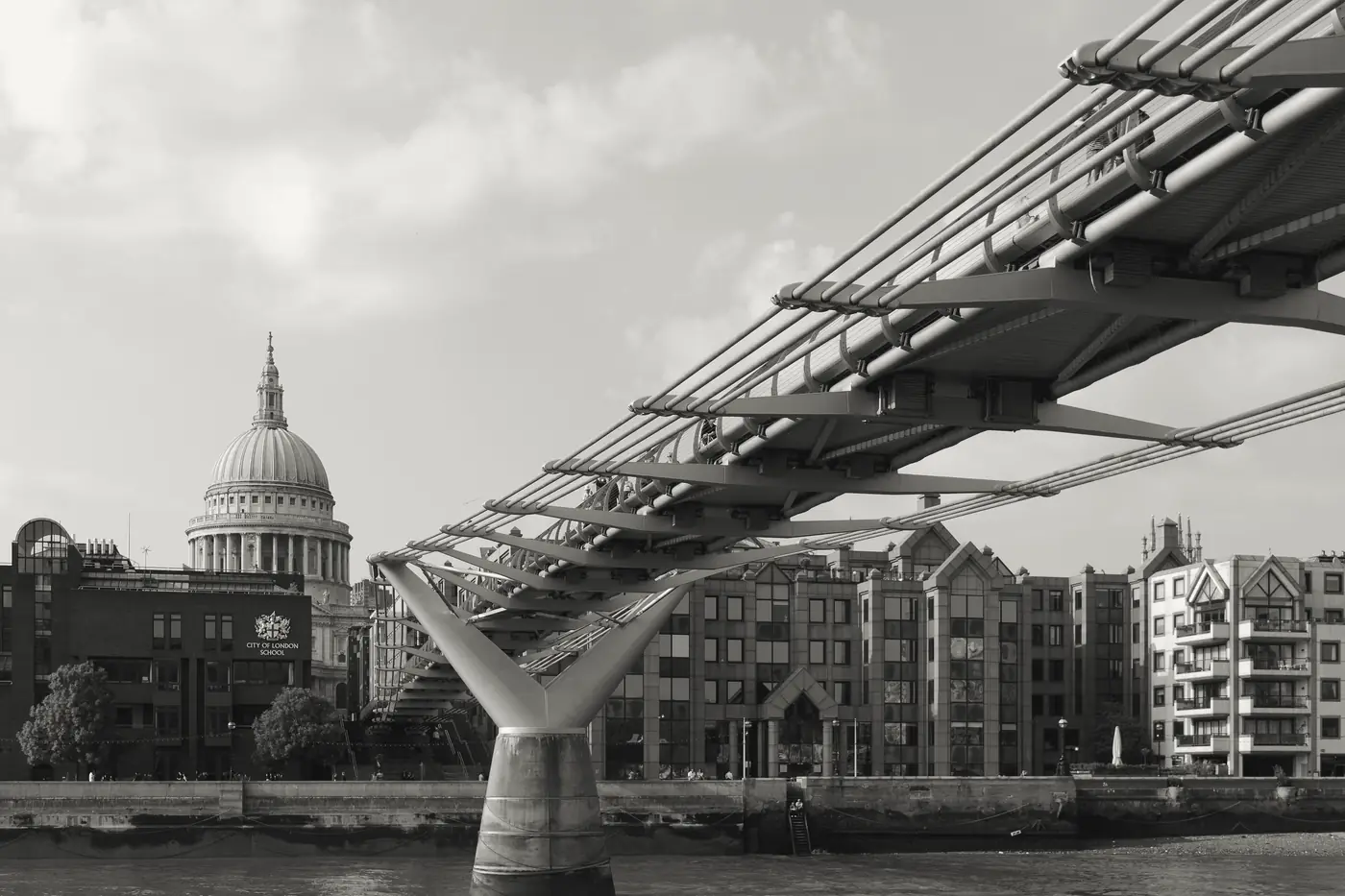
The London Millennium Footbridge opened across the Thames on 10 June 2000, and on its first day an estimated 80,000 to 100,000 people crossed it. Within a day or two the deck was moving sideways in a way that unsettled pedestrians, and on 12 June the bridge was closed. The design had been checked for vertical footfall loads, but published data on the sideways forces people exert were thin. Several explanations circulated. The slender new design might simply be too flexible. A strong wind or an unusual combination of gusts might have pushed the deck. The structure itself might have an unexpected vibration. A fourth possibility looked at the people on the deck. Your investigation has to separate the structure measured behavior from the forces acting on it. The investigation was led by the bridge designers at Arup, who had the structural model and modal calculations at hand. Look at when the sway appeared, how the movement related to the number of people, and whether the bridge dynamics matched the design. A convincing account must explain why the motion grew in a crowd and eased when people stopped walking.

The timeline
Piling starts on site, according to the design team's paper.
The bridge opens; an estimated 80,000 to 100,000 people cross on the first day.
The number of pedestrians allowed onto the bridge is reduced, and the sideways movements become far less frequent.
The bridge is closed to investigate the movement.
A research and testing program develops a retrofit to control the vibration.
The bridge reopens after the retrofit, as reported by the BBC in 2023.
Strogatz and colleagues publish a crowd-synchrony model in Nature.
A researched reconstruction for learning. These reasoning steps simplify a complex record; no score can capture the full history.
02 · The evidence
What does the record show?
Read each exhibit before settling on an explanation. The source links below every exhibit lead to the record behind it.
Exhibits reviewed 0 of 5
Measured sway and crowd density
The design team paper reports opening-day movement at about 0.8 hertz on the south span and near 0.5 and 1.0 hertz on the central span, with peak lateral acceleration of 200 to 250 milli-g, enough to make people hold the balustrades. Video analysis showed up to 2,000 people on the deck at once. This ties the motion to crowd density, but it does not by itself show the mechanism.
Source record s1web.archive.org
The modal tests
After closure, modal testing measured damping of about 0.6 to 0.8 percent of critical, close to the design assumption of 0.5 percent, and mode frequencies within about 10 percent of predictions. The authors took this to mean the structural model was valid and that the movement came from an unpredicted external force. The modal tests do not measure that force directly.
Source record s1web.archive.org
Arup public account
The Arup summary states that the bridge opened on 10 June 2000 with an estimated 80,000 to 100,000 people crossing, that sway reached about 70 millimeters, and that the bridge was closed on 12 June. It attributes the movement to sideways loads from walking, with footsteps becoming correlated as people fall into step with the sway. It does not give the full test program, which is in the technical paper.
Source record s2web.archive.org
A coupled-oscillator model
Strogatz and colleagues adapt models of coupled oscillators, the kind used for fireflies and neurons, to pedestrians on the bridge. They argue that the sway was not due to the bridge's innovative design, as was first thought, and that synchronization can amplify the motion. The paper is a theoretical model, so it establishes a mechanism consistent with the observations rather than a measured force law for each walker.
Source record s3nature.com
A later account of the reopening
A 2023 BBC report on a maintenance closure recalls that the bridge opened in June 2000, was shut two days later after users experienced sway, and that engineers worked out how to stop the oscillation before it reopened in 2002. It is a news report, so it does not give the damper design or the exact reopening date.
Source record s4bbc.co.uk
03 · Your reasoning
Follow the strongest explanation.
Choose an interpretation, then compare it with the evidence. You can revise your choice. The goal is understanding, not a perfect score.
04 · The findings
The chain behind the outcome.
Your notebook
Case report
Next in engineering & technology: A content file that was not code
The opening-day sway is best explained as a feedback between a light, laterally flexible deck and walkers who adjust their gait to the motion. A small sideways movement makes footing feel unstable, so people widen or steady their stance, and some begin to walk in step with the sway. Their combined sideways pushes then reinforce the movement. The design team reported that the lateral modes, near 0.5 to 1.0 hertz, responded in a way that depended on how many people were on the affected span, and that the effect built up and eased with crowd size and walking. Modal testing of the built bridge matched design predictions within about 10 percent, which supports the claim that an external force, not a defect in the structure, drove the motion. Strogatz and colleagues later modeled the process with the mathematics of coupled oscillators, showing how synchronization can emerge once enough people are on the bridge. The established points are the crowd density, the measured motion, the closure and the retrofit. The interpretation lies in the precise coupling between individual walkers and the deck, which remains a simplification. The retrofit added viscous dampers and tuned mass dampers, and the bridge reopened in 2002. The lesson for engineers is that some sideways forces depend on the motion they produce, so a design check should treat the crowd as part of the dynamic system.
Contributing causes and conditions
- A light, laterally flexible deck with low-frequency sideways modes
- Dense crowds on the affected spans, reaching about 1.3 to 1.5 people per square meter at peak
- Pedestrians who fell into step with the sway, adding forces that reinforced it
- Low structural damping, close to the design assumption of 0.5 percent of critical
- Limited published guidance on sideways pedestrian forces when the bridge was designed
OutcomeLondon Millennium Bridge sway
Take the method with you
- A force can depend on the motion it produces, turning a small disturbance into a growing one.
- Measure the structure behavior and the forces acting on it separately before assigning a cause.
- Choose a remedy that acts on the mechanism you have confirmed, and check whether the remedy changes the structure in ways you can accept.
You can read findings at any time. Exploring every reasoning step marks this case as complete in your notebook.
The open record
Sources & further reading
Read the original record and its scope before relying on a conclusion. Source references support the exhibit summaries; Faultory’s reasoning prompts are editorial reconstructions.
- s1
- s2Arup: The Millennium Bridge, challenge (archived page)
web.archive.org
- s3
- s4
Written and curated for Faultory by Yunus Emre Vurgun, with AI-assisted research and drafting. Sources and interpretations can need correction. Read our editorial standards or report an issue.
From the journal
Field notes that use this case
Keep investigating