After reading, you will be able to identify when a force depends on the motion it produces. You will also know how to tell a loop that grows from a load that merely acts on a structure.
01The bridge that twisted
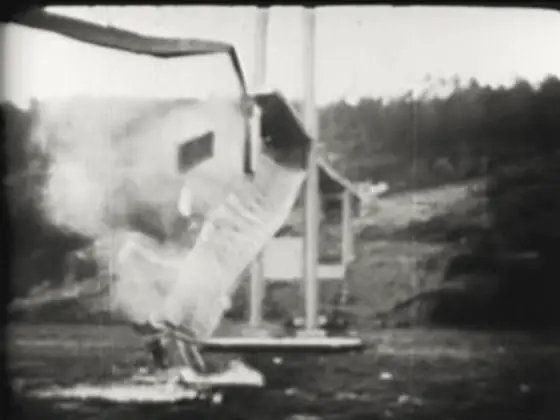
The Tacoma Narrows Bridge opened in July 1940. Its deck was narrow and shallow, and it moved visibly in the wind. On November 7, 1940, the motion changed character: vertical movement developed into large twisting oscillations, and the main span collapsed.
The popular picture is a steady wind pushing the bridge at its natural frequency, like a child pushing a swing. The Washington State Department of Transportation's history of the bridge describes torsional flutter as the principal explanation, in which aerodynamic forces that depend on the deck's motion reinforce that motion.
The question is not whether wind played a role. It did. The question is whether the force acting on the bridge was independent of the bridge's motion. For Tacoma, the answer is that it was not entirely independent.
02When a force depends on motion
Much everyday engineering treats loads as given. A gust has a speed, and a crowd has a weight. In flutter, the load depends on the state of the structure. Movement changes the airflow around the deck, and the changed airflow produces forces that can add energy to the oscillation.
Whether the energy grows depends on balance. The structure dissipates energy through damping, while motion-dependent aerodynamic forces can feed energy in. When the input exceeds the dissipation, the oscillation can grow even without a perfectly periodic wind. That is why a structure can look satisfactory under static loads and still be unstable in the wind.
Interpretation: static strength and a familiar natural frequency do not establish aerodynamic stability. The relevant test is of the coupled behavior of the structure and the airflow together.
The detailed mathematics of such loops is beyond this article, but the qualitative test is straightforward. Ask whether the aerodynamic force shifts in timing relative to the motion as the structure moves. If it does, the force can supply energy to the motion, and the remaining question is whether damping exceeds that supply at the amplitudes the structure will meet.
03Crowds as part of the loop
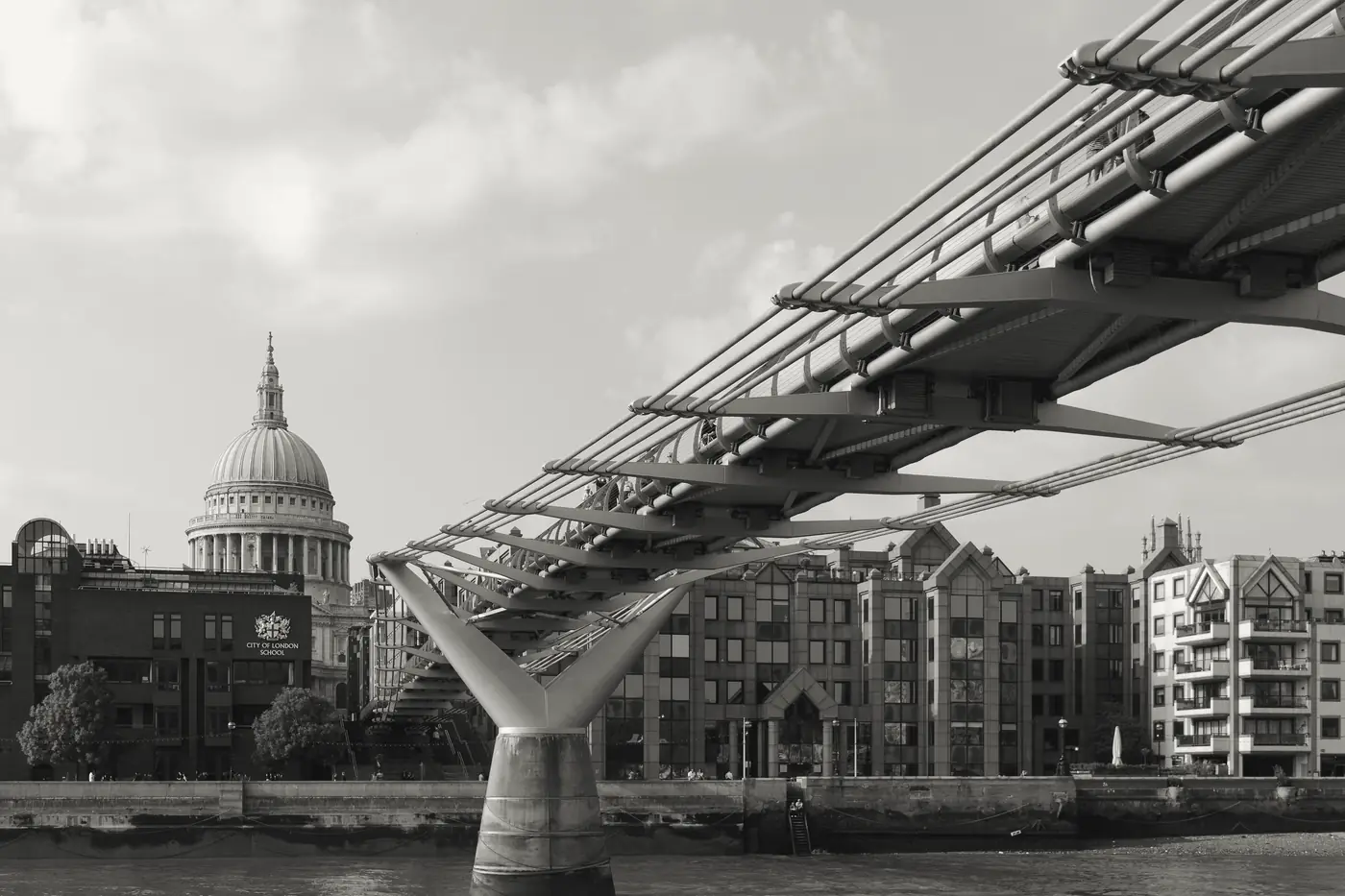
London's Millennium Bridge opened in June 2000. Soon after pedestrians streamed onto it on the opening day, the bridge began to sway from side to side. Many pedestrians fell spontaneously into step with the bridge's vibrations, which amplified them. A Nature paper describes this as an unexpected and now notorious phenomenon.
Here the loop runs between the structure and the people on it. A small sideways motion makes walkers adjust their footing to match it, and the adjusted footing pushes the deck further. The published model treats pedestrian footfall as responsive to the deck's motion, and that coupling is the basis of its account of the growing sway.
The interpretation should stay careful. Crowds are not simple machines, and the effect depends on density and on individual behavior. The structural lesson still stands: a load can depend on the response it causes.
Similar loops can arise in other rhythmic settings. When many people respond to the same motion, their small adjustments can align into a common rhythm that drives the structure harder. Such alignment is most likely when a crowd is dense, which matches the observation that footbridges begin to sway when packed with pedestrians.
04Cascades through a network
Power grids produce loops of a different kind. A transmission line that trips does not vanish from the system. Its flow moves to the remaining paths, which may then exceed their limits, trip and redistribute flow again. The loop runs through the network rather than through a single member.
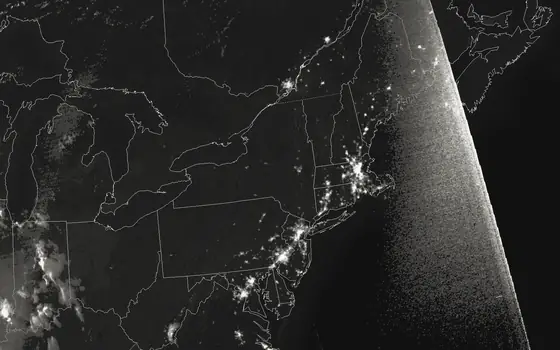
In the August 14, 2003 blackout, the final report describes how the loss of transmission paths changed flows on the lines that remained, and how that redistribution contributed to further losses. Monitoring and alarm functions had failed, so operators had a weaker view of the loop and were less able to break it.
Interpretation: a cascade is a feedback loop among components, and its growth depends on how quickly redistributed flows reach limits. Models that examine only the first trip miss the loop.
05How to find a loop
Start by asking what the motion changes. If a structure's motion alters the force acting on it, a loop is possible. Next ask whether the response amplifies the input or damps it, and whether there is a threshold beyond which the response grows quickly.
Then test at realistic amplitudes. Feedback often appears only above a particular condition, such as a wind speed, a crowd density or a line loading. Tests and simulations that stay below the threshold can look reassuring while the loop remains untested.
Finally, identify the energy path. In a bridge, that path runs through aerodynamic forces and structural damping. In a grid, it runs through flows and protective limits.
Once a candidate loop is found, name it in the report. A named loop can be watched by monitoring, rather than remaining a hidden property that appears only when it causes harm.
06Breaking the loop
Engineers can break a loop by adding damping, by changing the stiffness that controls the relevant mode of motion, or by changing the shape that governs the airflow. The Tacoma history connects the replacement bridge, which opened in 1950, to aerodynamic study and to lessons drawn from the collapse.
For crowds, the appropriate response depends on the specific structure and the loading. Each option must be checked against the loop it is meant to break, rather than assumed to work.
For power grids, breaking a loop means limiting the cascade. That involves preventing tree contact with lines, keeping monitoring reliable and planning responses for credible losses. These measures are largely operational rather than mechanical.
07Open questions
Historians and engineers still disagree about some details of Tacoma, including the sequence of the transition into torsion. The WSDOT history notes that disagreement. An explanation can rest on flutter while leaving the precise initiation of the motion open.
The same humility applies to crowds. The loop depends on density, footing and individual sensitivity, and those are not fixed quantities. Designers therefore need to treat crowd behavior as variable rather than as a single load.
The durable lesson is simple. When a structure's response can alter its own loading, the analysis is incomplete until the loop has been tested.
Terms in this note
- Flutter
- A self-excited oscillation in which aerodynamic forces depend on the structure's own motion and can add energy to it. Glossary
- Feedback loop
- A process in which part of a system's output returns as an input that changes the output further. Glossary
- Cascading failure
- A sequence in which one failure shifts load onto other elements, causing further failures in turn. Glossary
Test the idea
The case files behind this note

The open record
Sources & further reading
- 1Tacoma Narrows Bridge history: lessons from failure
Washington State Department of Transportation
- 2Tacoma Narrows Bridge history: the bridge machine since 1950
Washington State Department of Transportation
- 3
- 4Final Report on the August 14, 2003 Blackout in the United States and Canada
US-Canada Power System Outage Task Force
- 5WSDOT — Tacoma Narrows Bridge timeline
Washington State Department of Transportation
- 6
Written for Faultory by Yunus Emre Vurgun, with AI-assisted research and drafting. Editorial standards · Report an issue.