Your browser cannot save progress right now. You can still investigate; keep this tab open or enable local storage to save.
This case has been updated. Compatible choices are kept; revisit the evidence before drawing your conclusion.
01 · The briefing
Begin with the question.
Scurvy killed large numbers of sailors on long voyages in the eighteenth century, and naval surgeons had many proposed remedies. In 1747 James Lind, a Scottish naval surgeon, was serving aboard the Salisbury in the Channel Fleet, and the ship had already lost many men to scurvy on a long cruise. On 20 May 1747 Lind chose twelve patients whose cases were as similar as he could make them, housed them together and gave them a common diet. He then divided them into six pairs, each given a different treatment. This investigation asks what that trial separates. Several explanations were available to a reasonable reader at the time. One holds that the most dramatic recovery identifies the remedy. Another holds that a trial with twelve men is too small to mean anything. A third holds that the effect of fresh fruit was obvious to sailors and needed no test. Lind's own account was published in 1753, and later historians have argued about how far it established its conclusion. The investigation will separate what the trial showed from what it could not show at the time, including the chemistry that would later explain the result.
The timeline
Lind begins a controlled comparison of six remedies on twelve scurvy patients aboard HMS Salisbury at sea.
Six days after the trial begins, one of the two patients given oranges and lemons is fit for duty.
The Salisbury reaches Plymouth, by which point the citrus patients had recovered visibly.
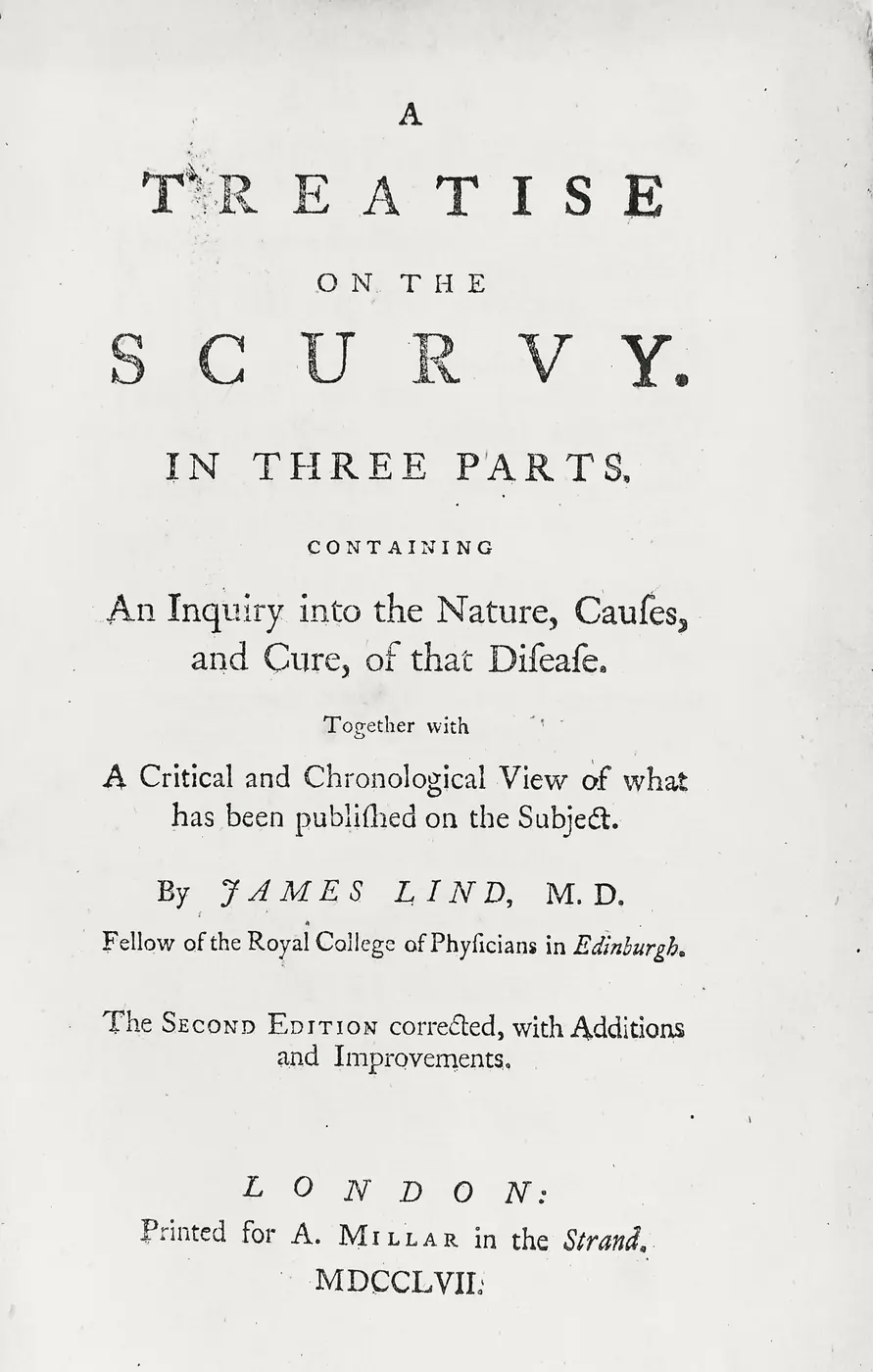
Lind publishes A Treatise of the Scurvy, with his account of the trial and a critical review of earlier writing.
The Navy's Sick and Hurt Board rejects a proposal to supply sailors with fruit juice, the year after the Treatise appeared.
The Navy's adoption of citrus comes about 42 years after the Treatise, a lag the James Lind Library describes.
A researched reconstruction for learning. These reasoning steps simplify a complex record; no score can capture the full history.
02 · The evidence
What does the record show?
Read each exhibit before settling on an explanation. The source links below every exhibit lead to the record behind it.
Exhibits reviewed 0 of 5
The design
Lind's account lists twelve patients on the Salisbury, all lying together and given one common diet. Two patients each received one of six treatments: cider, elixir of vitriol, vinegar, sea water, oranges and a lemon, or an electuary with barley water. The allocation is not described as random, and the groups were chosen to be as similar as Lind could make them.
Source record s2archive.org
The citrus pair
The two patients who received two oranges and one lemon each day ate the fruit greedily, and they used up the supply within six days. Lind reports that the oranges and lemons produced the most sudden and visible good effects, and that one of the pair was fit for duty at the end of six days. The other, by the time the ship reached Plymouth, was the best recovered of any patient in his condition.
Source record s2archive.org
Small numbers and careful observation
Lind judged the twelve-patient comparison convincing because the differences were large. He added selected observations on other patients, which he regarded as less reliable and not quantitative. Tröhler's account shows that Lind valued the quality of careful observation over the number of cases, a judgement of his period rather than a modern statistical one.
Source record s3jameslindlibrary.org
The concentrate
Lind recommended a condensate called rob, made by evaporating diluted fruit juice in nearly boiling water. Tröhler states that heat destroys much of the ascorbic acid in fresh juice, and later observers could not detect a beneficial effect from the condensate. The fruit given on the Salisbury was fresh, so the trial did not test the form that was later recommended.
Source record s3jameslindlibrary.org
Delay in the Navy
The Sick and Hurt Board rejected a proposal to supply fruit juice in 1754, the year after the Treatise appeared. Tröhler describes a 42-year lag between the clear description and its introduction, but argues that the Board did not act unreasonably in its first thirty years, because Lind's was one of many treatises and lemon juice was not new. Lind himself changed his theory of scurvy in light of his later observations.
Source record s3jameslindlibrary.org
03 · Your reasoning
Follow the strongest explanation.
Choose an interpretation, then compare it with the evidence. You can revise your choice. The goal is understanding, not a perfect score.
04 · The findings
The chain behind the outcome.
Your notebook
Case report
Next in science & discovery: Two wards and one difference
Lind's 1747 trial was an early controlled comparison, and its clearest result pointed to citrus. Oranges and lemons gave the fastest and most visible recovery among six remedies given to pairs of similar patients on one ship and one diet. The limits are equally clear. Twelve patients is a small number, allocation is not described as random, and Lind's supporting observations on other patients were not quantitative. What the trial could not show in 1747 was the cause. The vitamin behind the effect was identified only much later, so Lind could not say which component of the fruit worked, or why the other remedies did not. The later history complicates the story. Lind recommended a condensate of fruit juice, the rob, and heat destroys much of the active material in fresh juice. Later observers who tested the condensate could not detect a benefit, so the form of the remedy undercut the evidence for fruit. The Navy's Sick and Hurt Board rejected a proposal to supply fruit juice in 1754, and the Navy's adoption of citrus came decades after the Treatise. Tröhler argues that the delay was not unreasonable in the first thirty years, given the many treatises in circulation and the uneven support for some remedies. Lind himself changed his theory of scurvy in light of his later observations. The trial is therefore best read as strong evidence for a remedy, not as a complete explanation. It shows how the design of a test, the form of a treatment and the institutions that must use the result all matter.
Contributing causes and conditions
- Scurvy struck on long voyages when fresh food ran short, and the remedies in use were many, untested and often contradictory.
- Lind compared six remedies in matched pairs on one shared diet, and the citrus pair recovered fastest.
- The vitamin responsible was unknown in 1747, so the trial could identify a remedy but not its active component.
- The condensate Lind later recommended was heat-treated and lost much of its active material, so later tests of it failed.
- The Navy's delayed adoption reflected the number of competing treatises and the uneven support for some remedies.
OutcomeJames Lind's scurvy trial (1747)
Take the method with you
- A well-designed comparison can point to an answer even when the mechanism is still unknown.
- A remedy can be right in principle and still fail in practice if its form changes its effect.
- A small trial carries weight in proportion to how well its groups were controlled and how fully its result was reported.
You can read findings at any time. Exploring every reasoning step marks this case as complete in your notebook.
The open record
Sources & further reading
Read the original record and its scope before relying on a conclusion. Source references support the exhibit summaries; Faultory’s reasoning prompts are editorial reconstructions.
- s1James Lind Library, Lind J (1753), A Treatise of the Scurvy: record page
www.jameslindlibrary.org
- s2
- s3James Lind Library, Tröhler U (2003), James Lind and scurvy: 1747 to 1795
www.jameslindlibrary.org
Written and curated for Faultory by Yunus Emre Vurgun, with AI-assisted research and drafting. Sources and interpretations can need correction. Read our editorial standards or report an issue.
From the journal
Field notes that use this case
Keep investigating