Your browser cannot save progress right now. You can still investigate; keep this tab open or enable local storage to save.
This case has been updated. Compatible choices are kept; revisit the evidence before drawing your conclusion.
01 · The briefing
Begin with the question.
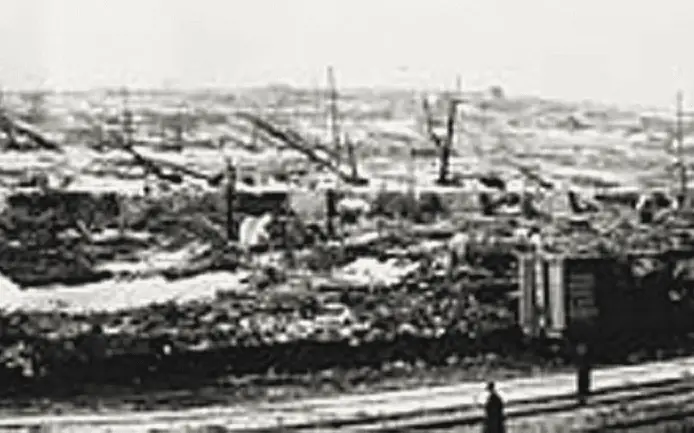
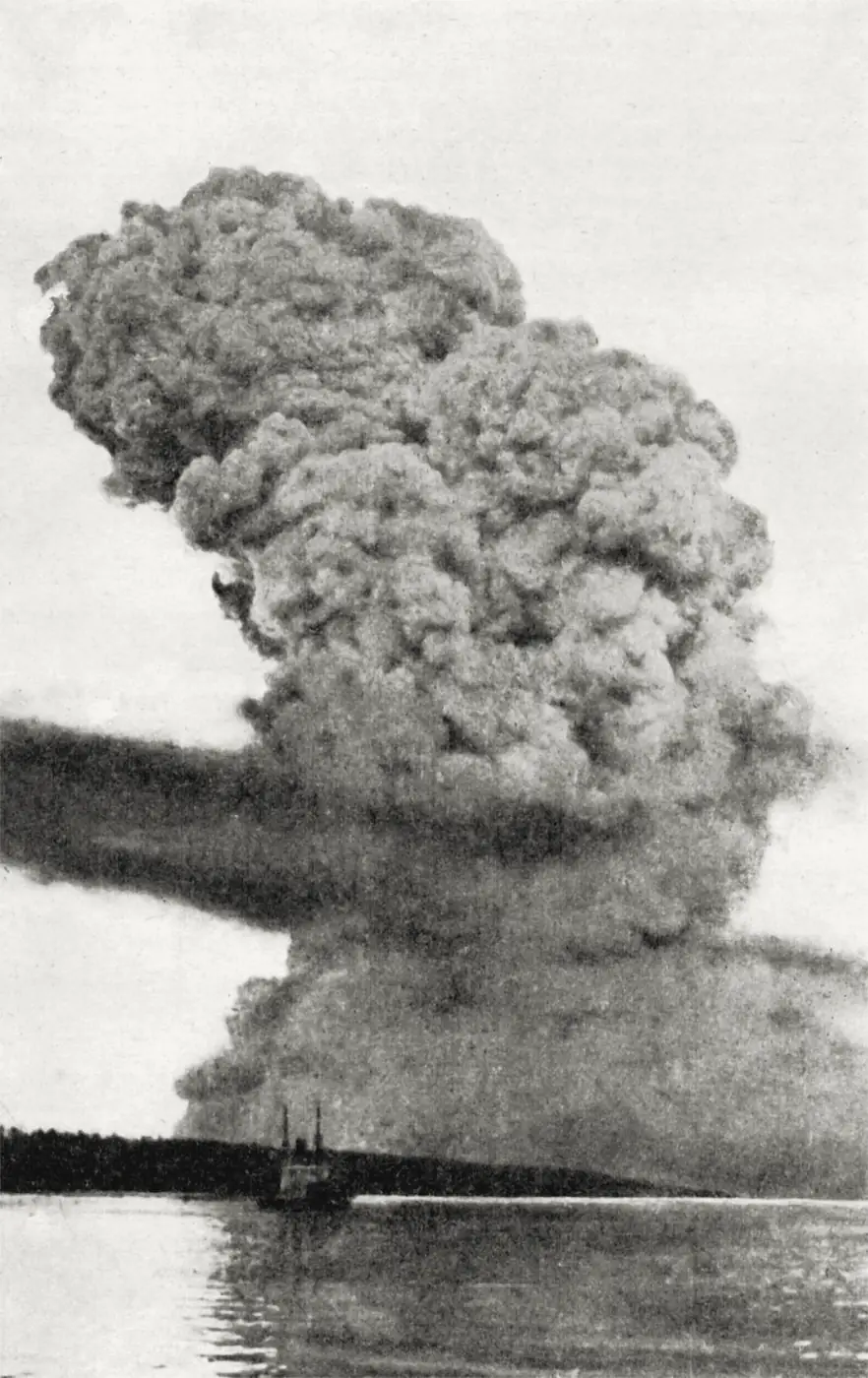
On the morning of 6 December 1917, Halifax was a crowded wartime port, an important staging area for transatlantic convoys. The Narrows, the harbour's tightest navigation section, was the scene of a collision between two steamers: the French Mont-Blanc, inbound with high explosives and a deck load of monochlorobenzene, and the Norwegian Imo, leaving Bedford Basin for New York, where it was to load relief supplies for occupied Belgium. The collision set off a fire and then an explosion that devastated the north end of the city. Deaths and injuries were heavy, and the exact totals differ between accounts.
Several explanations were offered at the time. Early rumours blamed enemy sabotage. Others fixed on one person, a pilot or a captain, as the decisive error. A third view treats the disaster as a simple navigation mistake by one ship. Each explanation has some support, which is why each survived. This investigation separates three questions: where each ship was and which side of the channel it should have used, what rules and practices governed a munitions ship in a crowded channel, and how the judicial verdicts were reached and later revised. Keep the collision, the cargo and the harbour system in view together. The explosion alone does not answer who was responsible.
The timeline
Mont-Blanc and Imo collide in The Narrows; sparks from the impact ignite the cargo of Mont-Blanc.
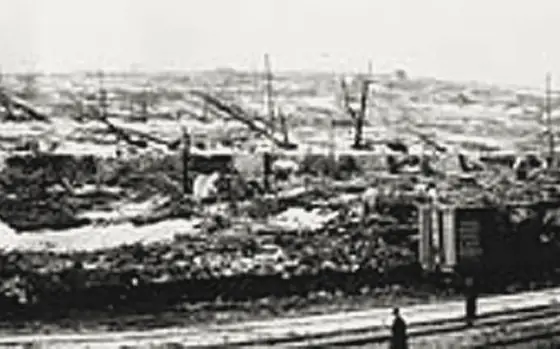
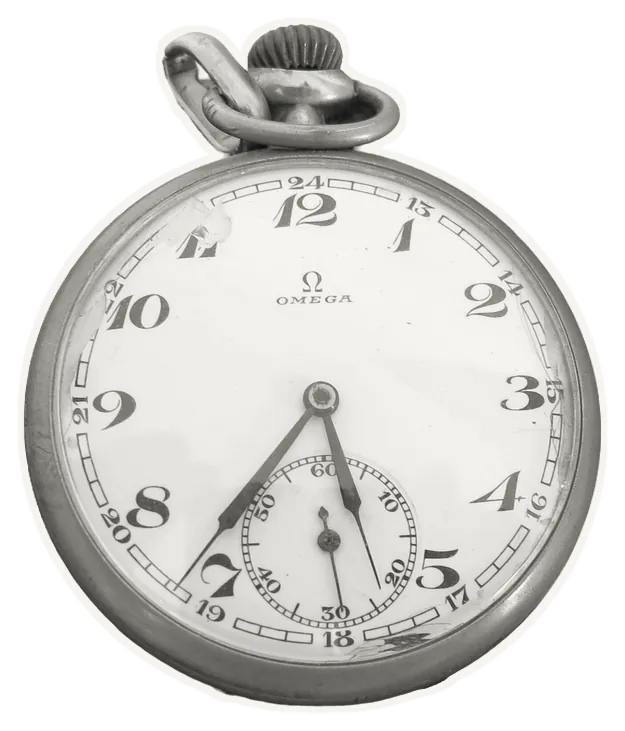
The explosion occurs a few seconds before 9:05 a.m., devastating the north end of Halifax.
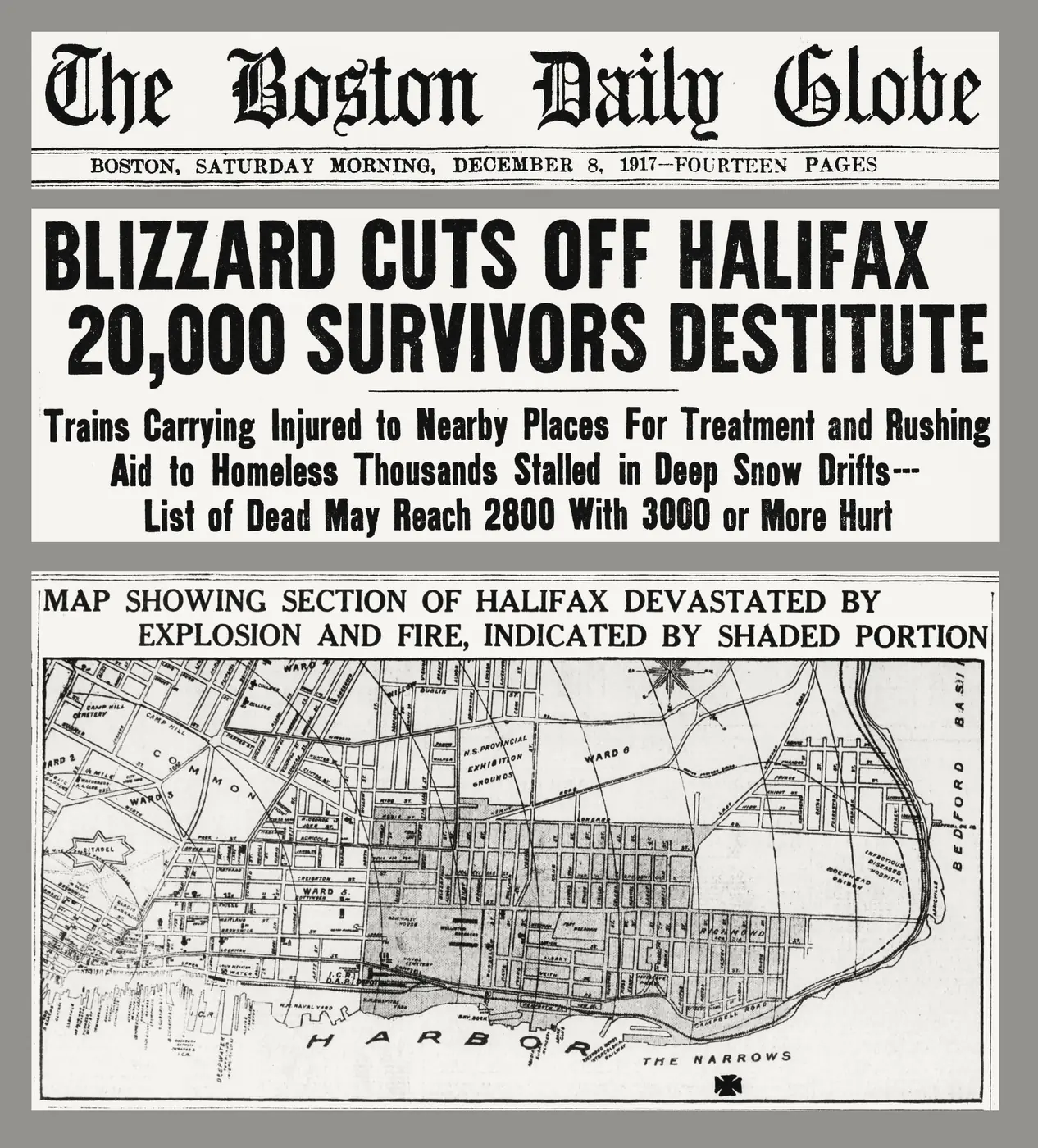
A federal Order-in-Council appoints the Halifax Relief Commission to oversee claims and reconstruction.
Judge Arthur Drysdale's inquiry finds Mont-Blanc solely at fault.
The Supreme Court of Canada holds both ships equally at fault; the Judicial Committee of the Privy Council upholds that verdict.
A researched reconstruction for learning. These reasoning steps simplify a complex record; no score can capture the full history.
02 · The evidence
What does the record show?
Read each exhibit before settling on an explanation. The source links below every exhibit lead to the record behind it.
Exhibits reviewed 0 of 5
Two ships, one channel
Imo was travelling south through the Narrows on the eastern, Dartmouth side, where outbound ships did not normally go. Mont-Blanc was inbound on the Dartmouth side as well. The record places both ships in one lane, but the summary does not settle the right-of-way question or the speed of either ship.
Source record s2thecanadianencyclopedia.ca
A cargo that changed the stakes
Mont-Blanc carried about 2,500 tons of high explosives and a deck load of monochlorobenzene, according to the Nova Scotia Archives. The archive links the blast to that cargo and describes damage across hundreds of acres. It does not, by itself, say whose navigation caused the collision.
Source record s1archives.novascotia.ca
No special protocol
The Canadian Encyclopedia reports that there was no special protocol for the passage of munitions ships in the harbour, and that other ships such as Imo were not ordered to hold their positions until Mont-Blanc passed. This establishes a gap in the rules. It does not show what either pilot decided in the seconds before impact.
Source record s2thecanadianencyclopedia.ca
A pilot's account and a judge's verdict
Judge Arthur Drysdale found Mont-Blanc solely at fault on 4 February 1918. Mont-Blanc's pilot, Francis Mackey, later maintained that Imo was moving at an unsafe speed. The charges against three men were ultimately dropped, and the appeal courts reassigned fault. A verdict is a formal judgment, but its reasoning was contested.
Source record s2thecanadianencyclopedia.ca
Models of the piloting rules
The Maritime Museum of the Atlantic holds models made for the Wreck Commissioner's Inquiry, used to re-enact the piloting rules and decisions at the heart of the explosion. A reconstruction of rules shows what was contested. It is not proof of what any pilot intended.
Source record s3maritimemuseum.novascotia.ca
03 · Your reasoning
Follow the strongest explanation.
Choose an interpretation, then compare it with the evidence. You can revise your choice. The goal is understanding, not a perfect score.
04 · The findings
The chain behind the outcome.
Your notebook
Case report
Next in history & systems: The parade and the closures
The collision was a navigation failure in a narrow, busy channel. Imo was on the wrong side of The Narrows, too far east, when it met the inbound Mont-Blanc. The sources agree on the positions and on the sequence of whistles and failed manoeuvres, then differ on blame. The 1918 inquiry placed the fault on Mont-Blanc. The appeal courts in 1919 found both ships equally at fault. That reversal matters: a single-cause story is harder to sustain once the traffic lanes are examined.
The scale of the destruction depended on a second condition. Mont-Blanc carried high explosives and a deck load of monochlorobenzene, and sparks from the collision ignited volatile material stored below. Ordinary traffic practice did not account for a munitions ship: no special protocol governed its passage, and other ships were not required to hold until it had passed.
Several claims remain interpretation. Right-of-way, speed and the sequence of commands are disputed, and the verdicts were reached amid intense public anger. The lasting conclusion is structural. Dangerous cargo in a narrow channel needs explicit lanes, holding procedures and communication rules, not only a competent pilot. The aftermath also shows the scale of consequences a harbour system must plan for: the Halifax Relief Commission was created to handle claims, rehousing and care.
Contributing causes and conditions
- Earlier passes that morning left Imo on the Dartmouth side, too far east for an outbound ship.
- Mont-Blanc was approaching inbound on the same Dartmouth side, and the two ships met head-on.
- A series of whistles and miscommunications, followed by failed manoeuvres, left no room to avoid impact.
- The collision ignited a deck load and cargo of high explosives and monochlorobenzene.
- No special protocol governed munitions ships, and other traffic was not ordered to hold.
OutcomeHalifax Explosion
Take the method with you
- A lane can be correct in general and still be wrong for the vessels actually present.
- A reversed verdict signals that the first reconstruction was incomplete, not that the whole investigation was worthless.
- Rules for a dangerous cargo must be written for that cargo, not assumed from general traffic rules.
You can read findings at any time. Exploring every reasoning step marks this case as complete in your notebook.
The open record
Sources & further reading
Read the original record and its scope before relying on a conclusion. Source references support the exhibit summaries; Faultory’s reasoning prompts are editorial reconstructions.
- s1Nova Scotia Archives - A Vision of Regeneration (Halifax Explosion exhibit)
archives.novascotia.ca
- s2The Canadian Encyclopedia - Halifax Explosion
www.thecanadianencyclopedia.ca
- s3Maritime Museum of the Atlantic - Explosion in The Narrows: The 1917 Halifax Harbour Explosion
maritimemuseum.novascotia.ca
Written and curated for Faultory by Yunus Emre Vurgun, with AI-assisted research and drafting. Sources and interpretations can need correction. Read our editorial standards or report an issue.
Keep investigating