After reading, you will be able to write conclusions in calibrated layers: what is established, what is probable and what is unresolved. The cases are the Tacoma Narrows collapse, the Endurance expedition's changing objective, the 1919 eclipse test of light bending and the early penicillin observation.
01A mechanism with contested details
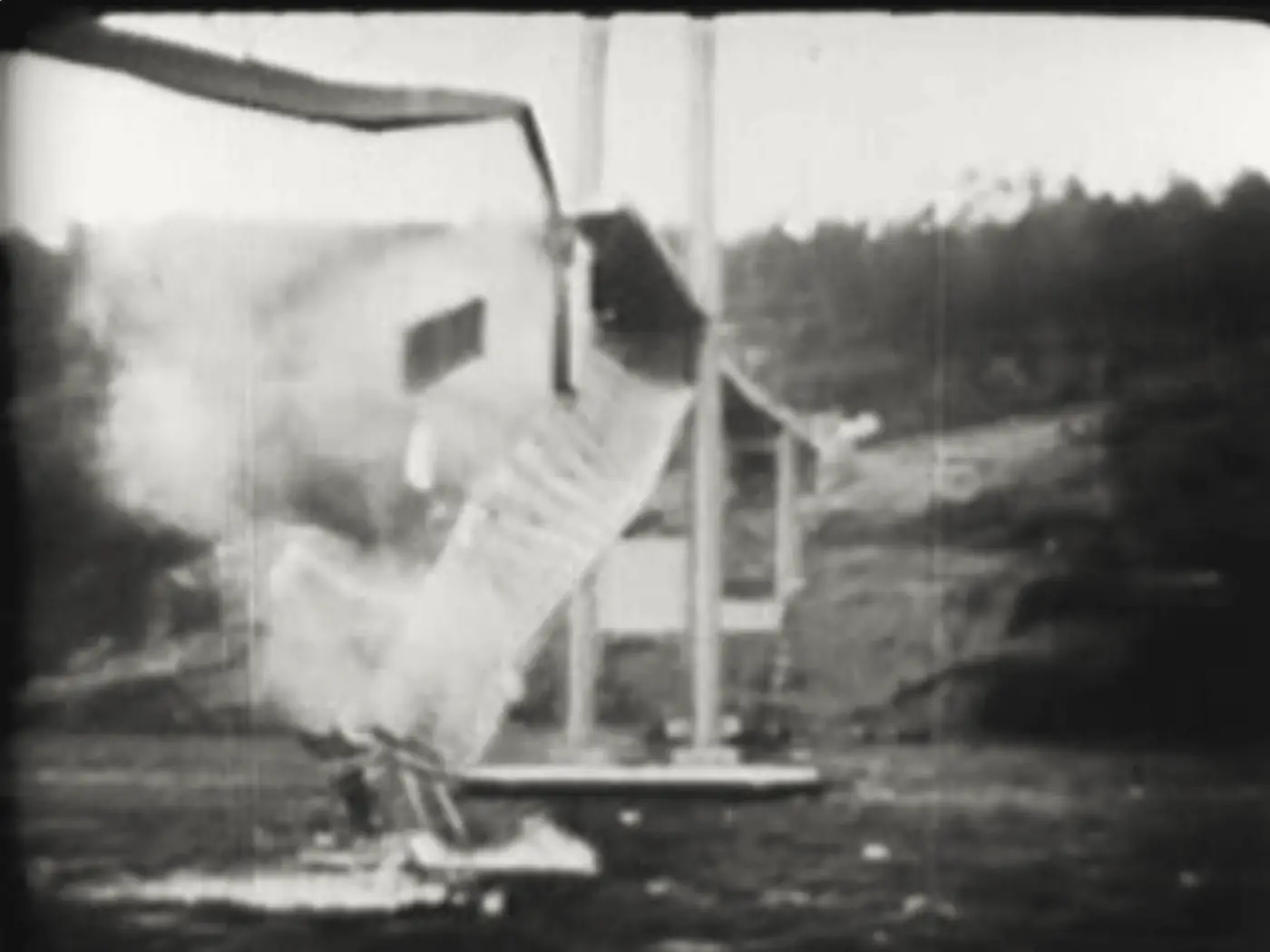
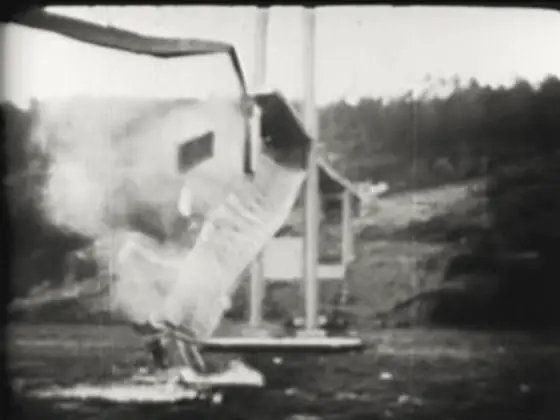
The Tacoma Narrows Bridge collapsed in November 1940 after its deck developed large twisting motions in the wind. The Washington State Department of Transportation's history of the bridge identifies torsional flutter as the principal explanation. Motion-dependent aerodynamic forces can reinforce the deck's oscillation, so the wind can feed the motion that the moving deck creates.
The same history is careful about what remains disputed. The precise sequence of the collapse, including the transition from vertical to torsional motion, is discussed with explicit disagreement, and so are the relative contributions of the structure and its aerodynamic shape. A well-supported mechanism does not require every detail to be closed.
This is the basic pattern of living with uncertainty. The central mechanism has strong support from the observed behavior and from the physics of coupled motion. The initiation sequence has weaker support. An honest statement separates the two, rather than presenting the whole account as one settled fact.
02An objective the ship could no longer serve
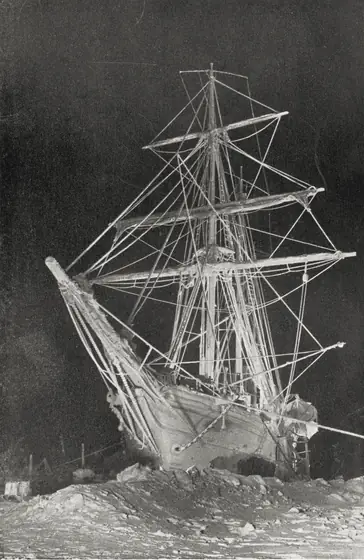
The Imperial Trans-Antarctic Expedition's Endurance, under Ernest Shackleton, was intended to cross Antarctica. Ice pressure damaged the ship beyond continued use, which ended the crossing as the organizing objective. The Royal Geographical Society's timeline records that the party moved onto the ice, that three boats were launched on 9 April 1916 for the voyage to Elephant Island, and that they landed there on 15 April. The island was uninhabited and far from regular shipping routes.
The later decisions appear in the record as a sequence of changing objectives. The timeline records Shackleton's decision on 24 April 1916 to sail the James Caird back toward South Georgia, where a whaling station could provide help. Six men sailed in that boat. The timeline also records that the 28 men of the party were returned alive.
The sources record decisions and their timing. They do not reproduce every private consideration aboard, and historians should not reconstruct conversations or motives the sources do not record. What the sources support is the logic of a changing objective: once the ship was lost, the constraints shifted to shelter, supplies and a route to help, and the plan changed to match them.
03Light bent by the Sun, measured once
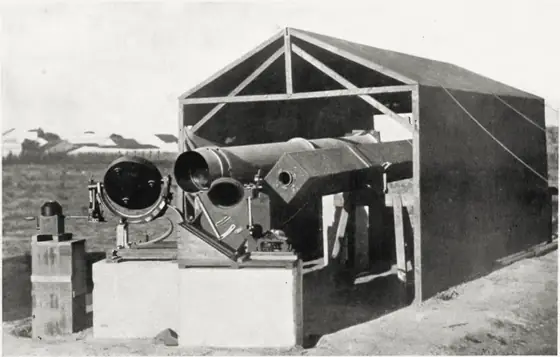
The total solar eclipse of 29 May 1919 gave astronomers a chance to test whether the Sun's gravity bends starlight. The paper by Dyson, Eddington and Davidson, published in 1920 in the Philosophical Transactions of the Royal Society, reports observations made at that eclipse, and its title names the subject: the deflection of light by the Sun's gravitational field.
A single eclipse yields a limited set of measurements, each made under difficult conditions, and the value of the deflection depends on how those measurements are reduced and corrected. The uncertainty is therefore part of the result, not decoration. A result that agrees with a prediction within its uncertainties is a different claim from one that confirms the prediction exactly.
The status of such a result depends on its uncertainty and on whether other observations, made under other conditions, reach the same conclusion. The honest way to read the paper is with its own error estimates in view, and alongside the later work that tested the same effect.
04An observation that is not yet a usable product
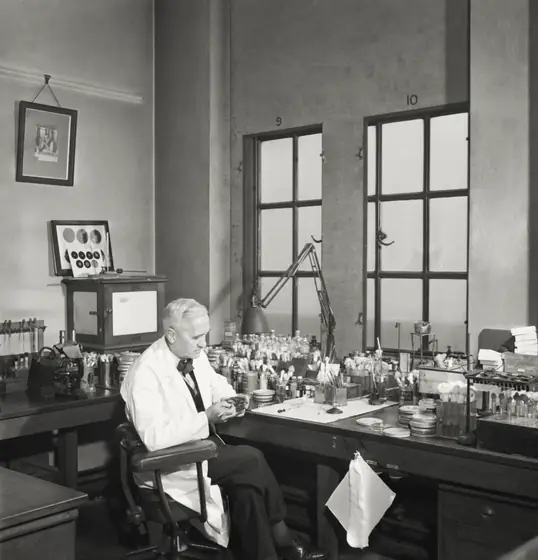
In 1928 Alexander Fleming noticed that a mold growing on a culture plate inhibited bacteria nearby. The observation was real, but a substance that clears a plate is not yet a medicine. The University of Oxford's account of the discovery of penicillin emphasizes that later work depended on a reliable way to measure activity.
N. G. Heatley's contribution was an assay: a cylinder-plate diffusion technique that gave a reliable and sensitive measure of penicillin activity, and was later adopted as the standard for antibiotic activity. Without a dependable measure, comparisons between preparations were unreliable, and uncertainty about a preparation's strength made each biological test harder to interpret.
The honest status of such a discovery lies between the extremes. The inhibition could be observed in the laboratory. Whether a usable preparation would be safe and effective in patients, and in what dose, was a separate question that needed separate tests. Partial resolution is common in the history of medicine, and the right description names what has been shown and what has not.
05Writing a conclusion in layers
A conclusion with calibrated language separates three layers: what is established by several independent lines of evidence, what is probable on the best current evidence, and what is still open. Each layer needs different words. Established results can be stated plainly. Probable ones can be described as the best-supported explanation. Open questions should be named as open, together with the evidence that would close them.
Words of limitation are precise tools. Consistent with means the evidence does not contradict the explanation; it does not mean the explanation has been demonstrated. Not excluded means a rival has not been ruled out. Established should be reserved for claims that have survived independent tests.
Writers are often tempted to flatten the layers into one confident sentence. Readers then cannot tell which part of the claim would fall if a new measurement arrived. A good account lets the reader see where it could be wrong.
06Acting while the picture is incomplete
Uncertainty does not stop decisions. Expeditions choose routes before the ice has revealed its full pattern, and engineers design structures before every aerodynamic question is answered. The discipline is to act on the best-supported explanation, keep the rivals visible, and set in advance the point at which new evidence will revise the plan.
The Endurance sources show that revision is not failure. The objective changed when the circumstances changed, and the record documents decisions shaped by shelter, supplies and the route to help. A plan that cannot change becomes a risk of its own.
Tacoma makes a parallel point from the engineering side. A mechanism with strong support should lead to tests of the coupled behavior of wind and structure, not to a fixed rule that treats the wind as an independent force.
Revisiting a conclusion should be routine. When a later measurement disagrees, the honest response is to say which part of the earlier account it touches and how far the revision reaches, rather than defending the whole account or abandoning it entirely.
Terms in this note
- Flutter
- A self-sustaining oscillation in which motion changes the aerodynamic forces that feed it, so that a structure can draw energy from the wind. Glossary
- Calibrated language
- Wording whose strength matches the evidence, distinguishing what is established, what is probable and what is still open. Glossary
- Assay
- A test that measures how much active substance a preparation contains, which is needed before preparations can be compared or dosed. Glossary
Test the idea
The case files behind this note

The open record
Sources & further reading
- 1Lessons from failure: the Tacoma Narrows Bridge
Washington State Department of Transportation
- 2Endurance expedition timeline and historical overview
Royal Geographical Society
- 3Sir Ernest Shackleton
Royal Museums Greenwich
- 4The discovery of penicillin
University of Oxford, Dunn School of Pathology
- 5
Written for Faultory by Yunus Emre Vurgun, with AI-assisted research and drafting. Editorial standards · Report an issue.