After reading, you will be able to reconstruct the documented history of an object or record, check whether independent methods could disagree with a claim, and ask what physical trace the claim would leave if it were true. The cases show a hidden component history, two lines of evidence that met, and a signal confirmed at two sites.
01A component with a history
Provenance is the documented history of an object or dataset: where it came from, who handled it, what was done to it, and what it experienced afterward. A gap in that history passes its uncertainty to every later conclusion, which is why careful investigators begin by asking for the record.
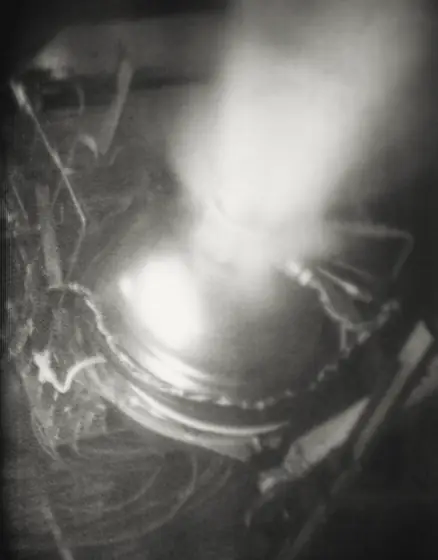
The Apollo 13 oxygen tank shows how a history can hide inside a procedure that seemed to work. On 14 April 1970, about 56 hours into the mission, the tank in the service module failed. The investigation traced the failure back through the tank's ground history. That history included a long heating operation to empty the tank before flight, and a mismatch between a ground power supply and the tank's protective thermostatic switches. Those ground events were the component's hidden history.
A passing test does not prove much about a component whose history includes an undocumented workaround. The test checks the condition it was designed for, not every condition the component has met.
02Two lines of evidence that could disagree
The end-Cretaceous boundary offers a case where independent lines of evidence met. A thin sediment layer contains unusual amounts of iridium, and a 1980 proposal linked that chemistry to an extraterrestrial impact. A chemical signal does not identify its source, however. The question was whether the physical record would show the processes an impact leaves behind.
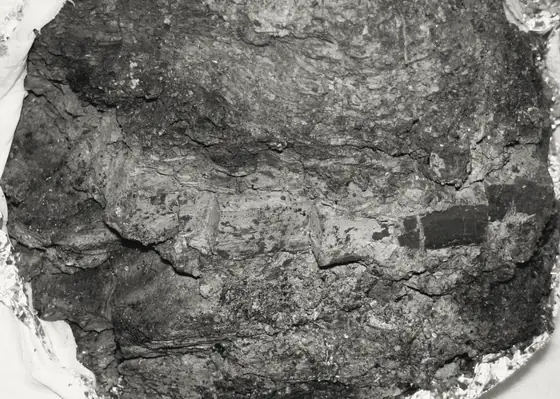
It did. The Lunar and Planetary Institute's account of a thick deposit on the southern peninsula of Hispaniola says that it was dominated by impact melt spherules and contained an unusually large amount of shocked quartz, both of which indicate ejection from an impact crater. The buried Chicxulub structure in Mexico had earlier been interpreted as volcanic, so its outline alone could not settle the question. Shocked minerals and impact melt in reexamined samples supplied process evidence that a circular outline could not.
The chemistry at the boundary and the process minerals at the structure came from different kinds of material. They are strong together because each could have failed on its own.
Independence also applies to the samples. Material from different sites, measured by different groups, makes it less likely that one contamination or one procedure produced both results. Agreement between such samples is more informative than agreement between two readings taken from the same specimen.
03Two detectors, one signal
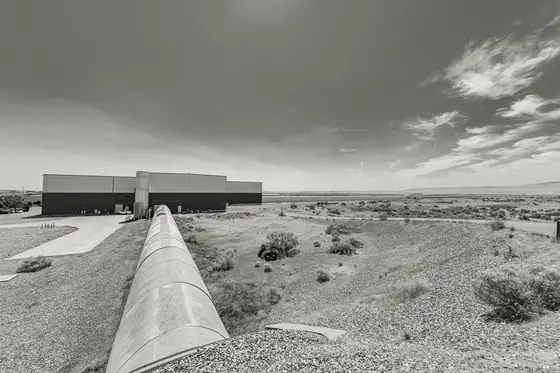
A physical event becomes more trustworthy when it is recorded by instruments that do not share the same vulnerabilities. On 14 September 2015 the two LIGO detectors, at Livingston in Louisiana and at Hanford in Washington, both registered a brief signal. The sites are far apart, so a local disturbance is unlikely to produce the same pattern at both.
Agreement alone is not enough. The collaboration also investigated whether environmental or instrumental disturbances could produce a similar signal, and it reported finding no such cause. The waveform rose in frequency from about 35 to 250 hertz, consistent with a modeled merger of two black holes, each about 30 times the mass of the Sun and about 1.3 billion light-years away. A signal that matches a prediction and survives an attempt to explain it away has passed two different tests.
For provenance, the lesson is that a result is also a chain of custody for data: where it was recorded, how it was calibrated, and what was done to rule out a common cause.
04Traces must fit the story
A forgery or a mistaken attribution usually leaves traces that disagree with the story it tells. Material may be too young or too old for the claimed date. Tool marks may not match the claimed method. Wear may show handling that the history never mentions. The test is not whether a story sounds plausible, but whether the physical record would look like this if the story were true.
Scientists apply the same logic. A hypothesis that explains an anomaly must predict something that can be checked elsewhere: a different detector, a different mineral or a different date. A story that cannot be checked is a candidate, not a result.
Independent dating is one of the strongest forms of this test. Two dating methods that rely on different physical processes, and that agree, are harder to misread or to fake than a single date supported only by a story. The agreement matters most when the methods share no calibration and no assumption that could carry an error from one to the other.
05Piltdown: a fossil that failed its tests
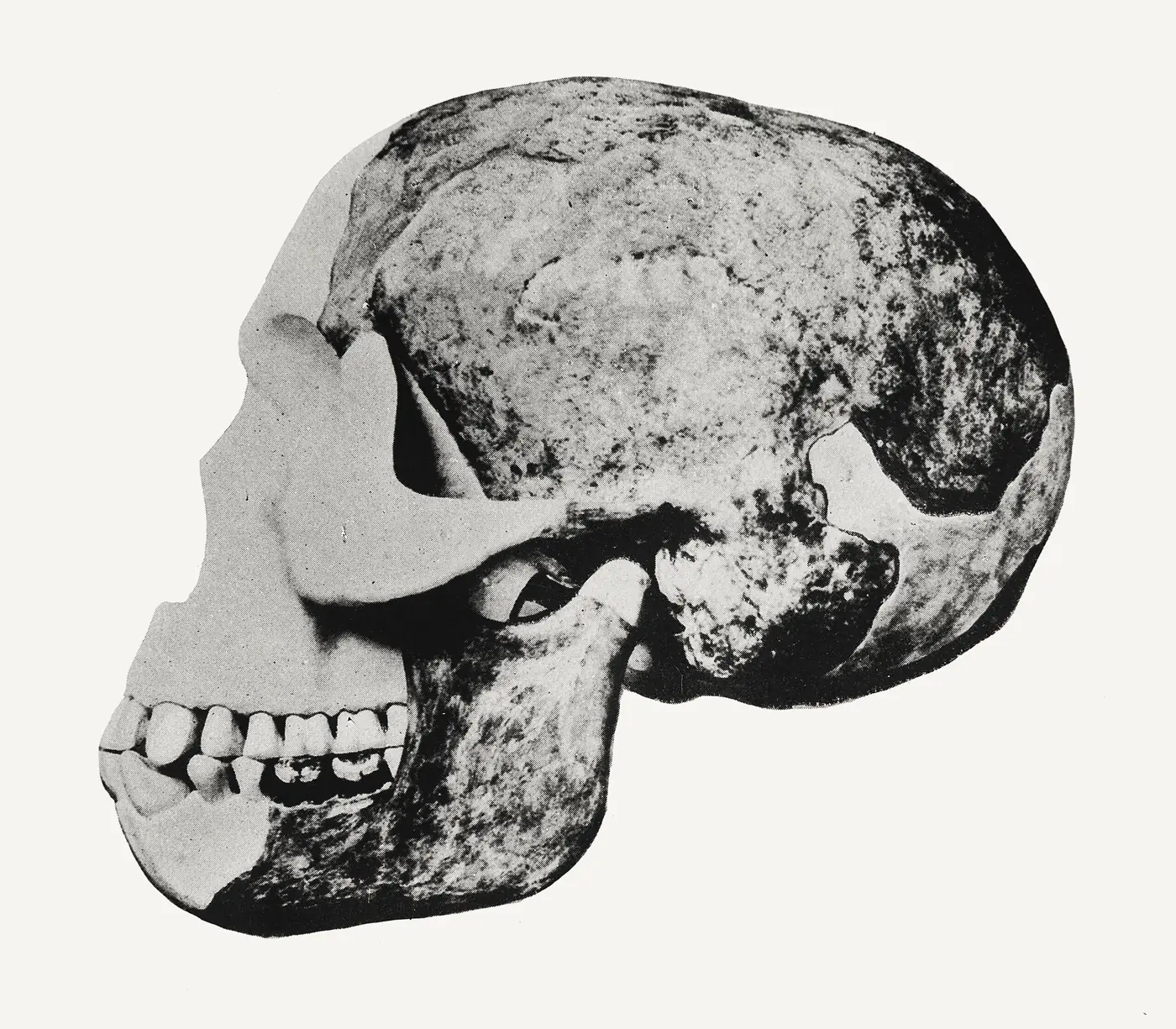
The Piltdown remains, announced in 1912 as an early human ancestor, show what happens when an object's history is taken on trust. The skull and jaw fragments reached the Natural History Museum through one finder, Charles Dawson, and for four decades the specimen was argued over as anatomy rather than tested as material.
The material tests came later. Kenneth Oakley's fluorine measurements in the late 1940s indicated that the bones were probably less than 50,000 years old, far too young for their ape-like features. In 1953, Joseph Weiner, Wilfrid Le Gros Clark and Oakley showed that the skull and jaw came from two species, a human and an ape, and that the teeth had been filed to look human. The surfaces had been stained and packed with gravel to match the site.
Each test asked whether a physical trace fitted the story, and none did. A 2016 study by De Groote and colleagues found the same staining, gravel loading and filling materials across the Piltdown finds and linked the fakes to Dawson, while stating that whether he acted alone remains uncertain. Material evidence can establish that an object is false more firmly than it can establish who made it.
06Guarding against a single striking observation
A single unusual observation can come from contamination, interference or a common-mode fault, in which a shared weakness makes two apparently separate checks fail together. The first question is what else would have to be true if the observation were genuine. The second is whether the checks share a clock, a calibration or a design assumption.
Agreement between methods is only as informative as their independence. Two instruments that depend on the same timing chain, or two tests that depend on the same procedure, can agree for the same wrong reason. Independent evidence has to differ in the assumptions it makes, not merely in the name of the instrument.
07Writing the chain down
A provenance record is useful only if it is written at the time, not reconstructed later from memory. Each handling step should note the date, the person or process, the conditions and any departure from the standard procedure. A workaround should be recorded as a change to the item's history, not as an invisible shortcut.
The Apollo 13 case shows the cost of an undocumented workaround. The procedure achieved its immediate purpose while changing the tank in a way that was outside its qualification. Investigators then had to reconstruct what the record had not captured, which is slower and less certain than writing it down at the time.
For any claim you evaluate, keep three lists: what is documented, what is inferred, and what would count against the claim. If the third list is empty, the claim has not yet been tested.
Provenance also includes the conditions under which a record was kept. A logbook written during an event, a dataset with its calibration history and a specimen with its storage record are each stronger than a later summary. Ask when each record was made, by whom, and whether the people who made it had a reason to shape it.
Terms in this note
- Provenance
- The documented history of an object, record or dataset, from its origin through every handling and processing step. Glossary
- Shocked quartz
- Quartz whose internal structure has been altered by the intense, brief pressure of a high-energy impact, one of the physical marks of an impact. Glossary
- Common-mode fault
- A shared weakness that makes two apparently separate checks fail together, so their agreement is less informative than it looks. Glossary
Test the idea
The case files behind this note

The open record
Sources & further reading
- 1Apollo 13 mission summary and investigation (NASA SP-4029)
NASA History Office
- 2Chicxulub discovery evidence
Lunar and Planetary Institute
- 3GW150914: the first detection of gravitational waves
LIGO Scientific Collaboration
- 4GW150914 public record of the discovery publication
LIGO Document Control Center
- 5New genetic and morphological evidence suggests a single hoaxer created 'Piltdown man'
Royal Society Open Science (De Groote and colleagues, 2016), via PubMed Central
- 6Natural History Museum (archived 2013) — Piltdown hoax revealed
Natural History Museum, London (archived copy)
Written for Faultory by Yunus Emre Vurgun, with AI-assisted research and drafting. Editorial standards · Report an issue.