Your browser cannot save progress right now. You can still investigate; keep this tab open or enable local storage to save.
This case has been updated. Compatible choices are kept; revisit the evidence before drawing your conclusion.
01 · The briefing
Begin with the question.
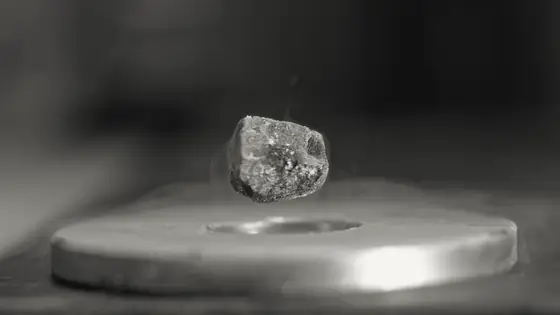
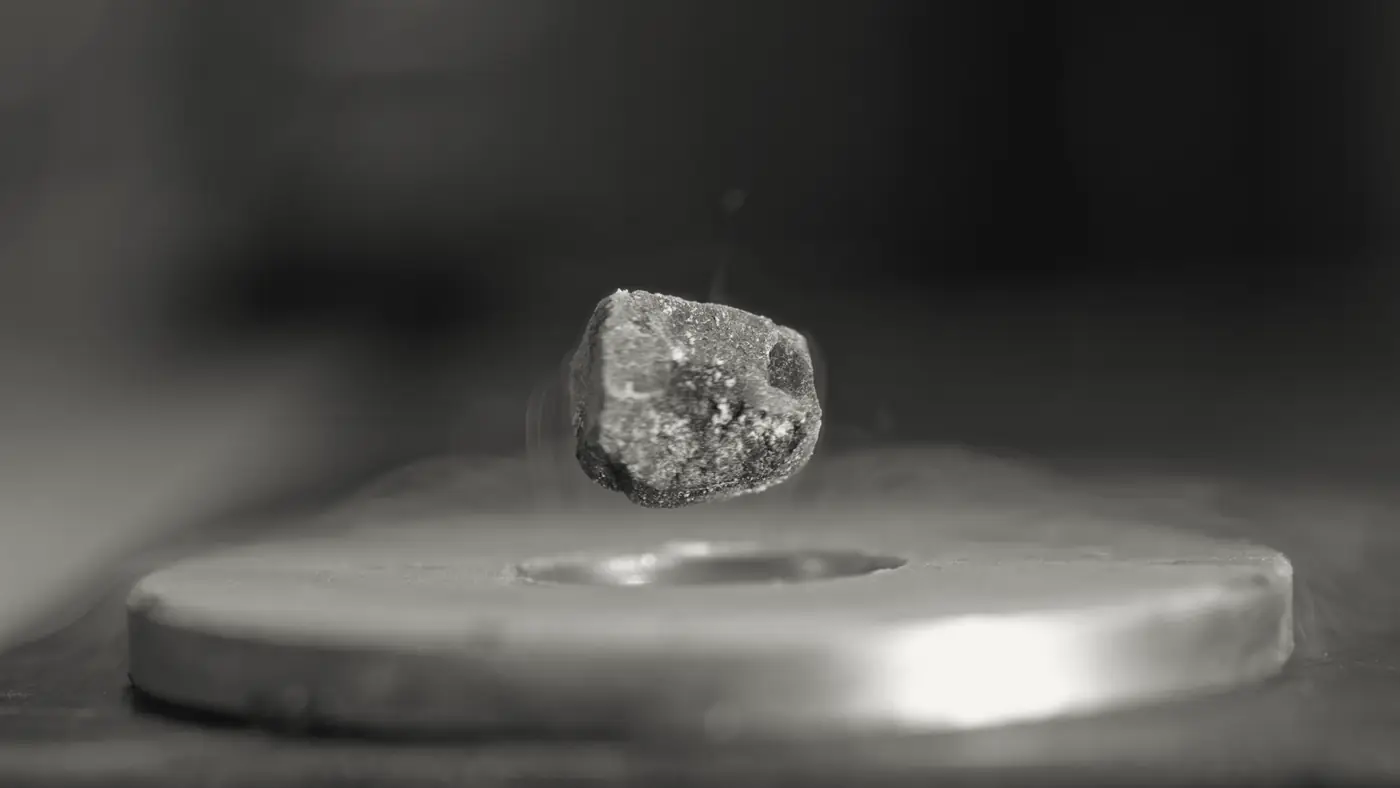
On 22 July 2023, Sukbae Lee and colleagues posted two preprints to arXiv claiming that a material called LK-99 was a superconductor at room temperature and ordinary atmospheric pressure. The compound is a copper-doped lead apatite, written Pb10-xCux(PO4)6O, and it was made by a solid-state method. A superconductor carries current with no electrical resistance and, in its strongest form, pushes magnetic fields out of its interior, which is the Meissner effect. A confirmed material of that kind would be a major discovery, so the claim spread fast through social media, with live replication attempts and images of small flakes that seemed to float.
Two readings competed. Supporters pointed to the levitation and to a drop in electrical resistance. Sceptics suggested that a magnet can hold a magnetic flake at an angle, and that an impurity can make a material look like a superconductor without being one. This investigation separates three things: what the preprints claimed, what the replication studies measured, and which explanation those measurements support. The question is not only whether LK-99 is a superconductor, but why it looked like one, and which test would have settled the matter.
The timeline
Two arXiv preprints by Lee and colleagues claim room-temperature, ambient-pressure superconductivity for LK-99.
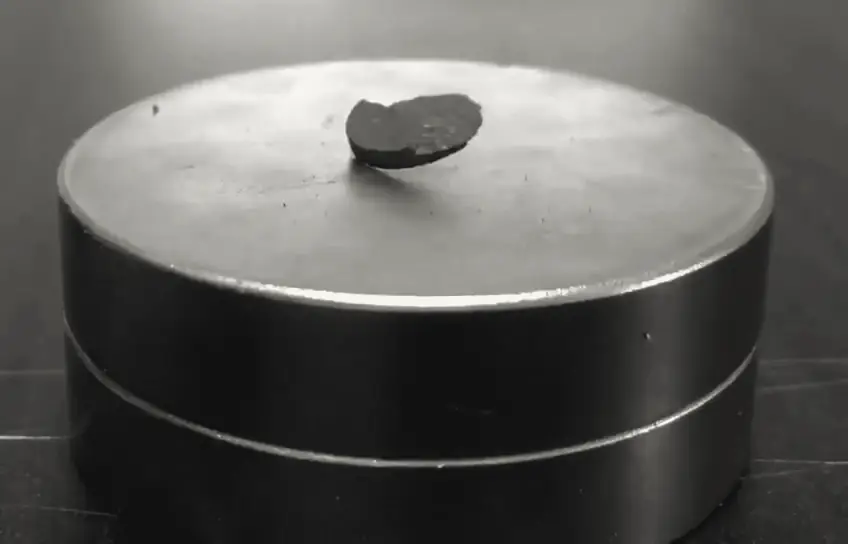
Guo, Li and Jia report that small flakes of LK-99-like samples half-levitate over a Nd2Fe14B magnet, without a Meissner effect or zero resistance.
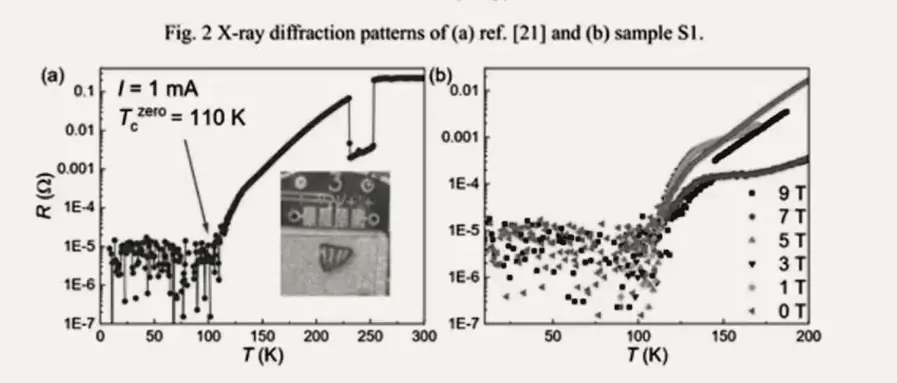
Zhu and colleagues report a sharp drop in resistance in samples containing copper sulfide, linked to a structural transition, with no zero resistivity.
Jain reports a copper(I) sulfide phase transition at 104 °C and argues that a valid test requires LK-99 made without copper sulfide.
Nature news reports that replication efforts had pieced together why LK-99 looked superconducting.
A researched reconstruction for learning. These reasoning steps simplify a complex record; no score can capture the full history.
02 · The evidence
What does the record show?
Read each exhibit before settling on an explanation. The source links below every exhibit lead to the record behind it.
Exhibits reviewed 0 of 5
The claim as posted
The preprint abstract describes a modified lead apatite, Pb10-xCux(PO4)6O with x between 0.9 and 1.1, made by solid-state synthesis. The authors describe the material as an ohmic metal above its claimed critical temperature and interpret levitation as the Meissner effect at room temperature and atmospheric pressure. This establishes what was claimed and how the authors read their own observations. It does not establish superconductivity, because it reports the authors' interpretation and was posted before peer review.
Source record s1arxiv.org
A magnetic explanation for the flake
Guo, Li and Jia made LK-99-like ceramic samples by solid-state sintering. Powder X-ray diffraction showed the main phases were the lead apatite and copper(I) sulfide. In some small flakes they observed half levitation above an Nd2Fe14B magnet. They attribute it to soft ferromagnetism combined with the flake's shape, and state that their measurements show no Meissner effect and no zero resistance. This supports a magnetic explanation for the floating flake that does not need superconductivity. It does not rule out other behaviour in samples that were not tested.
Source record s2arxiv.org
A resistance drop tied to copper sulfide
Zhu, Wu, Li and Luo measured the transport and magnetic properties of pure Cu2S and of LK-99 samples containing it. They report a sharp, superconducting-like transition with thermal hysteresis, but no zero resistivity. They argue that the drop is most likely a reduction in resistivity caused by a first-order structural phase transition of Cu2S at around 385 K. Measuring pure Cu2S strengthens the link. The authors present this as their argument, and the exact mechanism in every sample is not settled by this paper alone.
Source record s3arxiv.org
A test that removes the impurity
Jain's preprint states that copper(I) sulfide has a known phase transition at 104 °C, from an ordered low-temperature phase to a high-temperature superionic phase. It argues that the polycrystalline LK-99 samples contain a significant fraction of copper sulfide, so the apparent superconductivity may be linked to that transition. It concludes that LK-99 must be synthesised without any copper sulfide before its superconducting properties can be validated. This gives a clear test design. Its 104 °C figure differs from the 385 K given by Zhu and colleagues, and the sources do not resolve that gap.
Source record s4arxiv.org
The news verdict and what could be read
Nature's news report of 16 August 2023 describes replication efforts as having pieced together why LK-99 displayed superconducting-like behaviour. Its reference list cites the preprints discussed here. This establishes that a major science news outlet treated the replication results as settling the question. This case uses only the article's standfirst and reference list, not its detailed argument.
Source record s5nature.com
03 · Your reasoning
Follow the strongest explanation.
Choose an interpretation, then compare it with the evidence. You can revise your choice. The goal is understanding, not a perfect score.
04 · The findings
The chain behind the outcome.
Your notebook
Case report
Next in science & discovery: The signal that might have been a cloud
The best-supported conclusion is that LK-99 was not shown to be a superconductor. Replication studies within weeks offered two effects that could account for the headline observations without superconductivity. The first is magnetic. Guo, Li and Jia observed half levitation in small flakes over a magnet, attributed it to soft ferromagnetism combined with shape, and reported no Meissner effect and no zero resistance. The second is a copper sulfide transition. Zhu and colleagues argue that the sharp drop in resistance is most likely due to Cu2S, which has a known structural change, and Jain makes the same link. The two sources give different temperatures, about 385 K in one and 104 °C in the other, and these were not reconciled in the cited sources. Nature's news report of 16 August 2023 described replication efforts as having pieced together why the material looked superconducting. The lesson is that a claim can be partly right about a measurement and wrong about its cause, and that the decisive test removes the suspected impurity.
Contributing causes and conditions
- A solid-state synthesis that left copper(I) sulfide as a significant impurity
- A structural phase transition in Cu2S that lowers electrical resistivity near 104 °C or 385 K
- Thermal hysteresis that makes the drop look like a sharp superconducting transition
- Small flakes whose shape and soft ferromagnetism let a magnet hold them partly up
- Preprints circulated before peer review, so early measurements spread faster than controlled tests
- Replications that found no zero resistance and no Meissner expulsion in the samples they tested
OutcomeLK-99 superconductor claim (2023)
Take the method with you
- Separate what was observed from what was interpreted, and check which of the two a headline result actually establishes.
- Look for the test that removes the suspected confound, not a repeat of the same measurement under the same conditions.
- Before treating agreement or disagreement between replications as decisive, check whether they used the same material and measurements.
You can read findings at any time. Exploring every reasoning step marks this case as complete in your notebook.
The open record
Sources & further reading
Read the original record and its scope before relying on a conclusion. Source references support the exhibit summaries; Faultory’s reasoning prompts are editorial reconstructions.
- s1
- s2
- s3
- s4
- s5
Written and curated for Faultory by Yunus Emre Vurgun, with AI-assisted research and drafting. Sources and interpretations can need correction. Read our editorial standards or report an issue.
From the journal
Field notes that use this case
Keep investigating