Your browser cannot save progress right now. You can still investigate; keep this tab open or enable local storage to save.
This case has been updated. Compatible choices are kept; revisit the evidence before drawing your conclusion.
01 · The briefing
Begin with the question.
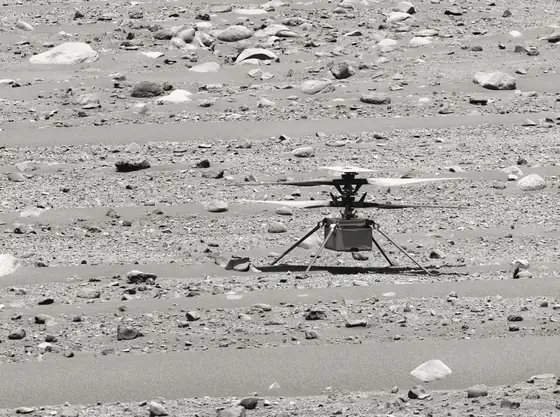
Ingenuity was a technology demonstration built to make up to five experimental flights over 30 days. It flew from the Martian surface for almost three years and made 72 flights. Flight 72, on 18 January 2024, was planned as a short vertical hop to check the helicopter's systems and photograph the area. It climbed to 40 feet (12 meters) and hovered as planned. Within about 30 seconds it was back on the ground, communications had stopped, and images taken days later showed its rotor blades were damaged. Two broad kinds of explanation fit the early evidence. One starts with the rotor, a mechanical failure that brought the helicopter down. The other starts with the landing conditions, such as the ground or the sensors that guided the flight. There was no crew, no recovered recorder and no eyewitness, only the data the helicopter sent before it went quiet and the images taken afterward. Flight data and post-flight images are the main evidence, so this investigation asks what they can support, what they cannot, and how the investigators separated the most likely sequence from the alternatives.

The timeline
Ingenuity makes the first powered, controlled flight by an aircraft on another planet.
During Flight 70, the helicopter photographs sand ripples. A NASA caption later says this smooth, relatively featureless terrain proved difficult for the navigation system to track during Flight 72.
Flight 72 climbs to 40 feet, hovers and starts its descent. Communications are lost near the ground and the helicopter lands roughly.
Communications with the helicopter are reestablished, and the team learns more about the flight.
NASA announces the end of the mission after imagery shows that one or more rotor blades were damaged.
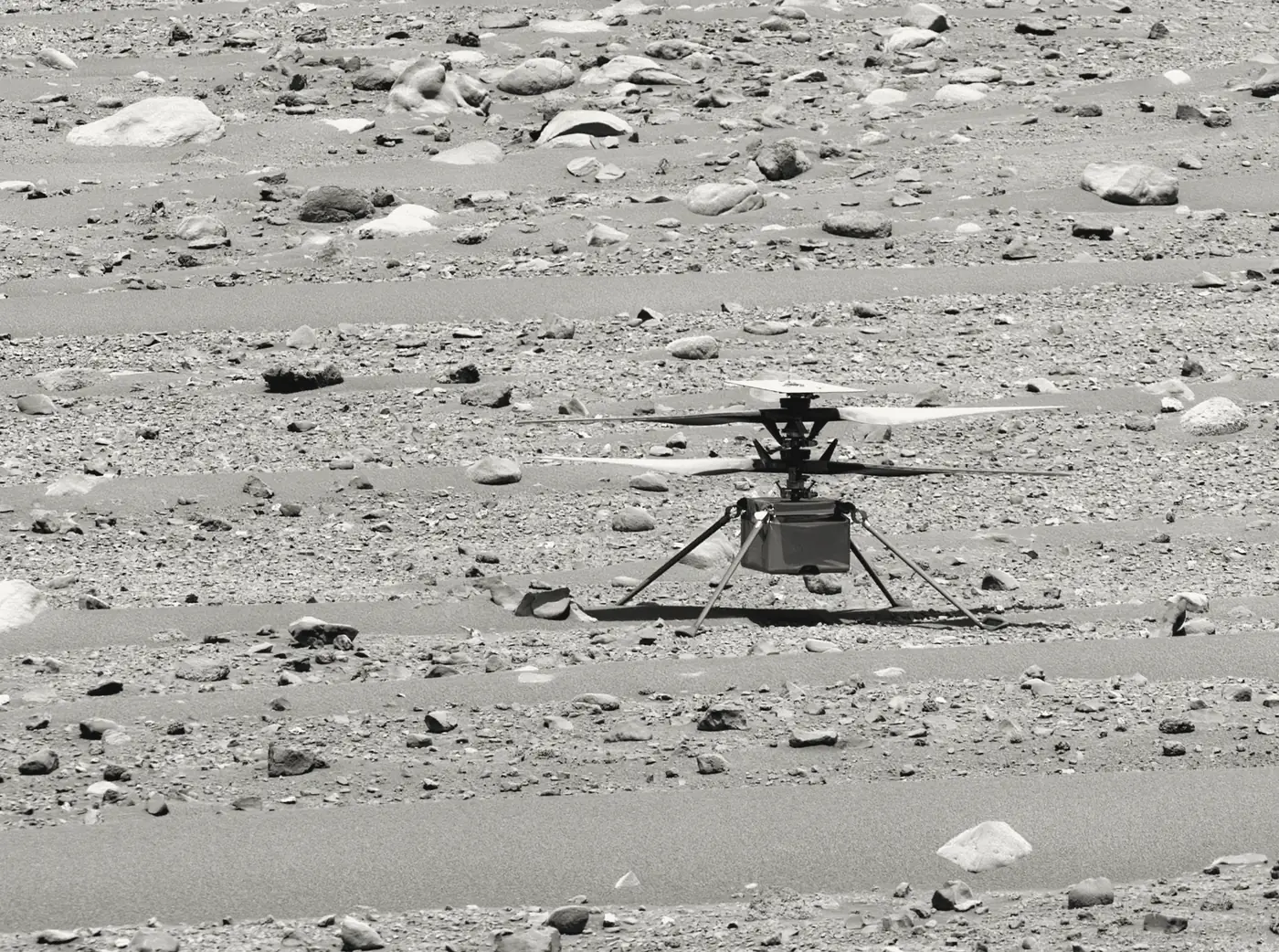
Perseverance images Ingenuity at its final airfield, which the team calls Valinor Hills.
JPL publishes the findings of the first aircraft accident investigation on another world, which names a navigation-led chain as the most likely scenario.
A researched reconstruction for learning. These reasoning steps simplify a complex record; no score can capture the full history.
02 · The evidence
What does the record show?
Read each exhibit before settling on an explanation. The source links below every exhibit lead to the record behind it.
Exhibits reviewed 0 of 5
A short hop with a planned descent
NASA's January 2024 release says Flight 72 was planned as a short vertical hop to assess the helicopter and photograph the area. The data show the helicopter climbing to 40 feet (12 meters), hovering for 4.5 seconds and then starting its descent at about 1 meter per second. About 1 meter above the surface it lost contact with the rover that relayed its signals. Imagery later showed damage to the rotor blades, and the release says the cause of the communications dropout and the helicopter's orientation at touchdown were still under investigation. The source establishes the planned profile and the loss of contact near the ground.
Source record s2jpl.nasa.gov
Navigation over featureless sand
The December 2024 JPL release says the navigation system tracked visual features on the ground with a downward-looking camera. That worked over pebbly, relatively flat terrain, which was enough for the first five flights. By Flight 72 the helicopter was in a region of Jezero Crater filled with steep, relatively featureless sand ripples. Data sent down during the flight show that about 20 seconds after takeoff the navigation system could not find enough surface features to track. The sources show where the helicopter was and what its navigation could see. They do not measure how much the ripples affected the estimate.
Source record s1nasa.gov
The most likely chain of events
The December 2024 release says that navigation errors created high horizontal velocities at touchdown, a conclusion drawn from photographs taken after the flight. In the most likely scenario, the hard impact on a ripple's slope pitched and rolled the helicopter. The rapid change in attitude loaded the fast-spinning rotor blades beyond their design limits, and all four snapped about a third of the way from the tip. The damaged blades then caused excessive vibration, tore one blade from its root and created an excessive power demand that ended communications. The release presents this as the most likely scenario, not a proven one.
Source record s1nasa.gov
Debris and the final airfield
NASA's Perseverance release of 6 February 2024 says the rover imaged Ingenuity at its final airfield on 4 February, after the rotor blades were damaged during landing on Flight 72. The December 2024 release uses a Perseverance image, taken about five weeks after the final flight, which shows part of one rotor blade lying about 49 feet (15 meters) west of the helicopter. The image shows where debris came to rest. It does not show the moment of impact, and the position of one blade does not by itself establish the order in which the blades broke.
Source record s3science.nasa.gov
What the investigators did not have
The December 2024 release quotes Ingenuity's first pilot, Håvard Grip of JPL, who says that the team had no black boxes or eyewitnesses. It also says that multiple scenarios are viable with the available data and that the navigation chain is the one the team believes most likely. The release says a detailed assessment would be published as a NASA technical report within weeks. The source sets the limits of the evidence: remote telemetry and post-flight images. It does not contain that report, which this case does not rely on.
Source record s1nasa.gov
03 · Your reasoning
Follow the strongest explanation.
Choose an interpretation, then compare it with the evidence. You can revise your choice. The goal is understanding, not a perfect score.
04 · The findings
The chain behind the outcome.
Your notebook
Case report
Next in engineering & technology: The wind that came from the corner
Ingenuity was built to test flight on Mars, and it exceeded that goal, making 72 flights in almost three years. Its final flight on 18 January 2024 was a short vertical hop meant to check its systems and photograph the area. The helicopter reached the planned 40 feet, hovered and began its descent, but about 20 seconds after takeoff its navigation could not find enough features to track. The ground there was covered with steep, relatively featureless sand ripples, and the investigation concluded that the resulting navigation errors most likely left the helicopter moving too fast sideways at touchdown. In NASA's most likely scenario, the hard impact on a ripple's slope pitched and rolled the helicopter, and the fast-spinning blades were loaded beyond their limits and broke. The damage caused vibration and a power demand that ended communications. Two points are firm: the mission ended after Flight 72, and the navigation design depended on surface texture that these ripples did not provide. Less firm are the touchdown speed and the exact order in which the blades broke, which the investigators reconstructed from telemetry and images. NASA says the findings are expected to help future Mars helicopters and other aircraft on other worlds.
Contributing causes and conditions
- The navigation system tracked visual features on the ground, and it needed enough surface texture to estimate velocity.
- Flight 72 took place over steep, relatively featureless sand ripples, where tracking failed about 20 seconds after takeoff.
- Navigation errors left the helicopter with high horizontal velocity at touchdown.
- The hard impact on a ripple's slope pitched and rolled the helicopter, loading the fast-spinning blades beyond their design limits.
- The broken blades caused excessive vibration and a power demand that ended communications.
OutcomeIngenuity Mars helicopter final flight (2024)
Take the method with you
- Test a system where it will actually operate, including the conditions that break its assumptions, not only the conditions it was designed for.
- A most likely explanation can guide action, but it should be labeled as probable when alternatives cannot be excluded.
- The order of events matters: a fault that appears before touchdown is a different problem from damage caused by the impact.
You can read findings at any time. Exploring every reasoning step marks this case as complete in your notebook.
The open record
Sources & further reading
Read the original record and its scope before relying on a conclusion. Source references support the exhibit summaries; Faultory’s reasoning prompts are editorial reconstructions.
- s1
- s2
- s3
Written and curated for Faultory by Yunus Emre Vurgun, with AI-assisted research and drafting. Sources and interpretations can need correction. Read our editorial standards or report an issue.
Keep investigating