Your browser cannot save progress right now. You can still investigate; keep this tab open or enable local storage to save.
This case has been updated. Compatible choices are kept; revisit the evidence before drawing your conclusion.
01 · The briefing
Begin with the question.
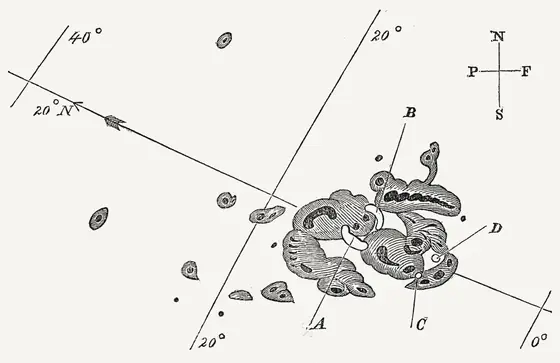
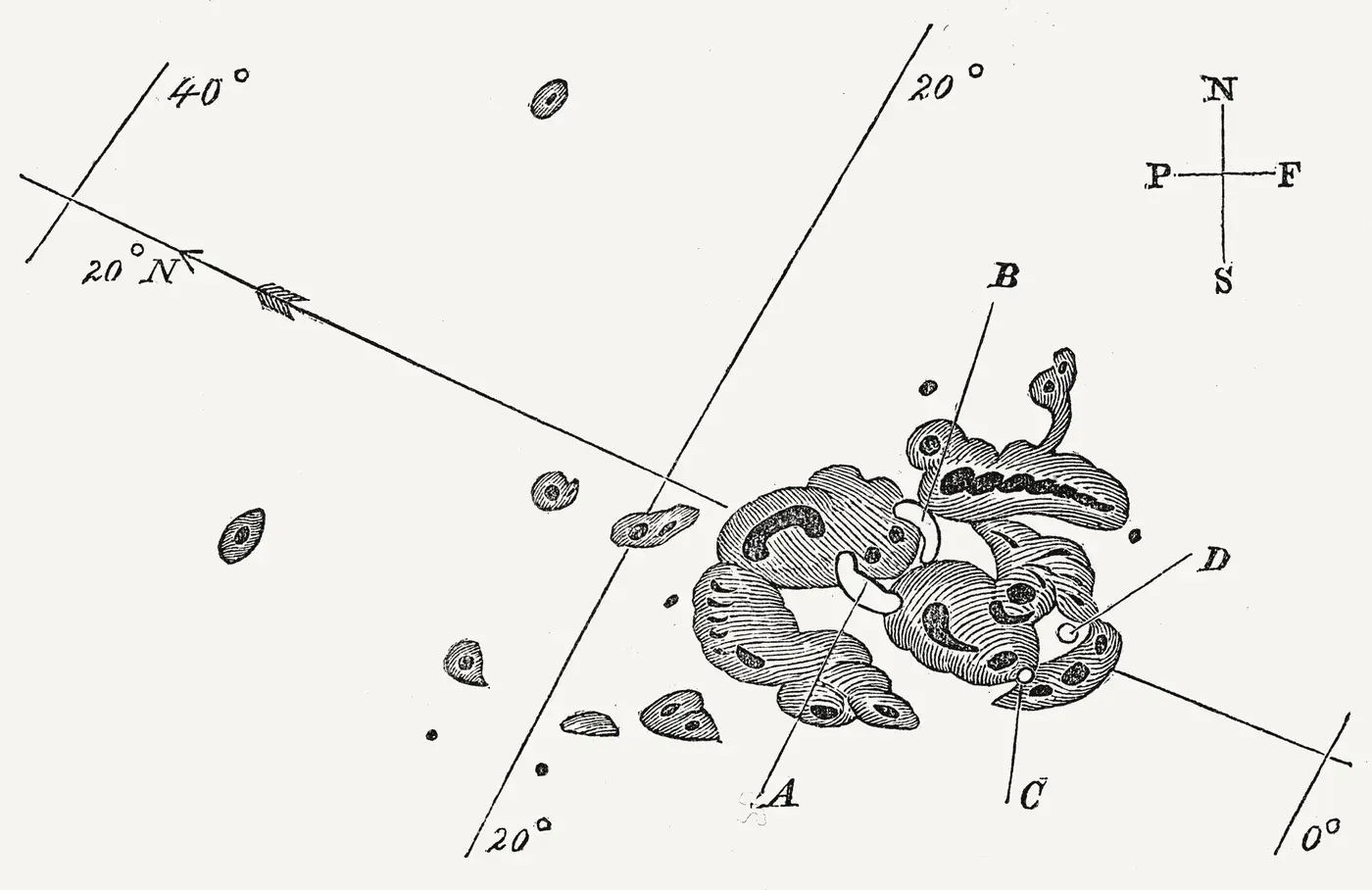
On the morning of 1 September 1859, Richard Carrington was making his customary observation of sunspots when he saw two patches of white light brighten within a group of spots. Richard Hodgson, a second observer, recorded the same sightings independently, and both published accounts in the Monthly Notices of the Royal Astronomical Society that year. Carrington placed the first outburst at about 11:18 Greenwich time, and the patches faded about five minutes later.
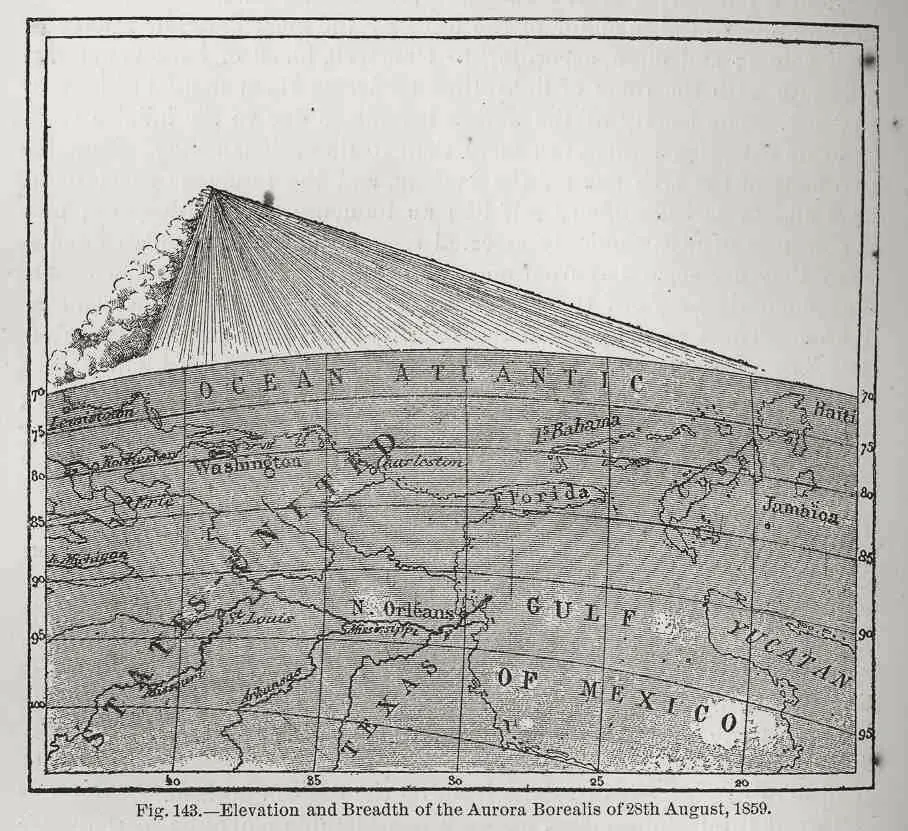
Earth's magnetic field was disturbed almost at once. The magnetic instruments at Kew Observatory recorded a sudden disturbance that Cliver and Svalgaard date to about 11:15 UT, a few minutes before Carrington's first outburst time; Hodgson's remark printed in Carrington's paper puts it at about 11:20. A great geomagnetic storm followed about 17.6 hours later. Auroras were seen at low magnetic latitudes, and telegraph lines were reported to spark in several places.
Later readers have offered three broad readings of this record. One treats the storm as a direct effect of a very large solar outburst. A second asks whether a single flare can explain a disturbance of that size, or whether other factors were involved. A third questions whether the timing is more than coincidence, since the sightings and the magnetic records come from different observers and different clocks. This investigation separates these readings. It asks what the surviving records show, what they cannot show, and how large the flare can reasonably be said to have been.
The timeline
Richard Carrington and Richard Hodgson each record a sudden brightening of a sunspot group. Carrington places the first outburst at about 11:18 Greenwich time.
The magnetic instruments at Kew Observatory record a sudden disturbance, a magnetic crochet of roughly 110 nT, at about 11:15 UT.
A great geomagnetic storm begins about 17.6 hours after the Kew disturbance, and the Kew trace is driven off scale.
Auroras are reported at low magnetic latitudes, including Honolulu and San Salvador, and telegraph lines are reported to spark and disrupt service.
The March 1989 geomagnetic storm, described by Cliver and Svalgaard as the largest since 1957, becomes the comparison point for the 1859 storm's modern size estimate.
Cliver and Svalgaard review the 1859 record and conservatively conclude that the Carrington flare was more than X10 class in soft X-rays.
A researched reconstruction for learning. These reasoning steps simplify a complex record; no score can capture the full history.
02 · The evidence
What does the record show?
Read each exhibit before settling on an explanation. The source links below every exhibit lead to the record behind it.
Exhibits reviewed 0 of 5
Carrington's timing of the first outburst
Carrington's 1859 paper describes the two white-light patches he saw on 1 September. He places the first outburst within about 15 seconds of 11:18 Greenwich mean time and takes 11:23 as the time of disappearance. He also says he avoided exchanging information with Hodgson, so the two accounts were independent. The paper establishes what Carrington saw and when he recorded it. It does not establish the flare's energy, its cause, or how closely his clock matched modern time.
Source record s1articles.adsabs.harvard.edu
Hodgson's independent sighting and the Kew link
Hodgson's 1859 note, titled On a curious Appearance seen in the Sun, describes observing the same group of spots on the morning of 1 September. He says the bright patches lasted for some five minutes and disappeared at about 11.25 a.m. He also reports that the magnetic instruments at Kew were disturbed at the same time. The note confirms a second, independent observer and the simultaneous Kew disturbance. It does not measure the flare's brightness, and visual timing by one observer carries its own uncertainty.
Source record s2articles.adsabs.harvard.edu
The Kew crochet and the storm 17.6 hours later
Cliver and Svalgaard's figure of the Kew trace places a magnetic crochet at 11:15 UT on 1 September, followed 17.6 hours later by a great geomagnetic storm that drove the record off scale. They give the crochet an amplitude of about 110 nT and compare it with the largest mid-latitude events. They define a crochet as a solar flare effect. This establishes the size and sequence of the magnetic signal at one observatory. It does not show that the flare caused the crochet by itself, and minute-level ordering depends on 1859 timekeeping.
Source record s3web.archive.org
A flare class inferred from modern comparisons
Cliver and Svalgaard compile intense soft X-ray flares recorded from 1984 to 2003 and use them to gauge the size of the Carrington flare. They conservatively conclude that it was a flare above X10 class. They also cite Tsurutani and colleagues, who reanalysed the Colaba (Bombay) horizontal record and found it consistent with a Dst index of about -1760 nT, calculated from estimated solar wind parameters and roughly three times the March 1989 storm. These are inferences from comparison, not readings from an instrument of 1859.
Source record s3web.archive.org
Telegraph disruption in a NASA summary
A 2014 NASA Science article on a near miss in July 2012 summarises the 1859 event as background. It states that the storm lit northern lights as far south as Cuba and caused global telegraph lines to spark, setting fire to some telegraph offices. It also describes the storm as driven by a series of coronal mass ejections. This establishes that telegraph damage is part of the public record as summarized by NASA. It does not reproduce the telegraph records, and its aurora location is not given in the magnetic latitudes Cliver and Svalgaard use.
Source record s4science.nasa.gov
03 · Your reasoning
Follow the strongest explanation.
Choose an interpretation, then compare it with the evidence. You can revise your choice. The goal is understanding, not a perfect score.
04 · The findings
The chain behind the outcome.
Your notebook
Case report
Next in science & discovery: A twist in the oldest light
The best-supported picture is this. On 1 September 1859 two observers independently reported a flash of white light on a sunspot group, and Carrington's timing puts the first outburst at about 11:18 Greenwich time. Shortly before that, the Kew magnetic record shows a sudden disturbance of roughly 110 nT, which the authors classify as a solar flare effect. About 17.6 hours later a geomagnetic storm drove the Kew trace off scale. Auroras were seen at low magnetic latitudes, and telegraph systems were disturbed.
The observations are the firm part: the sightings and the magnetic trace. The link between the flare and the storm is an inference from timing and from the pattern of fast-transit storms, not a direct measurement from 1859. The flare's size is inferred more loosely still. Cliver and Svalgaard compare the event with modern flares and conservatively place the flare above X10 in soft X-rays, and the Dst estimate of about -1760 nT they cite from Tsurutani and colleagues makes the storm roughly three times the March 1989 storm. Both figures carry the caution of an estimate.
The case shows the limits of a single famous event. Without the magnetic trace, the auroras and the telegraph reports agreeing, the story would rest on two sightings. With them, the claim that the sun produced an unusually large outburst has solid support, while its exact size and the minute-level timing remain uncertain.
Contributing causes and conditions
- A large eruption on the sun brightens a patch of the surface for several minutes, which Carrington and Hodgson observed on 1 September 1859.
- In the following days a series of coronal mass ejections reached Earth, according to the NASA summary, though the sources do not establish which one the flare launched.
- The flare's X-ray and ultraviolet output disturbs the ionosphere, producing the sudden crochet of about 110 nT recorded at Kew at 11:15 UT.
- About 17.6 hours later, the main storm drives the Kew record off scale and pushes auroras to low magnetic latitudes.
- According to the NASA summary, global telegraph lines spark during the storm, setting fire to some telegraph offices.
OutcomeCarrington Event (1859)
Take the method with you
- A dramatic observation can anchor a story, but its size usually depends on a chain of inferences that should be listed separately.
- Independent records matter: two observers and a magnetic trace that agree on timing are stronger evidence than one account.
- An estimate built by comparison with modern data is useful, but the comparison and its limits should be stated with it.
You can read findings at any time. Exploring every reasoning step marks this case as complete in your notebook.
The open record
Sources & further reading
Read the original record and its scope before relying on a conclusion. Source references support the exhibit summaries; Faultory’s reasoning prompts are editorial reconstructions.
- s1
- s2Monthly Notices of the Royal Astronomical Society: R. Hodgson, On a curious Appearance seen in the Sun (1859)
articles.adsabs.harvard.edu
- s3
- s4NASA Science: Near Miss: The Solar Superstorm of July 2012
science.nasa.gov
Written and curated for Faultory by Yunus Emre Vurgun, with AI-assisted research and drafting. Sources and interpretations can need correction. Read our editorial standards or report an issue.
Keep investigating