Your browser cannot save progress right now. You can still investigate; keep this tab open or enable local storage to save.
This case has been updated. Compatible choices are kept; revisit the evidence before drawing your conclusion.
01 · The briefing
Begin with the question.
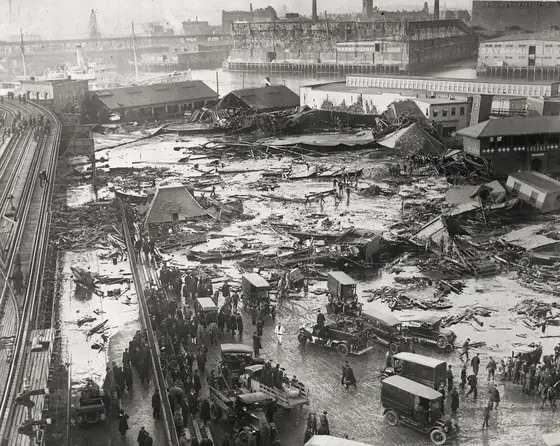
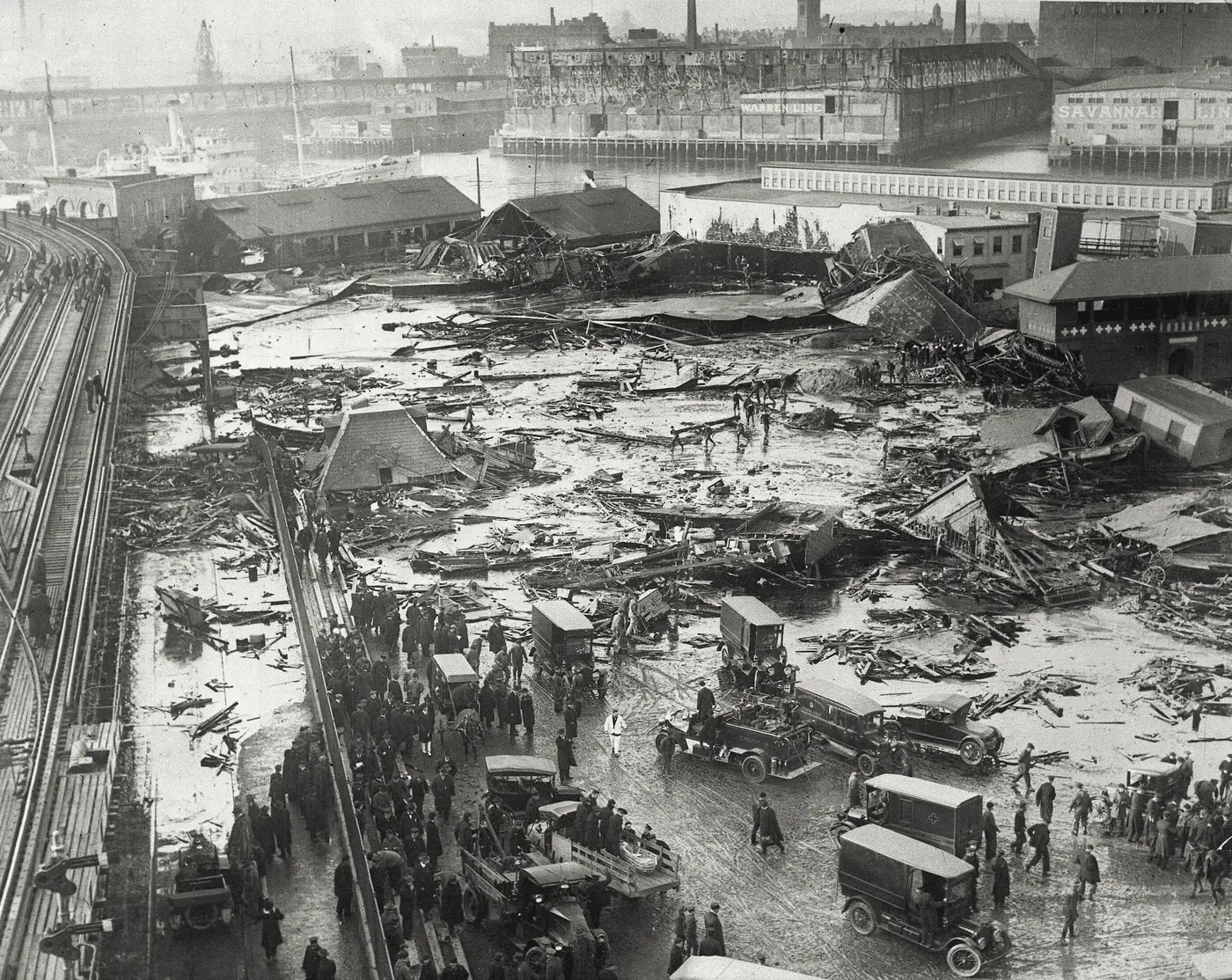
On 15 January 1919, a large steel tank of molasses on Commercial Street in Boston's North End ruptured. The Associated Press later reported that more than 2.3 million gallons were released in a wave that, according to historical accounts, was initially about 25 feet tall. It flattened buildings, damaged an elevated railway and killed 21 people, with about 150 more injured. Early reports gave a much lower count: a newspaper page dated 18 January listed nine men killed. At the time, the company that owned the tank, US Industrial Alcohol, claimed that anarchists had blown it up, a claim that Boston Magazine's account says had no evidence behind it. Lawsuits and later studies offered other explanations: a 2015 engineering analysis reported by the Boston Globe centred on the tank's construction and steel, and a 2016 fluid-dynamics study examined the temperature and the molasses itself. Accounts also differ on the wave's height, the early toll and the legal outcome, so the basic facts need checking before the causes can be compared. This investigation separates the evidence about the tank from the evidence about the weather, and tests the sabotage claim against the physical record, because a claim made by an interested party needs that test.
The timeline
A fresh shipment of warm molasses from the Caribbean is added to the tank, two days before it fails.
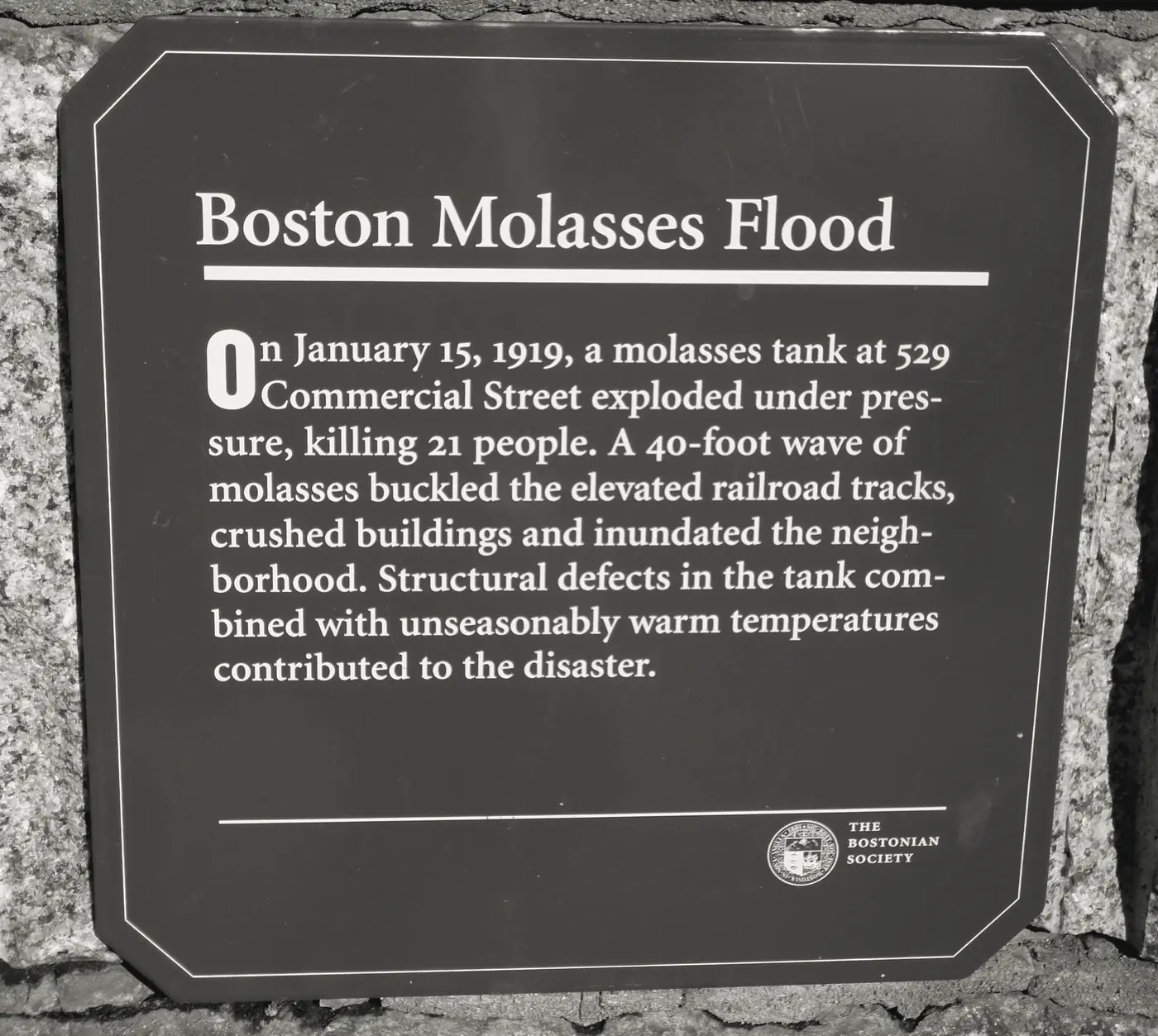
The tank ruptures on Commercial Street and releases about 2.3 million gallons; the initial wave is reported at about 25 feet.
A newspaper page from this date reports nine men killed and forty-three others injured in the early count.
The Boston Globe reports a new engineering analysis finding the tank overstressed and built from brittle steel. It says the exact cause of failure was not determined.
An Associated Press report of a Harvard-led study says cold weather thickened the molasses quickly and that the disaster might have claimed few lives in another season.
Boston Magazine, drawing on an interview with the author Stephen Puleo, reports that the sabotage claim had no evidence and that a judge ruled against the company.
A researched reconstruction for learning. These reasoning steps simplify a complex record; no score can capture the full history.
02 · The evidence
What does the record show?
Read each exhibit before settling on an explanation. The source links below every exhibit lead to the record behind it.
Exhibits reviewed 0 of 5
Early newspaper count: nine killed, forty-three injured
The Chronicling America archive holds a newspaper page dated 18 January 1919 whose OCR text reports that nine men were killed and forty-three others injured in the early count after the tank failed. OCR is machine-read text and can contain errors, so these figures come from this one copy. It establishes what the paper reported three days after the collapse. It does not establish the cause of the failure, the builders of the tank, or the final toll, which later sources give as 21 killed.
Source record s1web.archive.org
APS 2016 talk abstract: the wave and the temperature argument
A 2016 abstract for the American Physical Society's Division of Fluid Dynamics meeting, titled 'In a sea of sticky molasses,' summarizes the flood using contemporary accounts. It gives an initial wave of about 7.6 meters moving at more than 15 meters per second, and it says the molasses killed 21 people and injured 150 more while damaging the elevated train. It describes the talk's scope as temperature fluctuations and molasses rheology before the collapse. It is a short conference abstract, not a full paper, and it does not establish the cause of the rupture.
Source record s2meetings-archive.aps.org
2015 Globe report: overstress, brittle steel and an auditor's ruling
A January 2015 Boston Globe article reports a new analysis by Ronald Mayville, an engineer who had researched the disaster for years in his spare time. It says the tank was stressed well beyond its capacity and was made from steel that was brittle because it had low manganese. It reports that an auditor ruled against the owner, US Industrial Alcohol, after a three-year trial, finding that the riveted construction did not meet structural standards. The article says the exact cause of failure was not determined. It establishes the findings as reported. It is a newspaper account, not a full engineering report.
Source record s3bostonglobe.com
AP report: cold weather, warm molasses and the death toll
An Associated Press report of 24 November 2016, carried by Boston.com, describes a study by Harvard University researchers, who concluded that a winter chill cooled and thickened the molasses rapidly as it spread through the streets, complicating rescue. The report says the disaster might have claimed few if any lives had it occurred in spring, summer or fall. It also says the tank had been topped off two days earlier with fresh, warm Caribbean molasses, which was likely considerably warmer than the outside air. It establishes the study's temperature argument as reported. It does not establish that temperature caused the tank to fail.
Source record s4boston.com
Boston Magazine 2019: the sabotage claim and the judgment
A January 2019 Boston Magazine piece, drawing on an interview with the author Stephen Puleo, describes the anarchist-bombing theory as one with no evidence behind it. It says the judge ruled against the company and ordered it to pay damages that the magazine describes as millions. The magazine's description of the tank as shoddily built is its own framing. It establishes the outcome in outline, as reported. It does not establish the amounts or the cause of the failure, and it is a secondary account.
Source record s5bostonmagazine.com
03 · Your reasoning
Follow the strongest explanation.
Choose an interpretation, then compare it with the evidence. You can revise your choice. The goal is understanding, not a perfect score.
04 · The findings
The chain behind the outcome.
Your notebook
Case report
Next in history & systems: Why so many plants stopped at once
The record supports a layered answer rather than a single cause. The tank's construction and steel were a structural weakness. A 2015 analysis reported by the Boston Globe found the tank stressed beyond its capacity and built from brittle steel, and an auditor ruled after a three-year trial that its riveted construction did not meet structural standards. The anarchist claim is the least supported explanation: Boston Magazine's account says it had no evidence behind it. The 2016 study presented by Harvard researchers adds a second factor, the winter air. Warm molasses had been added two days before the collapse, and cold weather cooled and thickened it quickly, which the study suggests may have increased the death toll compared with another season. The early count of nine dead was an incomplete first report, and later accounts give 21 killed and about 150 injured. The Globe reports that the exact cause of the failure was not determined. The best-supported account is therefore a tank that was overstressed and poorly built, which failed under its load, with cold weather shaping how many people were harmed.
Contributing causes and conditions
- A steel tank holding more than it was designed for, with riveted construction that an auditor found did not meet structural standards.
- Brittle steel with low manganese content, which the 2015 Globe report describes as making the plates more likely to crack.
- Warm molasses added to the tank two days before the collapse, which the 2016 study says was likely considerably warmer than the winter air.
- Cold weather that thickened the molasses quickly, which the study says might have made the death toll higher than it would have been in another season.
- A sudden release of about 2.3 million gallons, whose initial wave is reported at about 25 feet by the AP and about 7.6 meters by the APS abstract.
OutcomeGreat Boston Molasses Flood (1919)
Take the method with you
- When an early count or an early claim conflicts with later records, treat it as a snapshot and check which figure a later source revised.
- A dramatic explanation, such as sabotage, needs evidence of its own. Ask what record would support it before weighing it.
- Separate the failure mechanism, meaning why the tank broke, from the conditions that made the outcome deadlier, such as the weather and the season, because different studies answer different parts of the question.
You can read findings at any time. Exploring every reasoning step marks this case as complete in your notebook.
The open record
Sources & further reading
Read the original record and its scope before relying on a conclusion. Source references support the exhibit summaries; Faultory’s reasoning prompts are editorial reconstructions.
- s1
- s2
- s3
- s4
- s5Boston Magazine: Great Boston Molasses Flood, things you didn't know (12 January 2019)
www.bostonmagazine.com
Written and curated for Faultory by Yunus Emre Vurgun, with AI-assisted research and drafting. Sources and interpretations can need correction. Read our editorial standards or report an issue.
Keep investigating