Your browser cannot save progress right now. You can still investigate; keep this tab open or enable local storage to save.
This case has been updated. Compatible choices are kept; revisit the evidence before drawing your conclusion.
01 · The briefing
Begin with the question.
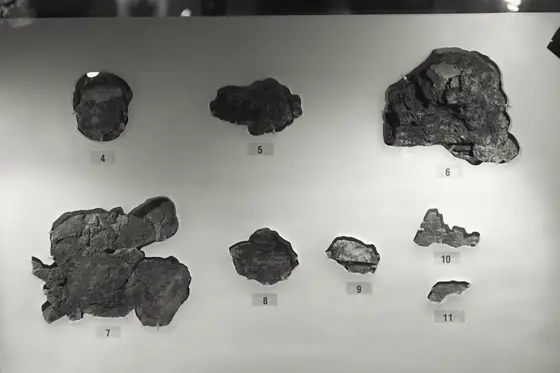
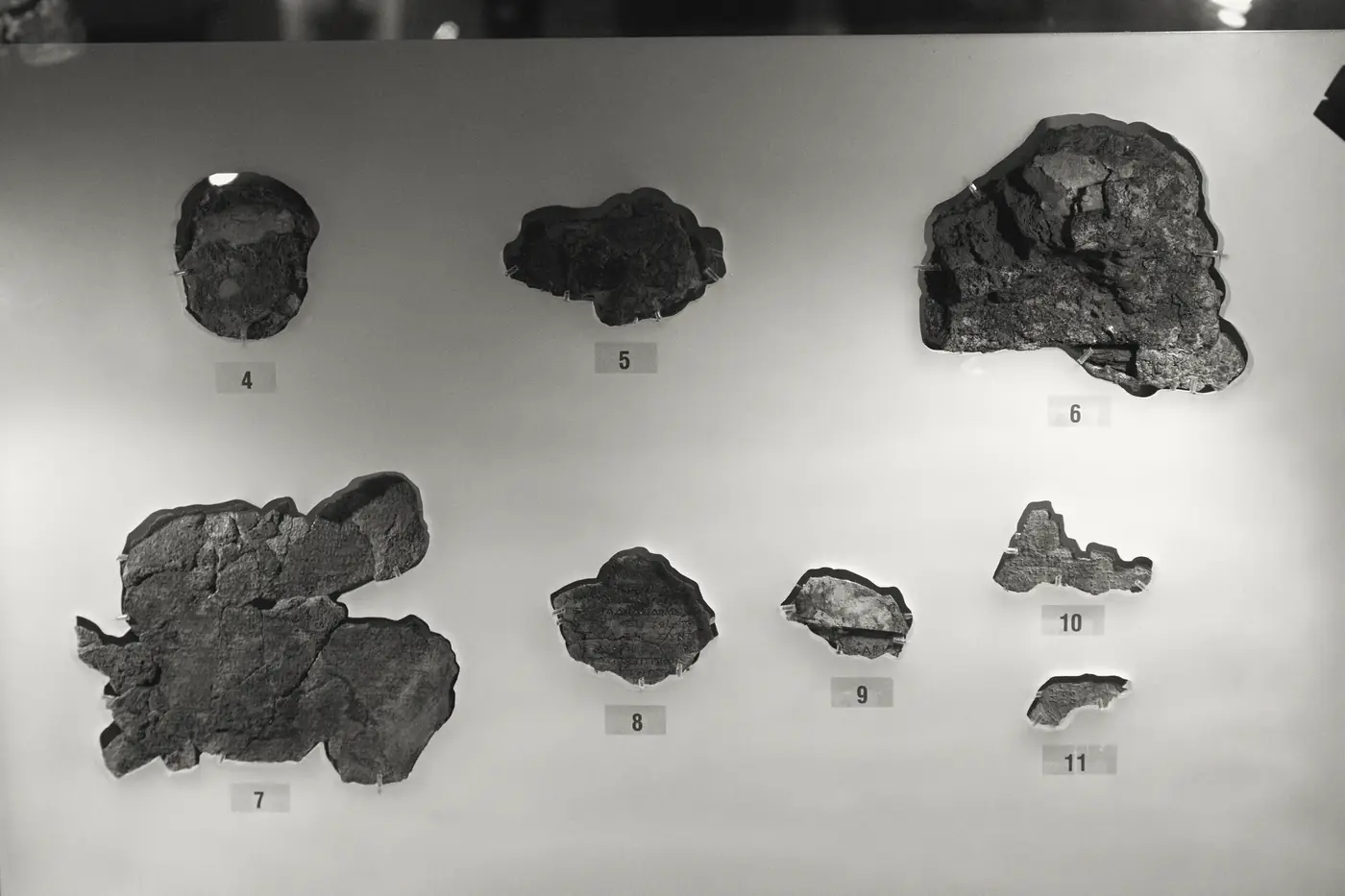
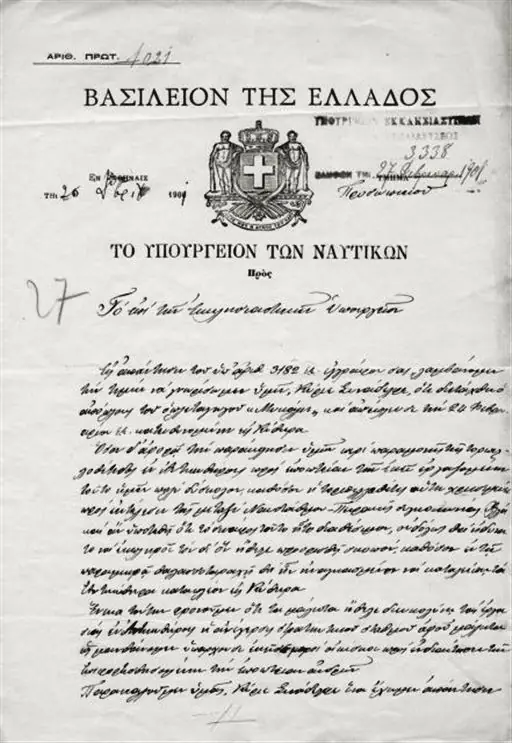
In 1901, objects were recovered from a shipwreck off the Greek island of Antikythera. Among them was a corroded bronze mass that later separated into fragments. Corrosion hid the gear teeth on the surface. The object was named after its place of discovery, and it has challenged researchers since 1901, as the 2021 study puts it.
The question is how modern imaging turned those fragments into a readable mechanism, and how far the resulting picture is measured and how far it is designed. Later research, including two Nature papers from 2006 and 2008 and a 2021 Scientific Reports study, treats the object as an astronomical calculator. The 2021 study reports 82 fragments and 30 gearwheels, and it rests on X-ray computed tomography of the fragments. This case separates the surviving physical evidence from the reconstruction built on it.
The timeline
Corroded fragments are recovered from a shipwreck near Antikythera.
Microfocus X-ray computed tomography and polynomial texture mapping are used on all 82 fragments.
Freeth and colleagues publish a Nature paper that reconstructs the gear functions and eclipse prediction.
Freeth and colleagues publish a Nature paper that reads the back dials, including the Metonic and Saros dials.
A Scientific Reports paper presents a model of the cosmos with a planetary display, based on the surviving gears and inscriptions.
A researched reconstruction for learning. These reasoning steps simplify a complex record; no score can capture the full history.
02 · The evidence
What does the record show?
Read each exhibit before settling on an explanation. The source links below every exhibit lead to the record behind it.
Exhibits reviewed 0 of 5
What survives, and how it was counted
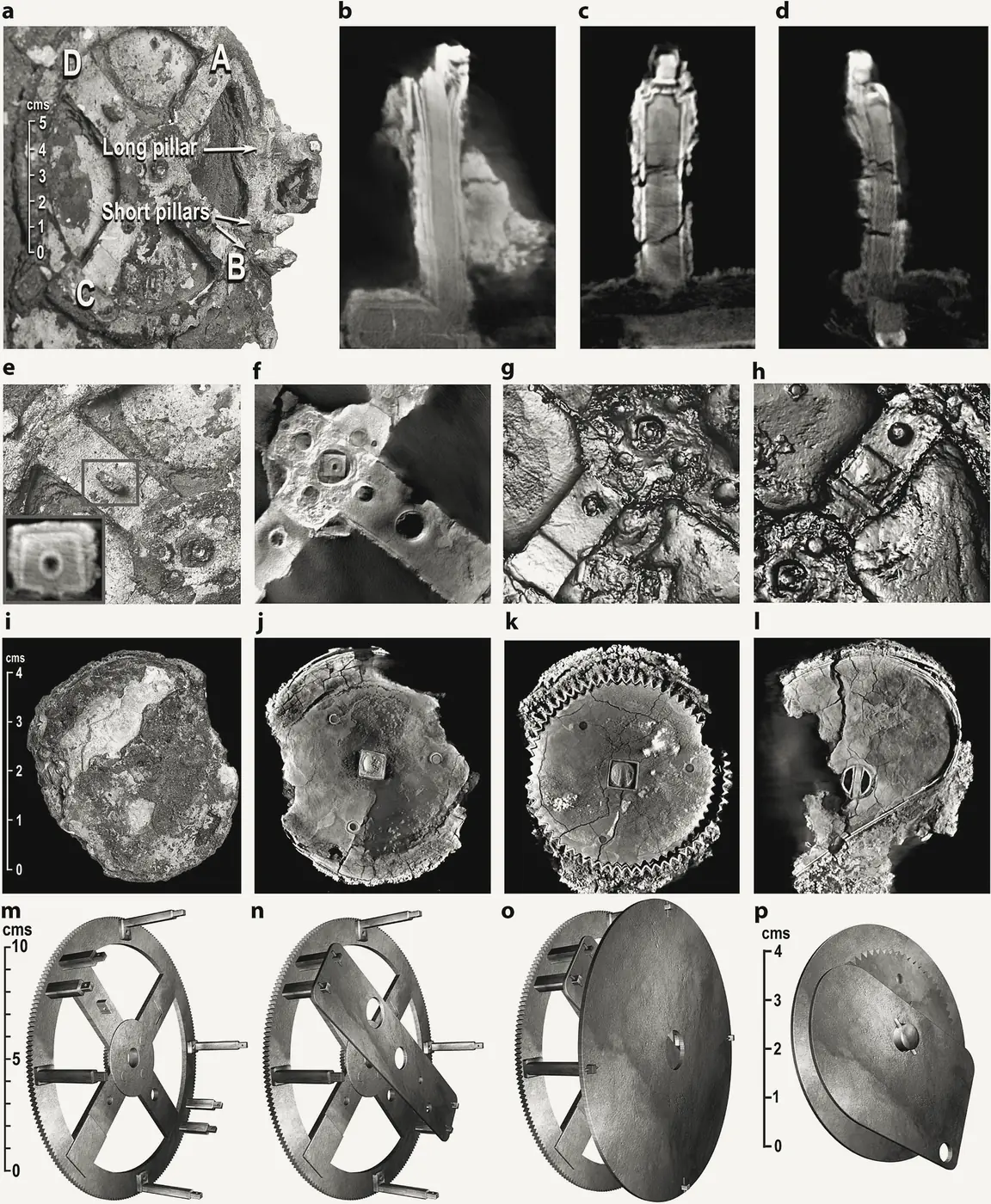
The 2021 Scientific Reports paper describes the mechanism as 82 fragments, of which about a third survives, including 30 corroded bronze gearwheels. Fragment A carries 27 of the 30 gears, with one each in Fragments B, C and D. Microfocus X-ray computed tomography and polynomial texture mapping of all 82 fragments, made in 2005, supplied data that earlier studies lacked. The paper reads the original tooth count of a gear in Fragment D as 63 teeth, because all but three teeth survive. This establishes which gears are physically present and how some were counted. It does not establish how the gears fitted together.
Source record s1nature.com
Eclipse prediction from the gear train
The 2006 Nature paper reports surface imaging and X-ray tomography of the fragments, and reconstructs how the gear train worked. The authors state that the mechanism predicted lunar and solar eclipses using Babylonian arithmetic-progression cycles, and that the planetary display is now lost. They also link the lunar gearing to Hipparchos's lunar theory of the second century BC. This establishes that the reconstruction supports the eclipse function. It does not establish the full set of displays, which the paper says are lost.
Source record s2nature.com
The back dials
The 2008 Nature paper reads the back of the mechanism. It identifies an upper back dial with a five-turn spiral for the 19-year Metonic calendar, and a lower back dial with a four-turn spiral for the Saros eclipse cycle of 223 lunar months. It also corrects an earlier reading: the upper subsidiary dial displays a four-year Olympiad, not a 76-year Callippic cycle. This establishes the dial functions and that correction. It does not settle the index letters, which the authors say need modification.
Source record s3nature.com
What is inferred rather than measured
The 2021 paper says that no surviving direct evidence shows gearing for the Sun and the superior planets, and the authors state that they cannot claim their model is a replica of the original. Its Venus and Saturn period relations come from numbers inscribed on the fragments, which the authors read from the tomography. The planetary gearing that displays those relations is therefore a hypothesis built to respect the inscriptions. This establishes which layers are inferred. It does not confirm the exact layout of the planetary train.
Source record s1nature.com
The project and the object's origin
The Antikythera Mechanism Research Project website describes the object as recovered from a shipwreck near Antikythera and presents the project as a study of the mechanism. It gives the project's public framing and not technical measurements. It is useful for locating the research programme, but not for gear counts or cycle claims, which come from the journal papers. This establishes the object's origin and the project's basic description. It does not establish any technical detail.
Source record s4antikythera-mechanism.gr
03 · Your reasoning
Follow the strongest explanation.
Choose an interpretation, then compare it with the evidence. You can revise your choice. The goal is understanding, not a perfect score.
04 · The findings
The chain behind the outcome.
Your notebook
Case report
Next in history & systems: A gas cloud from still water
The best-supported description has two layers. The measured layer is the set of surviving fragments and gears: 82 fragments, about a third of the original object, and 30 corroded gearwheels, with Fragment A holding 27. Microfocus X-ray CT and surface imaging let researchers see tooth profiles and inscriptions beneath the corrosion, so the gear counts and some dial functions are read from physical data rather than guessed. The interpretive layer is larger. Freeth and colleagues reconstruct how the gear train worked, including a Metonic calendar dial and a Saros eclipse dial, and show that eclipse predictions follow from Babylonian arithmetic cycles. The 2008 correction changed one dial's cycle from the Callippic to the Olympiad, which shows that a reading can change as evidence accumulates. The planetary display is lost, and the gearing for the Sun and superior planets is a hypothesis. The mechanism should therefore be read as a well-supported device with a reconstructed planetary and index layer, not as a finished replica of the original.
Contributing causes and conditions
- A bronze gear train whose teeth were hidden by corrosion and fragmentation
- A shipwreck context that split the object into 82 fragments, of which about a third survives
- Tomography and surface imaging that exposed tooth profiles and inscriptions
- Eclipse cycles based on Babylonian arithmetic progressions, and planetary period relations read from inscriptions, which constrain the gear ratios
- Inscriptions and dial spirals that carry the Metonic and Saros functions
- A planetary display that is lost and must be reconstructed by inference rather than direct evidence
OutcomeAntikythera mechanism
Take the method with you
- Separate what is measured from what is reconstructed, and say which is which when describing an object.
- Better instruments can recover information that an object's surface hides, but the data still need careful interpretation.
- When a reconstruction changes, check which claims rest on the physical record and which rest on the model.
You can read findings at any time. Exploring every reasoning step marks this case as complete in your notebook.
The open record
Sources & further reading
Read the original record and its scope before relying on a conclusion. Source references support the exhibit summaries; Faultory’s reasoning prompts are editorial reconstructions.
- s1
- s2
- s3
- s4Antikythera Mechanism Research Project — project website
www.antikythera-mechanism.gr
Written and curated for Faultory by Yunus Emre Vurgun, with AI-assisted research and drafting. Sources and interpretations can need correction. Read our editorial standards or report an issue.
Keep investigating