Your browser cannot save progress right now. You can still investigate; keep this tab open or enable local storage to save.
This case has been updated. Compatible choices are kept; revisit the evidence before drawing your conclusion.
01 · The briefing
Begin with the question.
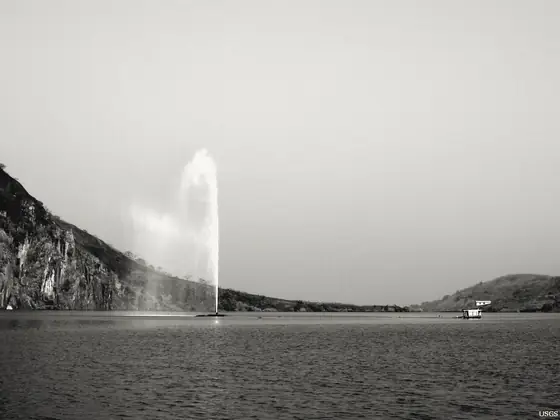
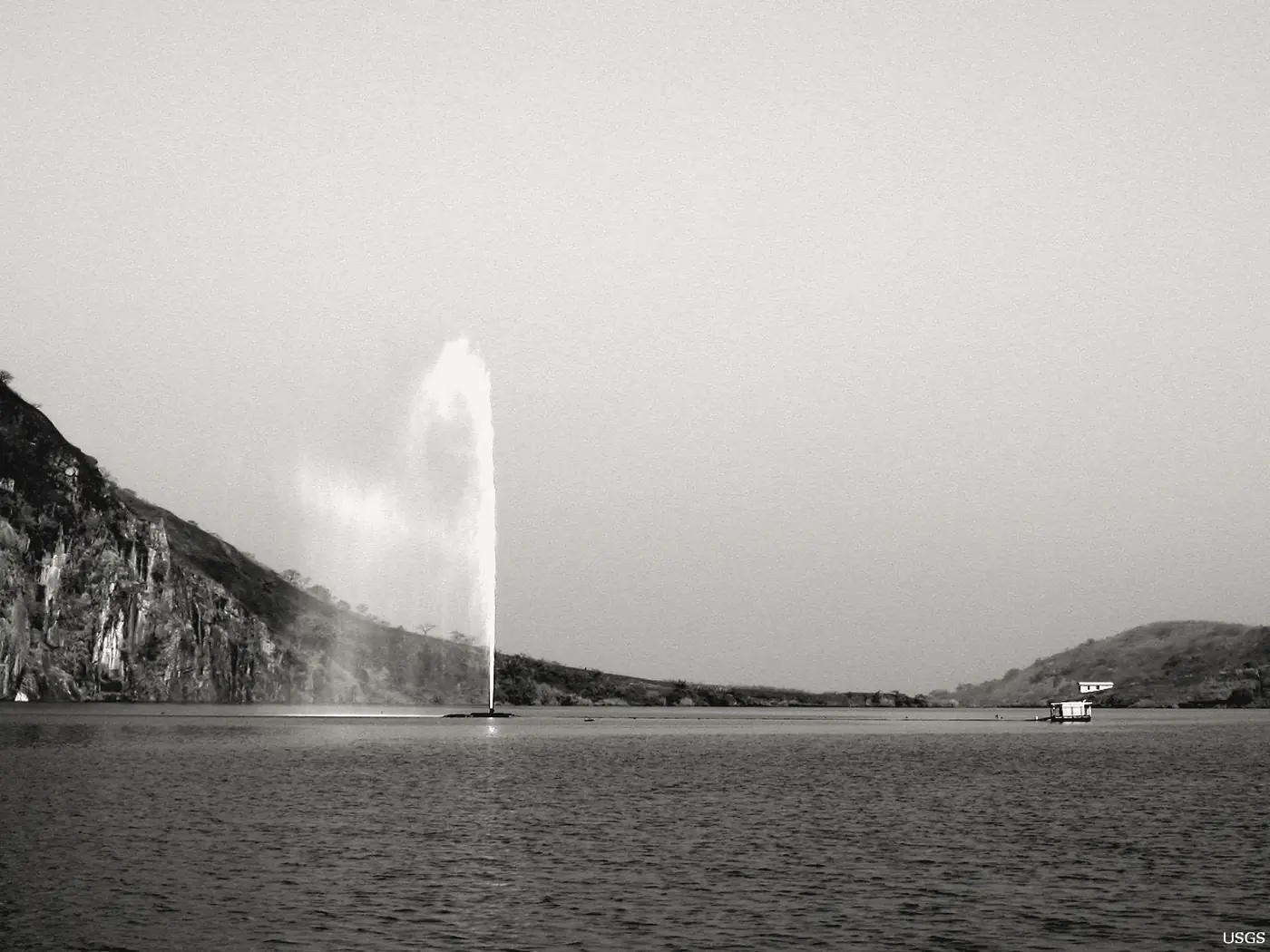
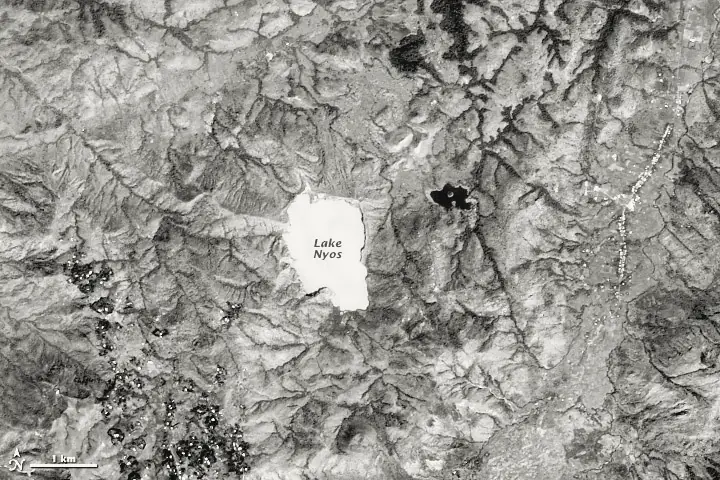
Lake Nyos is a crater lake in the volcanic highlands of northwest Cameroon. On 21 August 1986 a sudden release of gas from its deep water sent a dense cloud of carbon dioxide into the surrounding valleys. The people killed lived in nearby towns and villages, and thousands of livestock also died. The 1988 review calls such crater lakes a hitherto unrecognized natural hazard. Survivors were examined and interviewed by a medical team, and the investigators who followed had to reconstruct the event from chemistry, geology and medical records.
Two explanations were under debate from the start. One was volcanic: magma might have released gas directly into the lake. The other was a limnic eruption, in which carbon dioxide that had built up dissolved in deep water comes out of solution and erupts from the lake. A smaller release at Lake Monoun in 1984, which killed 37 people, raised the question of whether the two events shared a cause.
This investigation separates these readings. It asks what the chemistry, the medical evidence and the later measurements actually show, and which parts of the account remain open.

The timeline
A gas burst from Lake Monoun, a smaller crater lake in Cameroon, kills 37 people.
A sudden release of carbon dioxide from Lake Nyos kills at least 1,700 people in nearby settlements, and thousands of livestock also die.
Kling and colleagues review the chemical, isotopic, geologic and medical evidence and find that it supports four hypotheses: the gas was mostly carbon dioxide stored in the deep water, the victims died of carbon dioxide asphyxiation, the carbon dioxide was magmatic in origin, and there was no significant direct volcanic activity.
Sigurdsson argues that the deep-water geochemistry does not support a sudden injection of volcanic gas, and proposes a gradual build-up of dissolved gas instead.
A volcanic lakes workshop report in Eos notes that after the bottom water recharged with carbon dioxide, the limnic eruption hypothesis became the most likely explanation.
A researched reconstruction for learning. These reasoning steps simplify a complex record; no score can capture the full history.
02 · The evidence
What does the record show?
Read each exhibit before settling on an explanation. The source links below every exhibit lead to the record behind it.
Exhibits reviewed 0 of 5
The 1987 review of the evidence
The 1987 review by Kling and colleagues, indexed on PubMed, states that the release on 21 August 1986 caused the deaths of at least 1,700 people. It lists four hypotheses that the chemical, isotopic, geologic and medical evidence support: that the gas was mostly carbon dioxide stored in the hypolimnion, that victims died of carbon dioxide asphyxiation, that the carbon dioxide was magmatic in origin, and that there was no significant direct volcanic activity. This establishes the authors' synthesis at that date. It does not establish what triggered the release.
Source record s1eutils.ncbi.nlm.nih.gov
Sigurdsson's rival mechanism
Sigurdsson's 1988 review, indexed on PubMed, gives 1,746 deaths at Lake Nyos and 37 at Lake Monoun. It accepts a magmatic carbon source from isotope data, but argues that the geochemistry of deep water and gases does not support a sudden injection of volcanic gas. It proposes a gradual build-up of dissolved bicarbonate, with steady input from the mantle, and says that asphyxia from carbon dioxide caused almost all of the lethal effects. This is a proposed mechanism inferred from chemistry, not an observed event.
Source record s2eutils.ncbi.nlm.nih.gov
Cloud volume and the range of deaths
Wagner and colleagues, in a 1988 medical evaluation indexed on PubMed, describe a carbon dioxide cloud with an estimated volume of about 1 cubic kilometer that caused 1,700 to 2,000 human fatalities and killed thousands of livestock and wild animals. The range shows that early counts were uncertain. The paper establishes the scale of the cloud estimate and the death range. It does not establish how the gas was released, and the volume is an estimate.
Source record s3eutils.ncbi.nlm.nih.gov
A regional summary of the two releases
An archived USGS page, carrying a Smithsonian Global Volcanism Program summary, dates the Lake Monoun release to August 1984 and the Lake Nyos release to August 1986. It says that the two releases together resulted in the loss of nearly 1,800 lives. This establishes the regional pattern and a rounded combined toll. It does not separate the two tolls, and it gives only month-level dates.
Source record s4web.archive.org
The later recharge observation
A 2016 Eos report from a volcanic lakes workshop in Cameroon, by Rouwet, Tanyileke and colleagues, gives the 21 August 1986 cloud as killing 1,746 people and more than 3,000 livestock. It says that early disagreement was between volcanic and limnic eruption, and that after the bottom water naturally recharged with carbon dioxide, the limnic eruption hypothesis was the most likely. It establishes the later consensus and the recharge observation. It does not give the measurements behind the recharge or the trigger.
Source record s5eos.org
03 · Your reasoning
Follow the strongest explanation.
Choose an interpretation, then compare it with the evidence. You can revise your choice. The goal is understanding, not a perfect score.
04 · The findings
The chain behind the outcome.
Your notebook
Case report
Next in history & systems: The computer said the cash was missing
The best-supported account is that Lake Nyos had carbon dioxide dissolved in bottom waters that did not mix with the surface. On 21 August 1986 a large volume of that gas was released suddenly, forming a cloud that killed at least 1,700 people and thousands of livestock in nearby settlements. The reviews attribute the deaths mainly to carbon dioxide asphyxia.
The source of the gas is less settled. The 1987 review of Kling and colleagues supported a magmatic origin for the carbon dioxide and found no significant direct volcanic activity. Sigurdsson's 1988 review accepted a magmatic carbon source too, but argued that the geochemistry does not support a sudden injection of volcanic gas, and proposed slow build-up of dissolved gas sustained by input from the mantle. The 2016 Eos report, from a volcanic lakes workshop, concluded that the limnic eruption hypothesis was the most likely explanation after the lake's bottom water recharged with carbon dioxide.
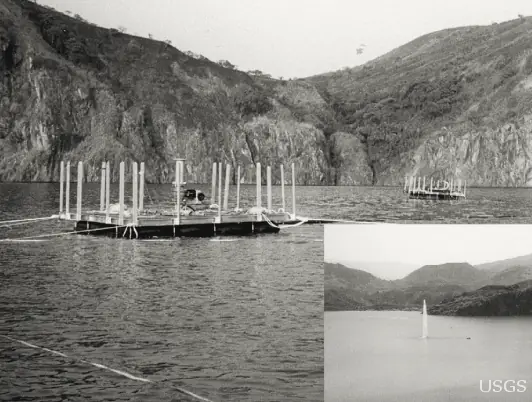
The death toll appears as 1,700 to 2,000 in some sources and as 1,746 in others, and the USGS summary gives nearly 1,800 for Monoun and Nyos together. The earlier Monoun release, with 37 deaths, shows that the hazard was not unique to one lake. The engineering response, which vents deep-water gas through pipes, followed the understanding that the gas could build up again.
Contributing causes and conditions
- Carbon dioxide from deep sources accumulates dissolved in the stagnant bottom water of the lake, where the water is largely isolated from the surface.
- The deep water becomes close to saturated, so the gas stays under pressure rather than escaping gradually.
- A disturbance whose exact nature was not directly observed releases a large volume of gas at once, forming a cloud.
- The cloud moves into the valleys around the lake, where people and livestock breathe it in towns and villages.
- Carbon dioxide asphyxia accounts for almost all of the lethal effects, according to Sigurdsson's review.
OutcomeLake Nyos gas disaster (1986)
Take the method with you
- Two explanations can share a key fact, so separate the disputed link, here the source of the gas, from the agreed one, here asphyxia.
- Early death tolls vary across sources, so report the range and say which source gives which number.
- A later observation, such as the lake's recharge, can settle a question that early evidence left open.
You can read findings at any time. Exploring every reasoning step marks this case as complete in your notebook.
The open record
Sources & further reading
Read the original record and its scope before relying on a conclusion. Source references support the exhibit summaries; Faultory’s reasoning prompts are editorial reconstructions.
- s1
- s2PubMed: Sigurdsson H., Gas bursts from Cameroon crater lakes: a new natural hazard (1988)
eutils.ncbi.nlm.nih.gov
- s3
- s4
- s5
Written and curated for Faultory by Yunus Emre Vurgun, with AI-assisted research and drafting. Sources and interpretations can need correction. Read our editorial standards or report an issue.
Keep investigating