After reading, you will be able to list what a release pipeline assumes about tests, staging and review. You will also be able to explain how a single defective file or artifact can reach very many machines before anyone responds.
01Content that was not code
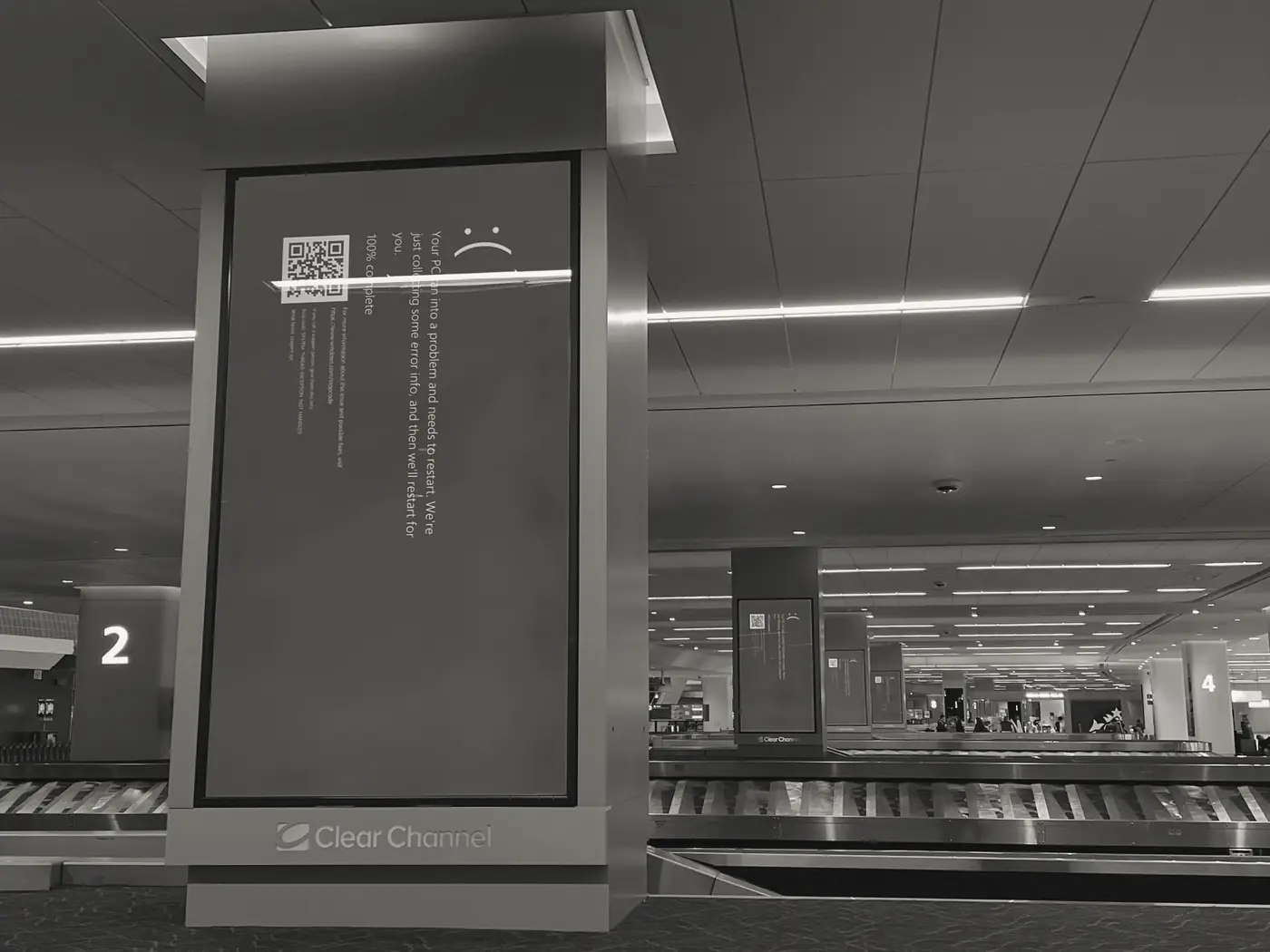
On 19 July 2024 (UTC), CrowdStrike released a content configuration update for its Falcon sensor on Windows. It was not a new sensor release. It was Rapid Response Content, data that existing sensor code interprets to decide what to detect. Hosts in scope that were online between 04:09 and 05:27 UTC and received it crashed with a Blue Screen of Death, and the update was reverted at 05:27 UTC.
The fault was a mismatch between data and code. The new Interprocess Communication Template Type defined 21 input fields, but the integration code supplied 20 values. A Template Instance with a non-wildcard match on the 21st input then made the Content Interpreter read past the end of the input array. The analysis calls this an out-of-bounds read and says it was not an arbitrary memory write. Microsoft estimated that the update affected 8.5 million Windows devices, or less than one percent of all Windows machines.
02What the tests and the validator assumed
A pipeline assumes that its tests exercise the inputs that matter. This template had shipped in sensor 7.11 in February 2024 and passed a stress test in March, but that testing used wildcard matches on the 21st input. The root cause analysis says the mismatch and the unsafe read were therefore not exercised before release.
A pipeline also assumes that its validator checks what the reader will actually receive. The Content Validator evaluated the new instances against the 21 inputs the template expected, so the problematic instance passed, even though the integration code supplied only 20. CrowdStrike later added runtime bounds checks to the Content Interpreter on 25 July, and a compile-time input-count check in production from 27 July.
03Staged rollout and blast radius
The fault reached every in-scope online host within a short window. The root cause analysis lists as a finding that each Template Instance should be deployed in a staged rollout, in which a canary group receives updates before wider groups do. Both CrowdStrike documents describe these as measures to be added, and the case does not show how many crashes a canary group would have prevented.
Knight Capital in August 2012 shows the same exposure from another direction. New code reached seven of eight router servers, and the eighth still ran the old Power Peg code. An order flag used for the new program activated the old function on that server. The SEC's findings include 97 automated emails and inadequate controls over outgoing orders, aggregate exposure and incident response, and the SEC reported losses exceeding $460 million.
Interpretation: blast radius is the set of machines, accounts or services that one change can reach before it is stopped or reverted. A staged rollout limits that set over time, and an independent check on aggregate exposure limits it in size. In these cases both were absent or incomplete, and the cases do not show that either would have been enough alone.
04Trust in the artifact, not the repository
The xz Utils backdoor of 2024 sat in release files, not in the public git source. Andres Freund reported an obfuscated injection in the build-to-host.m4 file that appeared in the released tarballs for versions 5.6.0 and 5.6.1, but not in the upstream version of that file and not in the repository. The injected step ran during configure, and only under particular build conditions, including GNU ld and Debian or RPM package builds.
The first clue was an ordinary symptom. SSH logins on a Debian sid system had become slow and were producing valgrind errors. In one timing test a failing login took 0.299 seconds before the backdoored library was installed and 0.807 seconds after. Much of the payload had been committed to the repository as test files, and no 5.6.0 test used them.
The maintainer's page says the tarballs were created and signed by a second account, whose access was limited to items hosted on GitHub and the xz subdomain. The record does not show who controlled that account, and this case does not attribute the work to any person.
Interpretation: the review trusted the public source, and the build trusted the artifact that was signed. The software supply chain is the path from source code to the files people install, and a defect or an attack can enter at any link along it.
05Automation that acted on a stale check
On the night of 19 October 2025 Pacific time, DynamoDB's public regional endpoint in us-east-1 began failing DNS resolution, and clients could not establish new connections from 11:48 PM PDT. Amazon's post-event summary names a latent race condition in the DNS management system as the root cause. The system was split in two. A DNS Planner produced versioned plans of load balancers and weights, and three Enactors, run redundantly in three Availability Zones, applied those plans to Amazon Route 53.
A freshness check ran once, before a plan was applied. One Enactor was unusually delayed while retrying endpoint updates, and the Planner produced newer plans in the meantime. A second Enactor applied one of the newer plans and began clean-up, which deletes plans much older than the one just applied. The delayed Enactor then wrote its much older plan over the newer one, because its check had gone stale. The clean-up then deleted the older plan, which was now the active one, and every IP address for the regional endpoint was removed.
Interpretation: the pipeline assumed that a check made before a write would still hold at the moment of writing. The summary says that Amazon disabled the DNS Planner and Enactor automation worldwide and will fix the race before turning it back on. The sequence is reconstructed from a written summary, not from logs or code, so the timing of the two Enactors is an inference.
06Asking what each stage assumes
Before trusting a pipeline, list what each stage assumes. Which inputs does the test cover, and which values does it leave out? Does the validator check what the reader will consume? Does a canary group see a change before everyone else? Does a check happen at the moment of writing, or earlier?
Interpretation: in these cases the controls existed on paper. CrowdStrike had a validator and stress tests, and Amazon had a freshness check. Knight's systems generated 97 automated emails, while its controls over outgoing orders were found inadequate. What failed was the match between each control and the condition it was meant to cover.
The CrowdStrike and Knight Capital cases share a feature: a single change had broad reach before it was stopped. The xz case differs, because the source looked clean and the artifact did not. The DynamoDB case differs again, because a control that was correct when it ran was stale when the write happened. Each one asks a different question of the pipeline.
Terms in this note
- Staged rollout
- A release made in stages, starting with a small canary group, so that a defect is seen by few machines before wider groups receive it. Glossary
- Software supply chain
- The sources, build steps, signing and distribution that turn source code into the files users install. A defect or an attack can enter at any link. Glossary
- Blast radius
- The number of machines, accounts or services that a single change can affect before the change is stopped or reverted. Glossary
Test the idea
The case files behind this note




The open record
Sources & further reading
- 1
- 2
- 3
- 4
- 5
- 6
Written for Faultory by Yunus Emre Vurgun, with AI-assisted research and drafting. Editorial standards · Report an issue.